QUESTION IMAGE
Question
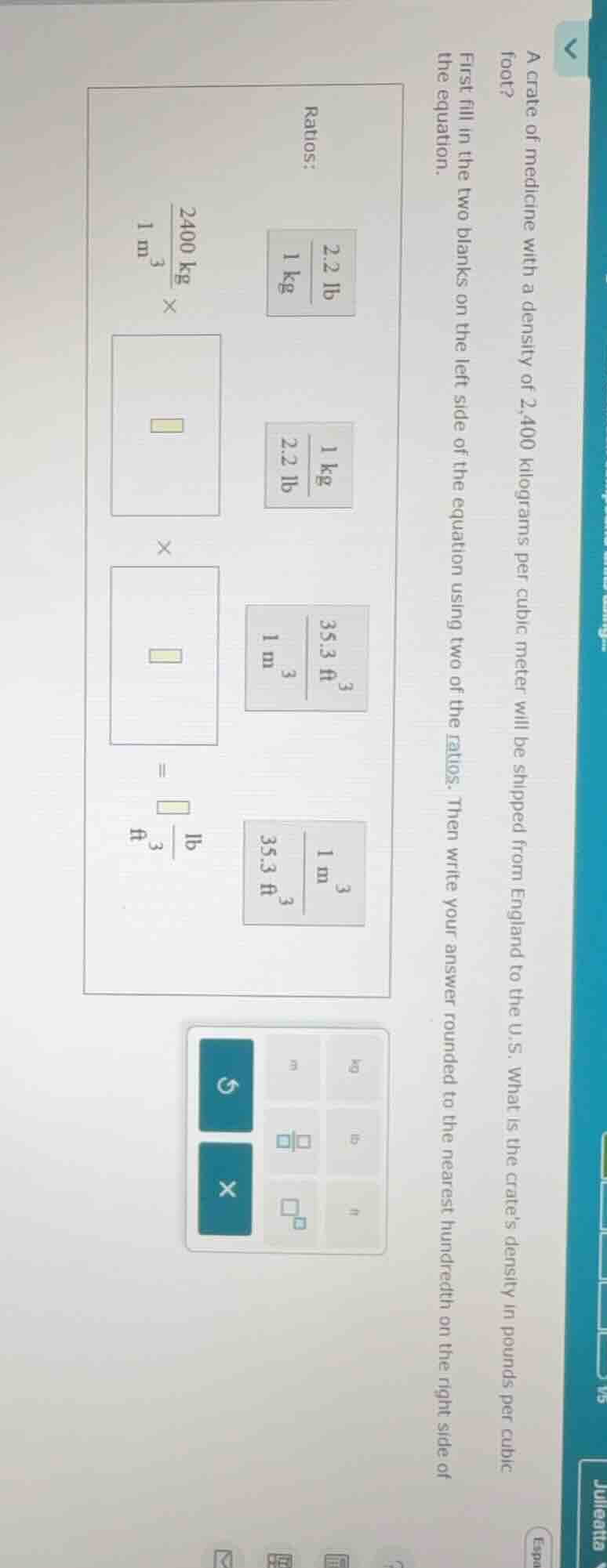
a crate of medicine with a density of 2,400 kilograms per cubic meter will be shipped from england to the u.s. what is the crate’s density in pounds per cubic foot? first fill in the two blanks on the left side of the equation using two of the ratios. then write your answer rounded to the nearest hundredth on the right side of the equation. ratios: \\(\frac{2.2\text{ lb}}{1\text{ kg}}\\) \\(\frac{1\text{ kg}}{2.2\text{ lb}}\\) \\(\frac{35.3\text{ ft}^3}{1\text{ m}^3}\\) \\(\frac{1\text{ m}^3}{35.3\text{ ft}^3}\\) \\(\frac{2400\text{ kg}}{1\text{ m}^3}\\) \\(\times\\) \\(\square\\) \\(\times\\) \\(\square\\) \\(=\\) \\(\frac{\square\text{ lb}}{\text{ft}^3}\\)
Step1: Convert kg to lb
We know the density is \(2400\frac{\text{kg}}{\text{m}^3}\), and we need to convert kg to lb. The ratio for kg to lb is \(\frac{2.2\text{ lb}}{1\text{ kg}}\) (since we want to cancel out kg and get lb). So we multiply \(2400\frac{\text{kg}}{\text{m}^3}\) by \(\frac{2.2\text{ lb}}{1\text{ kg}}\).
\(2400\frac{\text{kg}}{\text{m}^3}\times\frac{2.2\text{ lb}}{1\text{ kg}} = \frac{2400\times2.2\text{ lb}}{\text{m}^3}\)
Step2: Convert \(m^3\) to \(ft^3\)
Now we need to convert cubic meters to cubic feet. The ratio for \(m^3\) to \(ft^3\) is \(\frac{1\text{ m}^3}{35.3\text{ ft}^3}\) (wait, no, actually to convert \(m^3\) to \(ft^3\), we need to use the reciprocal if we want to cancel \(m^3\). Wait, the density is per cubic meter, so we have \(\frac{\text{lb}}{\text{m}^3}\) from step 1, and we need to get \(\frac{\text{lb}}{\text{ft}^3}\), so we need to multiply by \(\frac{1\text{ m}^3}{35.3\text{ ft}^3}\) (because \(\text{m}^3\) is in the denominator, so multiplying by \(\frac{1\text{ m}^3}{35.3\text{ ft}^3}\) would cancel \(\text{m}^3\) and give \(\text{ft}^3\) in the denominator). Wait, no, let's re - express:
From step 1, we have \(\frac{2400\times2.2\text{ lb}}{\text{m}^3}\). To convert \(\text{m}^3\) to \(\text{ft}^3\), we know that \(1\text{ m}^3 = 35.3\text{ ft}^3\), so the conversion factor is \(\frac{1\text{ m}^3}{35.3\text{ ft}^3}\) (if we have \(\frac{\text{lb}}{\text{m}^3}\), multiplying by \(\frac{1\text{ m}^3}{35.3\text{ ft}^3}\) gives \(\frac{\text{lb}}{\text{ft}^3}\) because \(\text{m}^3\) in the denominator and numerator cancels). Wait, actually, the correct conversion is: if \(1\text{ m}^3 = 35.3\text{ ft}^3\), then \(\frac{1\text{ m}^3}{35.3\text{ ft}^3}=1\), so we can multiply by that.
So now we multiply the result from step 1 by \(\frac{1\text{ m}^3}{35.3\text{ ft}^3}\) (wait, no, let's do the math correctly. Let's first calculate step 1: \(2400\times2.2 = 5280\), so we have \(\frac{5280\text{ lb}}{\text{m}^3}\). Now, to convert \(\text{m}^3\) to \(\text{ft}^3\), since \(1\text{ m}^3 = 35.3\text{ ft}^3\), then \(\frac{1\text{ m}^3}{35.3\text{ ft}^3}\) is the conversion factor. Wait, no, if we have \(\frac{\text{lb}}{\text{m}^3}\), and we want \(\frac{\text{lb}}{\text{ft}^3}\), we need to multiply by \(\frac{1\text{ m}^3}{35.3\text{ ft}^3}\) because \(\text{m}^3\) in the denominator and numerator will cancel, and we get \(\frac{\text{lb}}{\text{ft}^3}\).
So \(\frac{5280\text{ lb}}{\text{m}^3}\times\frac{1\text{ m}^3}{35.3\text{ ft}^3}=\frac{5280}{35.3}\frac{\text{lb}}{\text{ft}^3}\)
Step3: Calculate the value
Now we calculate \(\frac{5280}{35.3}\approx149.575\). Rounding to the nearest hundredth, we get approximately \(149.58\) (wait, wait, no, wait: \(2400\times2.2 = 5280\), then \(5280\div35.3\approx149.575\), which rounds to \(149.58\)? Wait, no, maybe I made a mistake in the conversion factor. Wait, actually, the conversion from \(m^3\) to \(ft^3\) is \(1\text{ m}^3 = 35.3147\text{ ft}^3\) (approx 35.3). Wait, but let's check the steps again.
Wait, the density is \(2400\frac{\text{kg}}{\text{m}^3}\). First, convert kg to lb: \(1\text{ kg}=2.2\text{ lb}\), so \(2400\text{ kg}=2400\times2.2\text{ lb}=5280\text{ lb}\) per cubic meter. Then, convert cubic meter to cubic foot: \(1\text{ m}^3 = 35.3\text{ ft}^3\), so to find pounds per cubic foot, we divide the pounds per cubic meter by the number of cubic feet in a cubic meter? Wait, no: if there are 35.3 cubic feet in a cubic meter, then in one cubic foot, the mass would be (mass per cubic meter) divided by (cubic feet per cubic met…

Snap & solve any problem in the app
Get step-by-step solutions on Sovi AI
Photo-based solutions with guided steps
Explore more problems and detailed explanations
The two ratios are \(\frac{2.2\text{ lb}}{1\text{ kg}}\) and \(\frac{1\text{ m}^3}{35.3\text{ ft}^3}\) (wait, no, the second ratio should be \(\frac{1\text{ m}^3}{35.3\text{ ft}^3}\) to cancel \(m^3\) and get \(ft^3\) in the denominator). Then the calculation gives approximately \(149.58\frac{\text{lb}}{\text{ft}^3}\).
Wait, but let's do the calculation again: \(2400\times2.2 = 5280\), \(5280\div35.3\approx149.575\), which rounds to \(149.58\). So the final answer is approximately \(149.58\) pounds per cubic foot.