QUESTION IMAGE
Question
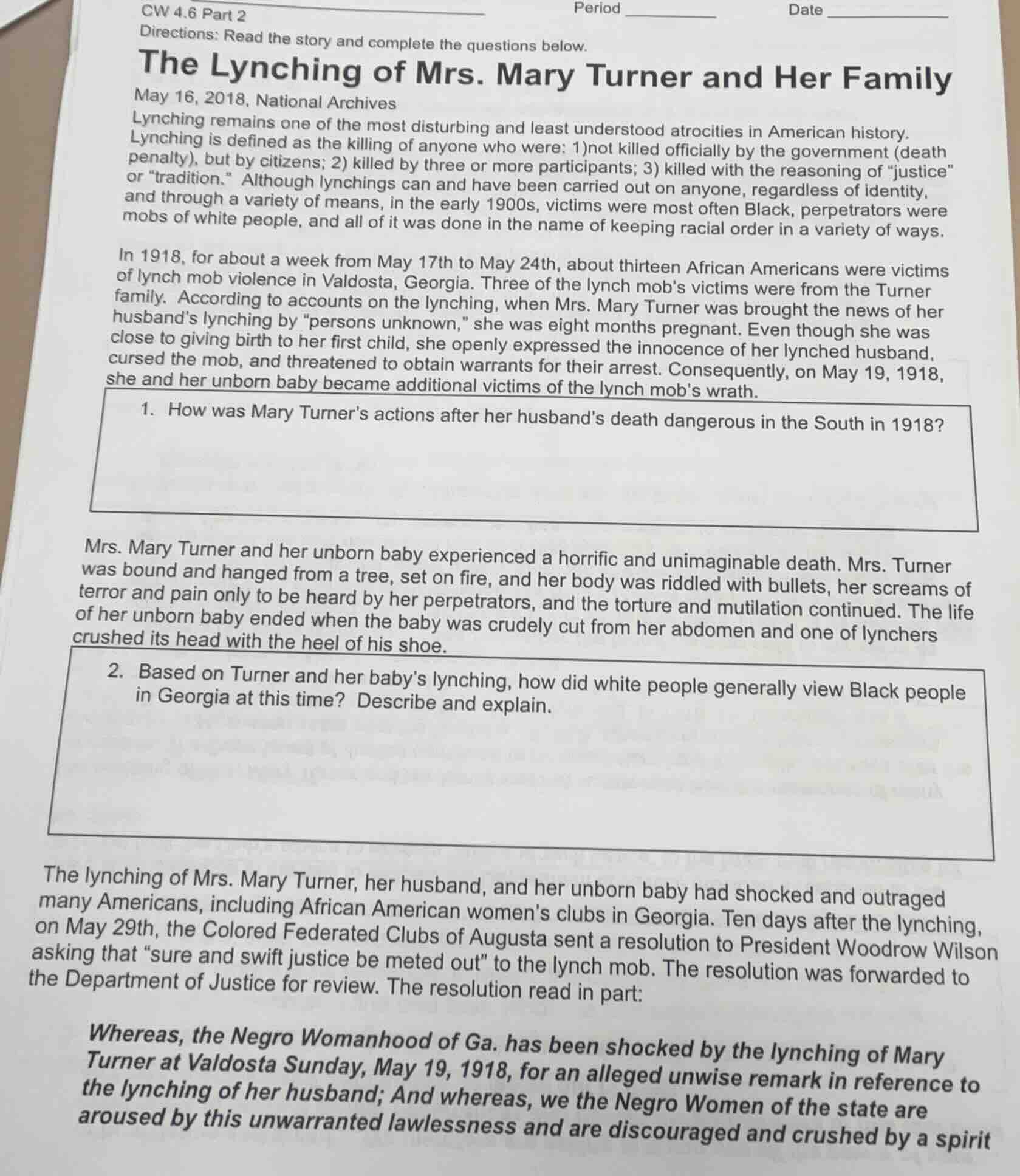
cw 4.6 part 2 period ____ date ____ directions: read the story and complete the questions below. the lynching of mrs. mary turner and her family may 16, 2018, national archives lynching remains one of the most disturbing and least understood atrocities in american history. lynching is defined as the killing of anyone who were: 1)not killed officially by the government (death penalty), but by citizens; 2) killed by three or more participants; 3) killed with the reasoning of \justice\ or \tradition.\ although lynchings can and have been carried out on anyone, regardless of identity, and through a variety of means, in the early 1900s, victims were most often black, perpetrators were mobs of white people, and all of it was done in the name of keeping racial order in a variety of ways. in 1918, for about a week from may 17th to may 24th, about thirteen african americans were victims of lynch mob violence in valdosta, georgia. three of the lynch mobs victims were from the turner family. according to accounts on the lynching, when mrs. mary turner was brought the news of her husbands lynching by \persons unknown,\ she was eight months pregnant. even though she was close to giving birth to her first child, she openly expressed the innocence of her lynched husband, cursed the mob, and threatened to obtain warrants for their arrest. consequently, on may 19, 1918, she and her unborn baby became additional victims of the lynch mobs wrath. 1. how was mary turners actions after her husbands death dangerous in the south in 1918? mrs. mary turner and her unborn baby experienced a horrific and unimaginable death. mrs. turner was bound and hanged from a tree, set on fire, and her body was riddled with bullets, her screams of terror and pain only to be heard by her perpetrators, and the torture and mutilation continued. the life of her unborn baby ended when the baby was crudely cut from her abdomen and one of lynchers crushed its head with the heel of his shoe. 2. based on turner and her babys lynching, how did white people generally view black people in georgia at this time? describe and explain. the lynching of mrs. mary turner, her husband, and her unborn baby had shocked and outraged many americans, including african american womens clubs in georgia. ten days after the lynching, on may 29th, the colored federated clubs of augusta sent a resolution to president woodrow wilson asking that \sure and swift justice be meted out\ to the lynch mob. the resolution was forwarded to the department of justice for review. the resolution read in part: whereas, the negro womanhood of ga. has been shocked by the lynching of mary turner at valdosta sunday, may 19, 1918, for an alleged unwise remark in reference to the lynching of her husband; and whereas, we the negro women of the state are aroused by this unwarranted lawlessness and are discouraged and crushed by a spirit
Question 1
In 1918 South, racial hierarchy enforced white supremacy. Mary Turner, a Black woman, challenged the lynch mob (white-dominated) by asserting her husband’s innocence, cursing them, and threatening legal action. This defied the racial order that suppressed Black resistance, making her a target as whites sought to maintain control through terror.
The lynching of Mary Turner (pregnant) and her baby shows white Georgians viewed Black people as inferior, expendable, and without human rights. The extreme violence (hanging, burning, killing the unborn) reflected dehumanization—they saw Black lives as unworthy of protection, using terror to enforce racial subordination and maintain white dominance.

Snap & solve any problem in the app
Get step-by-step solutions on Sovi AI
Photo-based solutions with guided steps
Explore more problems and detailed explanations
Mary Turner's actions were dangerous because in 1918 South, white mobs enforced racial supremacy through lynching. By publicly defending her husband, cursing the mob, and threatening legal action, she challenged white authority and the racial order they sought to maintain, provoking their violent retribution to suppress Black resistance.