QUESTION IMAGE
Question
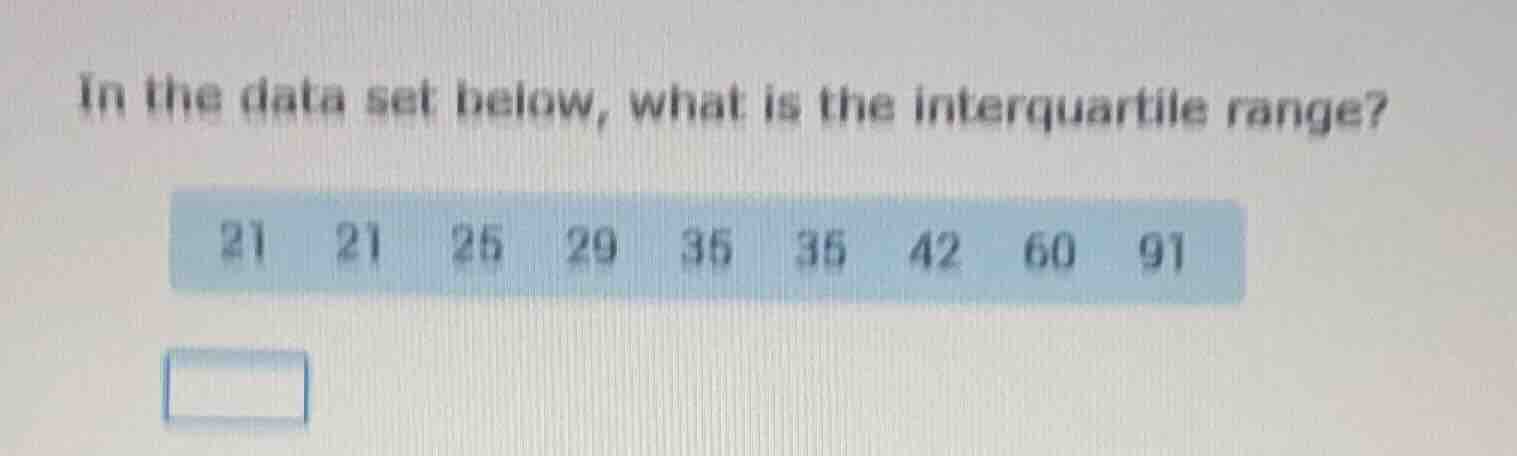
in the data set below, what is the interquartile range?
21 21 25 29 35 35 42 60 91
Step1: Find the median (Q2)
The data set is already ordered: \(21, 21, 25, 29, 35, 35, 42, 60, 91\). There are 9 data points, so the median (middle value) is the 5th term, which is \(35\).
Step2: Find Q1 (median of lower half)
The lower half of the data (excluding the median) is \(21, 21, 25, 29\). The median of this subset (2nd term) is \(\frac{21 + 25}{2} = 23\)? Wait, no, for even number of terms in the lower half (4 terms), the median is the average of the 2nd and 3rd? Wait, no, the lower half is the first 4 terms (since total is 9, median is 5th, so lower half is first 4: positions 1 - 4). Wait, actually, when n is odd, the lower half is the first \(\frac{n - 1}{2}\) terms. So n = 9, \(\frac{9 - 1}{2}=4\) terms: \(21, 21, 25, 29\). The median of these 4 terms: the 2nd and 3rd terms are 21 and 25. Wait, no, for a set with 4 terms, the median (Q1) is the average of the 2nd and 3rd? Wait, no, actually, in some definitions, for a data set with n elements, the position of Q1 is \(\frac{n + 1}{4}\) and Q3 is \(\frac{3(n + 1)}{4}\) when n is odd. Let's use the formula for quartiles:
For a data set with \(n = 9\) (odd), the position of Q1 is \(\frac{9 + 1}{4}=2.5\)th term. So we take the average of the 2nd and 3rd terms. The 2nd term is \(21\), 3rd term is \(25\). So Q1 = \(\frac{21 + 25}{2}=23\)? Wait, no, wait the data set is \(21, 21, 25, 29, 35, 35, 42, 60, 91\). Let's list the positions:
Position 1: 21
Position 2: 21
Position 3: 25
Position 4: 29
Position 5: 35 (median, Q2)
Position 6: 35
Position 7: 42
Position 8: 60
Position 9: 91
So Q1 is the median of the first 4 terms (positions 1 - 4)? No, actually, the lower half is positions 1 - 4 (since median is position 5), so the median of positions 1 - 4: the set is \(21, 21, 25, 29\). The median of this set (4 elements) is the average of the 2nd and 3rd elements? Wait, no, the median of a set with even number of elements is the average of the two middle numbers. So for \(21, 21, 25, 29\), the two middle numbers are the 2nd (\(21\)) and 3rd (\(25\))? Wait, no, when ordered, the two middle numbers are at positions 2 and 3 (since 4 elements: positions 1,2,3,4; middle are 2 and 3). So Q1 = \(\frac{21 + 25}{2}=23\)? Wait, but maybe another approach: using the formula for quartiles where Q1 is the value at the \(\frac{n + 1}{4}\)th position. For n = 9, \(\frac{9 + 1}{4}=2.5\)th position. So we take the average of the 2nd and 3rd terms. The 2nd term is \(21\), 3rd term is \(25\). So Q1 = \(\frac{21 + 25}{2}=23\).
Now Q3: position is \(\frac{3(9 + 1)}{4}=7.5\)th term. So the 7th and 8th terms: 7th term is \(42\), 8th term is \(60\). So Q3 = \(\frac{42 + 60}{2}=51\).
Wait, but let's check another way. The upper half of the data (excluding the median) is \(35, 42, 60, 91\) (positions 6 - 9). The median of these 4 terms: 2nd and 3rd terms are \(42\) and \(60\). So Q3 = \(\frac{42 + 60}{2}=51\).
Now interquartile range (IQR) is Q3 - Q1. So Q3 = 51, Q1 = 23? Wait, but let's check again. Wait, maybe I made a mistake in Q1. Let's list the data:
Data: [21, 21, 25, 29, 35, 35, 42, 60, 91]
n = 9.
Median (Q2) is the 5th term: 35.
Lower half: first 4 terms: [21, 21, 25, 29]
Median of lower half (Q1): since there are 4 terms, the median is the average of the 2nd and 3rd terms? Wait, no, the 2nd term is 21, 3rd term is 25. So (21 + 25)/2 = 23.
Upper half: last 4 terms: [35, 42, 60, 91]
Median of upper half (Q3): average of 2nd and 3rd terms: 42 and 60. (42 + 60)/2 = 51.
Then IQR = Q3 - Q1 = 51 - 23 = 28? Wait, but let's check with another method. Alternatively, using the formul…

Snap & solve any problem in the app
Get step-by-step solutions on Sovi AI
Photo-based solutions with guided steps
Explore more problems and detailed explanations
28