QUESTION IMAGE
Question
day 1 - 8th grade science staar review
matter and energy - teks 8.5a (r), 8.5b (r), 7.5c (s), 7.6a (s), 7.6b (s) name date
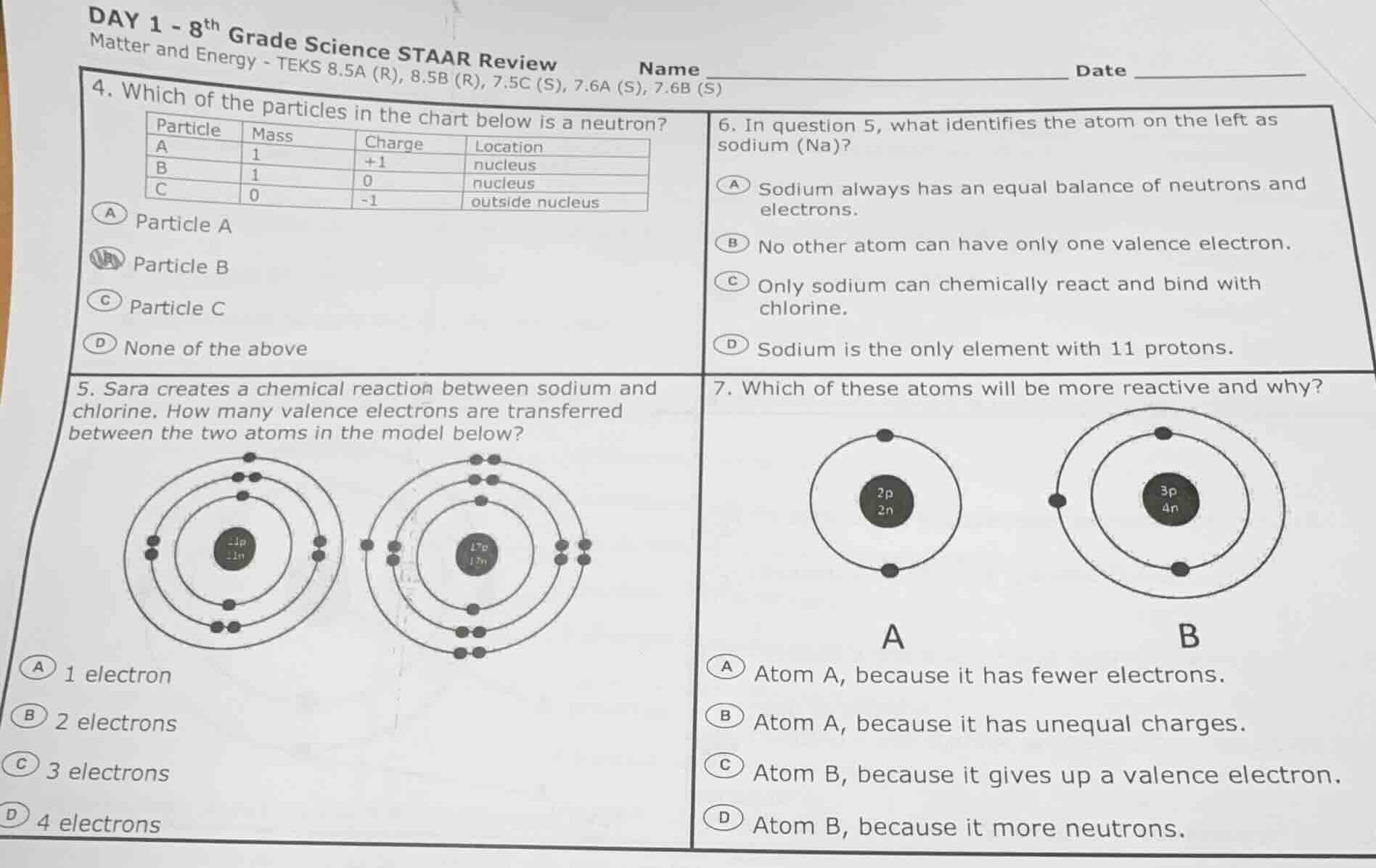
- which of the particles in the chart below is a neutron?
(chart: particle, mass, charge, location; a: 1, +1, nucleus; b: 1, 0, nucleus; c: 0, -1, outside nucleus)
a particle a
b particle b
c particle c
d none of the above
- sara creates a chemical reaction between sodium and chlorine. how many valence electrons are transferred between the two atoms in the model below?
(images of two atom models)
a 1 electron
b 2 electrons
c 3 electrons
d 4 electrons
- in question 5, what identifies the atom on the left as sodium (na)?
a sodium always has an equal balance of neutrons and electrons.
b no other atom can have only one valence electron.
c only sodium can chemically react and bind with chlorine.
d sodium is the only element with 11 protons.
- which of these atoms will be more reactive and why?
(images of two atoms labeled a and b)
a atom a, because it has fewer electrons.
b atom a, because it has unequal charges.
c atom b, because it gives up a valence electron.
d atom b, because it more neutrons.
Step1: Identify neutron properties
Neutrons have mass = 1, charge = 0, location = nucleus. Match to Particle B.
Step2: Find sodium valence electron transfer
Sodium (left atom) has 1 valence electron; it transfers this 1 electron to chlorine.
Step3: Identify sodium's defining feature
Elements are defined by proton number; sodium has 11 protons, unique to it.
Step4: Determine reactive atom
Atom B has 1 valence electron, which it easily gives up, making it more reactive.

Snap & solve any problem in the app
Get step-by-step solutions on Sovi AI
Photo-based solutions with guided steps
Explore more problems and detailed explanations
- B. Particle B
- A. 1 electron
- D. Sodium is the only element with 11 protons.
- C. Atom B, because it gives up a valence electron.