QUESTION IMAGE
Question
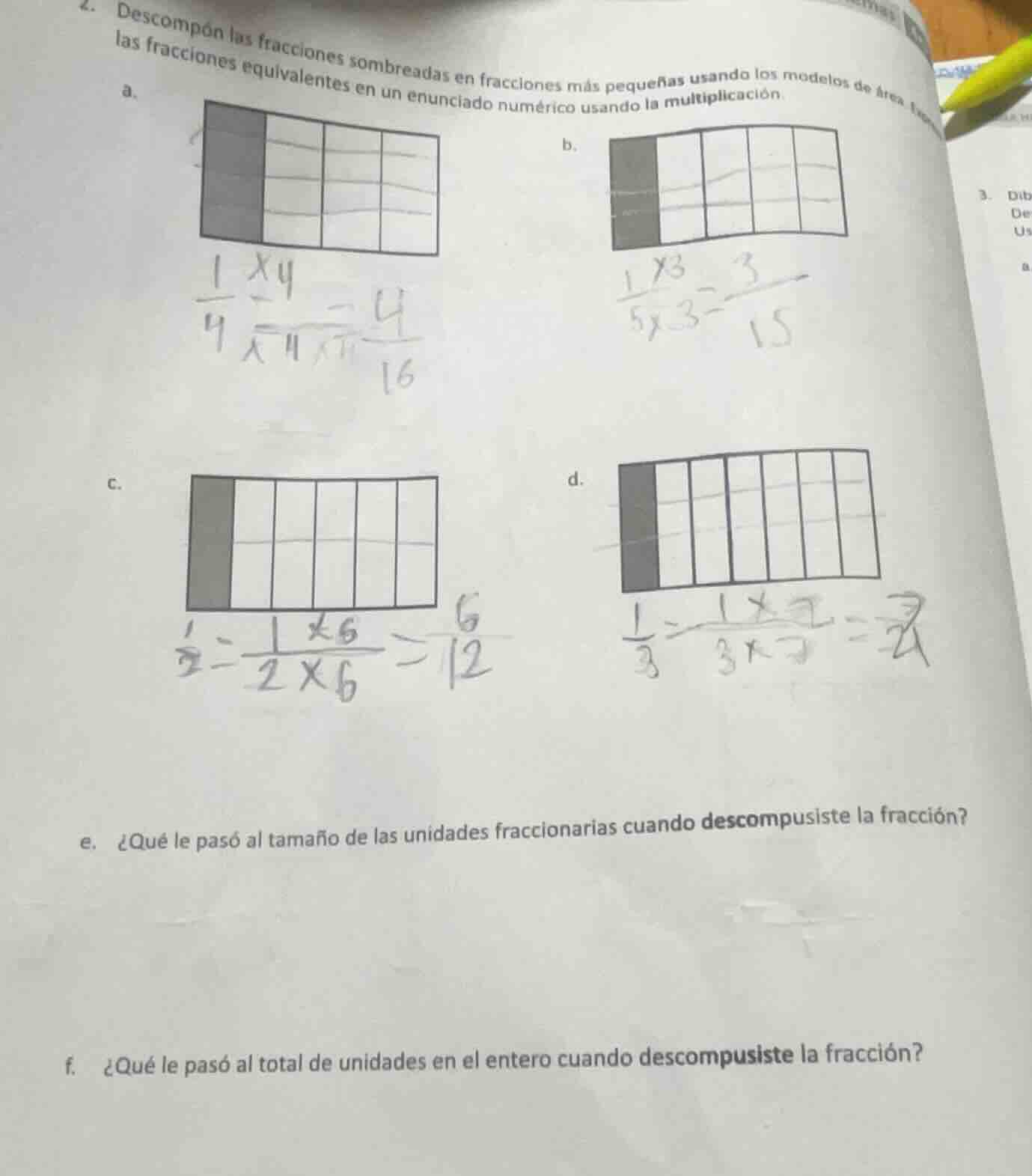
- descompón las fracciones sombreadas en fracciones más pequeñas usando los modelos de área las fracciones equivalentes en un enunciado numérico usando la multiplicación
a.
b.
c.
d.
e. ¿qué le pasó al tamaño de las unidades fraccionarias cuando descompusiste la fracción?
f. ¿qué le pasó al total de unidades en el entero cuando descompusiste la fracción?
Step1: Analyze part a's fraction
The shaded part is $\frac{1}{4}$. To decompose, multiply numerator/denominator by 4:
$\frac{1 \times 4}{4 \times 4} = \frac{4}{16}$
Step2: Analyze part b's fraction
The shaded part is $\frac{1}{5}$. Multiply numerator/denominator by 3:
$\frac{1 \times 3}{5 \times 3} = \frac{3}{15}$
Step3: Analyze part c's fraction
The shaded part is $\frac{1}{2}$. Multiply numerator/denominator by 6:
$\frac{1 \times 6}{2 \times 6} = \frac{6}{12}$
Step4: Analyze part d's fraction
The shaded part is $\frac{1}{3}$. Multiply numerator/denominator by 7:
$\frac{1 \times 7}{3 \times 7} = \frac{7}{21}$
Step5: Answer part e (fraction unit size)
When decomposing, we split each unit into smaller equal parts, so the fractional units become smaller.
Step6: Answer part f (total units)
When decomposing, we multiply the number of total units by the same factor used for numerator/denominator, so the total number of units increases.

Snap & solve any problem in the app
Get step-by-step solutions on Sovi AI
Photo-based solutions with guided steps
Explore more problems and detailed explanations
a. $\frac{1}{4} = \frac{1 \times 4}{4 \times 4} = \frac{4}{16}$
b. $\frac{1}{5} = \frac{1 \times 3}{5 \times 3} = \frac{3}{15}$
c. $\frac{1}{2} = \frac{1 \times 6}{2 \times 6} = \frac{6}{12}$
d. $\frac{1}{3} = \frac{1 \times 7}{3 \times 7} = \frac{7}{21}$
e. The size of the fractional units decreased (became smaller).
f. The total number of units in the whole increased.