QUESTION IMAGE
Question
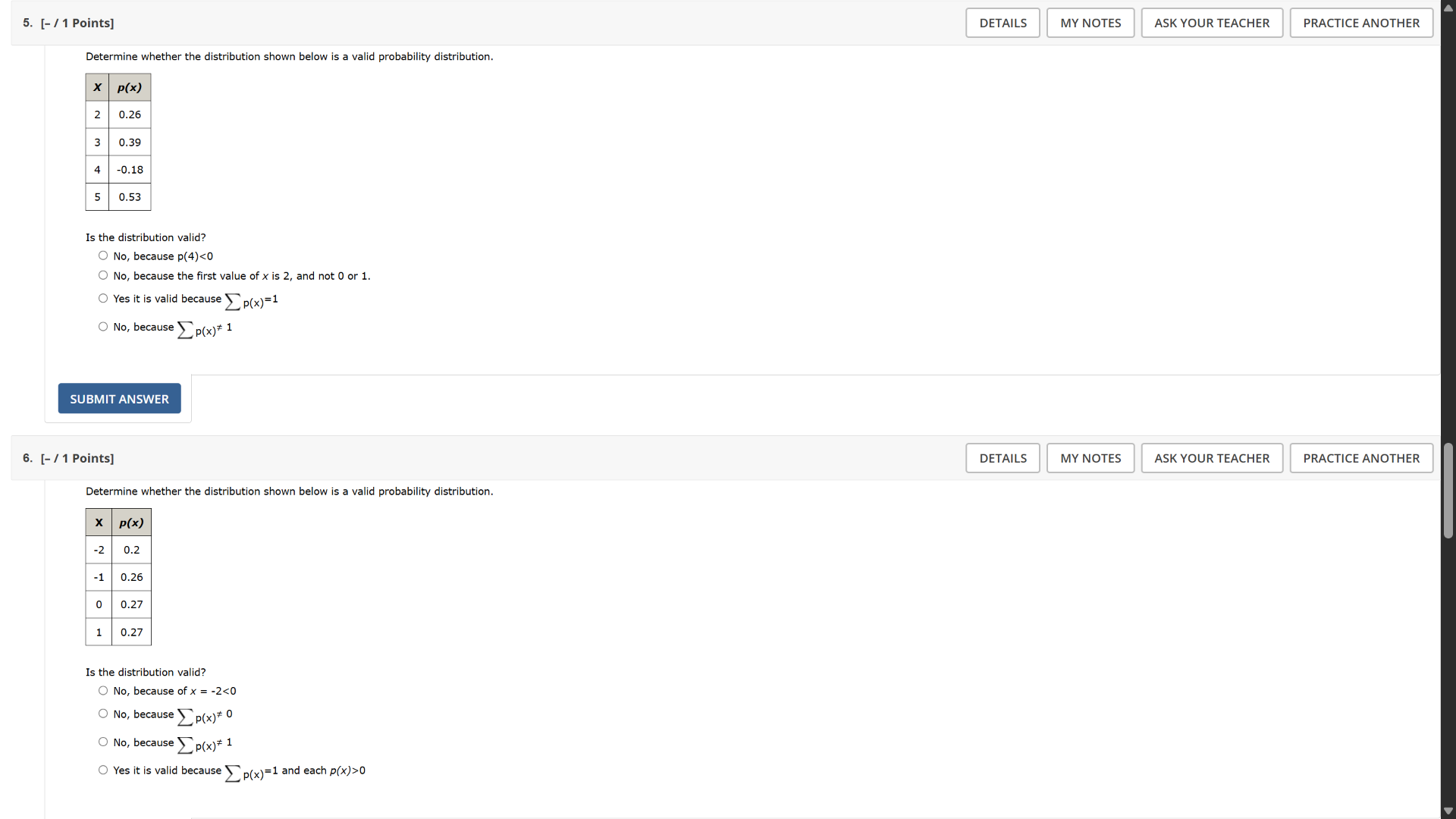
- determine whether the distribution shown below is a valid probability distribution.
| x | p(x) |
|---|---|
| 3 | 0.39 |
| 4 | -0.18 |
| 5 | 0.53 |
is the distribution valid?
- no, because p(4)<0
- no, because the first value of x is 2, and not 0 or 1.
- yes it is valid because $\sum p(x)=1$
- no, because $\sum p(x)\
eq 1$
- determine whether the distribution shown below is a valid probability distribution.
| x | p(x) |
|---|---|
| -1 | 0.26 |
| 0 | 0.27 |
| 1 | 0.27 |
is the distribution valid?
- no, because of x = -2<0
- no, because $\sum p(x)\
eq 0$
- no, because $\sum p(x)\
eq 1$
- yes it is valid because $\sum p(x)=1$ and each $p(x)>0$
Response
Question 5
Step1: Recall validity conditions
A valid probability distribution requires two conditions: (1) Each probability \( p(x) \geq 0 \) for all \( x \); (2) The sum of all probabilities \( \sum p(x) = 1 \).
Step2: Check each condition
- For \( p(4) = -0.18 \), this is less than 0, violating the first condition.
- Let's also check the sum: \( 0.26 + 0.39 + (-0.18) + 0.53 = 0.26 + 0.39 = 0.65; 0.65 - 0.18 = 0.47; 0.47 + 0.53 = 1 \). But since \( p(4) < 0 \), the first condition fails. The option about \( x \) starting at 2 is irrelevant (probability distributions don't require \( x \) to start at 0 or 1). The sum is 1, but the negative probability makes it invalid. So the correct reason is \( p(4) < 0 \).
Step1: Recall validity conditions
Valid probability distribution: (1) \( p(x) \geq 0 \) for all \( x \); (2) \( \sum p(x) = 1 \).
Step2: Check each condition
- Check \( p(x) \): \( 0.2, 0.26, 0.27, 0.27 \) are all \( > 0 \).
- Check the sum: \( 0.2 + 0.26 + 0.27 + 0.27 = 0.2 + 0.26 = 0.46; 0.46 + 0.27 = 0.73; 0.73 + 0.27 = 1 \). Both conditions are satisfied. The options about \( x = -2 < 0 \) are irrelevant ( \( x \) can be negative in a probability distribution for a discrete random variable, it's the probability that must be non - negative). The sum is 1, and each \( p(x) > 0 \), so it's valid.

Snap & solve any problem in the app
Get step-by-step solutions on Sovi AI
Photo-based solutions with guided steps
Explore more problems and detailed explanations
A. No, because \( p(4) < 0 \)