QUESTION IMAGE
Question
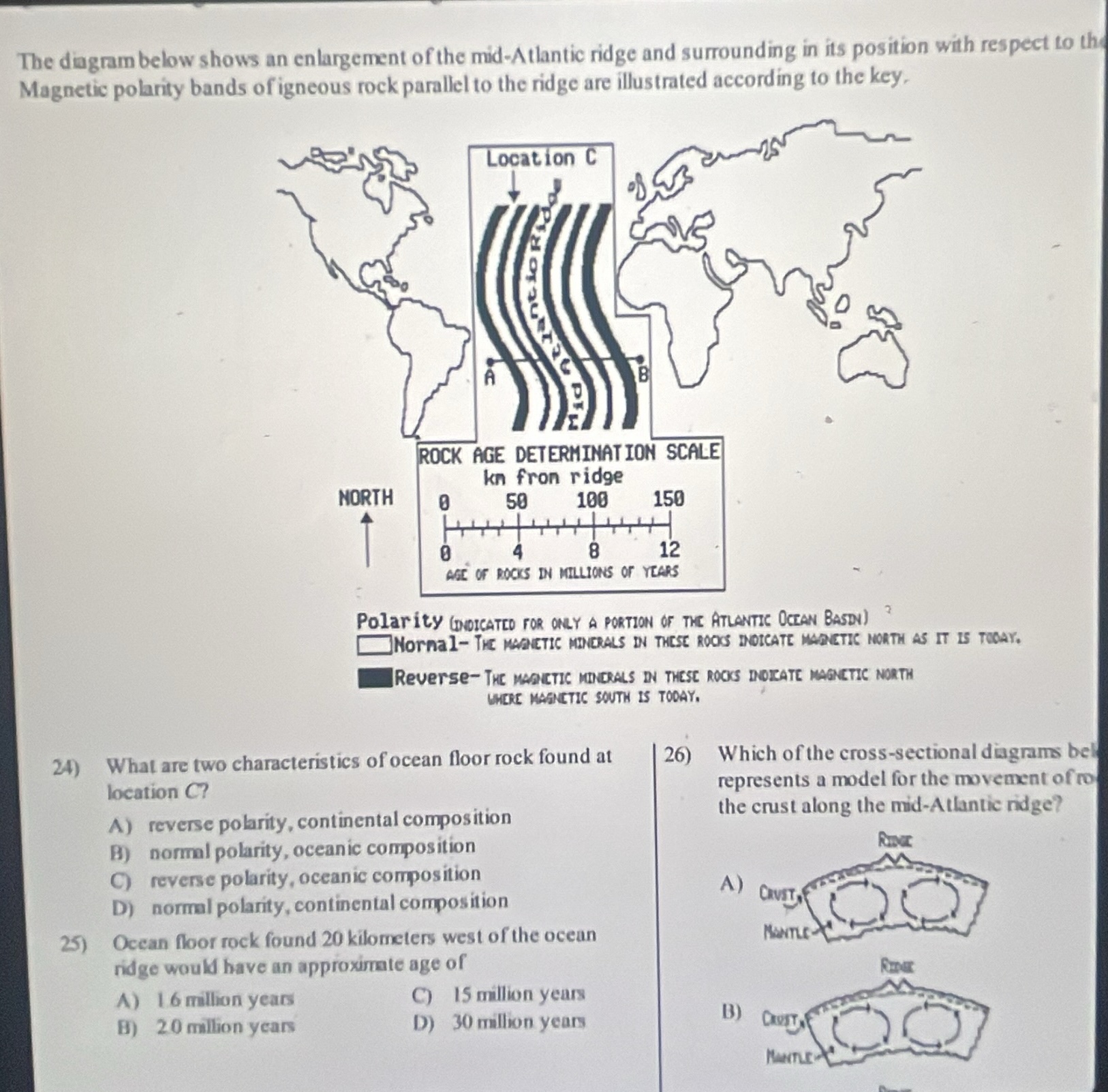
the diagram below shows an enlargement of the mid - atlantic ridge and surrounding in its position with respect to the magnetic polarity bands of igneous rock parallel to the ridge are illustrated according to the key.
(world map with mid - atlantic ridge and magnetic polarity bands diagram, and a rock age determination scale: x - axis: km from ridge (0, 50, 100, 150), y - axis: age of rocks in millions of years (0, 4, 8, 12); polarity key: normal (magnetic north as today) and reverse (magnetic north where magnetic south is today))
- what are two characteristics of ocean floor rock found at location c?
a) reverse polarity, continental composition
b) normal polarity, oceanic composition
c) reverse polarity, oceanic composition
d) normal polarity, continental composition
- ocean floor rock found 20 kilometers west of the ocean ridge would have an approximate age of
a) 1.6 million years
b) 2.0 million years
c) 15 million years
d) 30 million years
- which of the cross - sectional diagrams bel represents a model for the movement of ro the crust along the mid - atlantic ridge?
(diagrams a and b of crust and mantle movement at the ridge are shown)
Question 24
- Analyze polarity: Location C is in the black (reverse polarity) band, so reverse polarity.
- Analyze composition: Mid - Atlantic ridge rocks are oceanic (basalt), not continental (granite). So reverse polarity and oceanic composition.
Step1: Analyze the scale
The scale shows distance from ridge (km) vs age (million years). The relationship: at 50 km, age is 4 million years. So the rate is $\frac{4\ million\ years}{50\ km}=0.08\ million\ years\ per\ km$.
Step2: Calculate age for 20 km
For 20 km west of ridge, age = $20\ km\times0.08\ million\ years\ per\ km = 1.6\ million\ years$.

Snap & solve any problem in the app
Get step-by-step solutions on Sovi AI
Photo-based solutions with guided steps
Explore more problems and detailed explanations
C. reverse polarity, oceanic composition