QUESTION IMAGE
Question
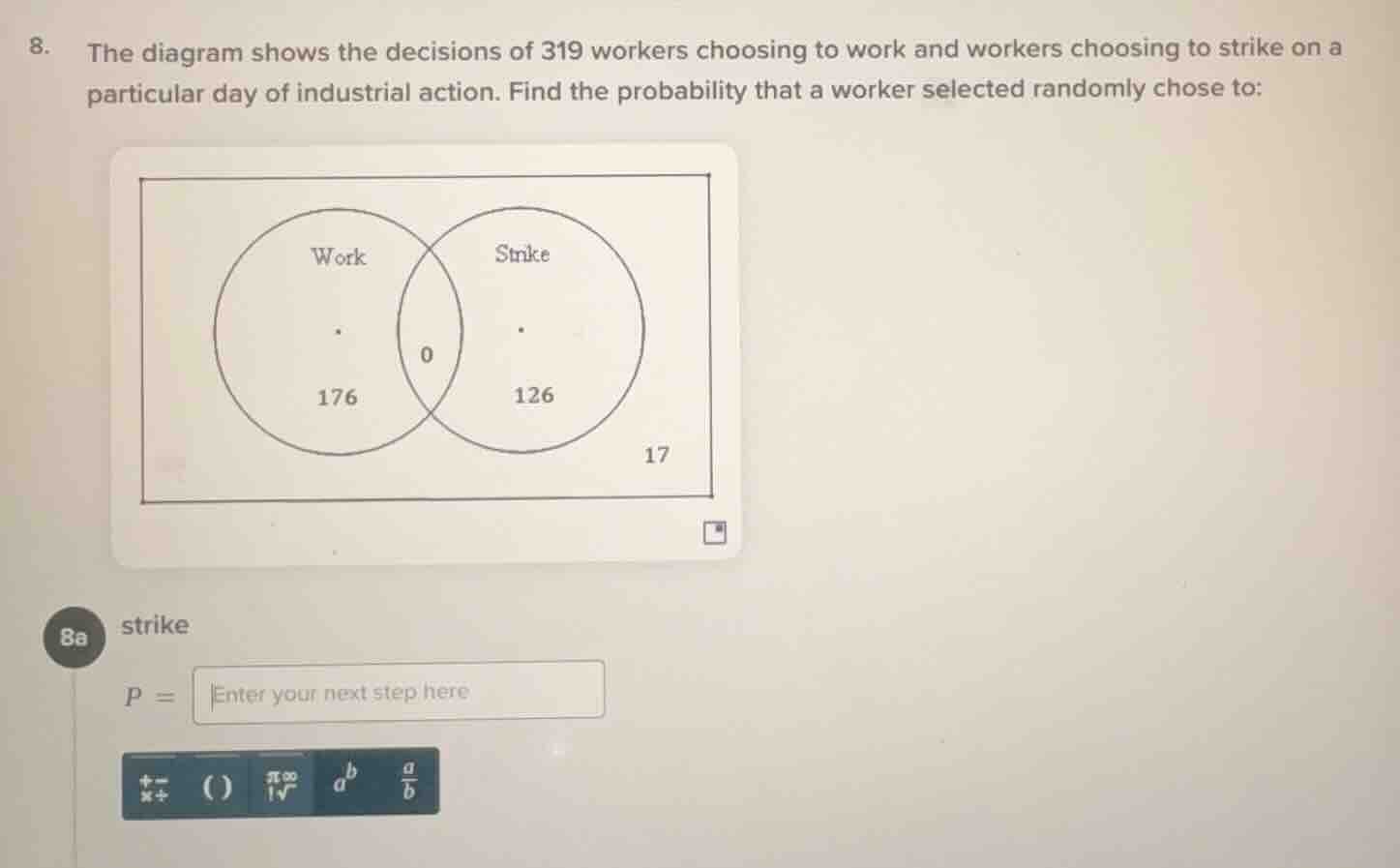
- the diagram shows the decisions of 319 workers choosing to work and workers choosing to strike on a particular day of industrial action. find the probability that a worker selected randomly chose to: 8a strike p =
Step1: Find total workers who struck
The number of workers who chose to strike is the number in the "Strike" circle (including the overlap, but here overlap is 0) plus any? Wait, no, the Venn diagram: the "Strike" circle has 126, and the overlap with Work is 0. Wait, but also, is there a universal set? Wait, total workers are 319. Wait, the diagram: Work circle has 176, Strike circle has 126, overlap 0, and outside both is 17. Let's check: 176 + 0 + 126 + 17 = 319, which matches. So the number of workers who chose to strike is the number in the Strike circle (126) plus the overlap? Wait no, the Strike circle: the part only Strike is 126, and overlap with Work is 0. So total striking workers are 126 (since overlap is 0, so only Strike) + 0 (overlap) = 126? Wait no, wait the Venn diagram: Work circle: 176 (only Work), overlap: 0, Strike circle: 126 (only Strike), and outside both: 17. So total workers: 176 + 0 + 126 + 17 = 319. So the number of workers who chose to strike is the number in the Strike circle (including overlap, but overlap is 0) so 126 (only Strike) + 0 (both) = 126? Wait no, probability is (number of favorable outcomes) / (total number of outcomes). Favorable outcomes: workers who chose to strike. So that's the number in the Strike circle (including the overlap) plus? Wait, the Strike circle: the region for Strike is the part only Strike (126) and the overlap (0). So total striking workers: 126 + 0 = 126? Wait but let's check again. The total number of workers is 319. The number of workers who struck: looking at the Venn diagram, the Strike circle has 126 (only Strike) and 0 (both Work and Strike). So total striking is 126 + 0 = 126? Wait no, maybe I misread. Wait the diagram: Work circle has 176 (only Work), overlap is 0, Strike circle has 126 (only Strike), and outside both is 17. So total workers: 176 (Work only) + 0 (both) + 126 (Strike only) + 17 (neither) = 319. So the number of workers who chose to strike is the number in the Strike circle, which is 126 (Strike only) + 0 (both) = 126. Wait but that seems low. Wait maybe the overlap is 0, so workers who struck are 126, and total workers 319. So probability is 126 / 319? Wait no, wait 126 + 0 is 126? Wait no, maybe the Strike circle includes the overlap. Wait the problem says "workers choosing to strike" – so that's all workers in the Strike circle, which is the part only Strike (126) and the part that both work and strike (0). So total striking workers: 126 + 0 = 126. Total workers: 319. So probability P = 126 / 319? Wait but let's calculate 126 + 0 is 126, total is 319. Wait 126 + 176 + 17 = 319 - 126? No, 176 + 126 + 17 = 319, so 176 + 126 + 17 = 319, so 126 is the number of striking workers. So probability is 126 / 319. Wait but let's check: 176 (work only) + 0 (both) + 126 (strike only) + 17 (neither) = 319. So striking workers: 126 (strike only) + 0 (both) = 126. So P = 126 / 319. Let's simplify? 126 and 319: 319 divided by 126 is 2 with remainder 67. 126 and 67: 126 divided by 67 is 1 with remainder 59. 67 and 59: 67 divided by 59 is 1 with remainder 8. 59 and 8: 59 divided by 8 is 7 with remainder 3. 8 and 3: 8 divided by 3 is 2 with remainder 2. 3 and 2: 3 divided by 2 is 1 with remainder 1. 2 and 1: 2 divided by 1 is 2 with remainder 0. So GCD is 1. So 126/319 is simplified. Wait but maybe I made a mistake. Wait the problem says "workers choosing to strike" – maybe the overlap is 0, so workers who struck are 126, and total is 319. So P = 126/319. Let's compute that: 126 ÷ 319 ≈ 0.39498... But let's check the total again. 176 (work only) + 0 (both) + 12…

Snap & solve any problem in the app
Get step-by-step solutions on Sovi AI
Photo-based solutions with guided steps
Explore more problems and detailed explanations
\(\frac{126}{319}\)