QUESTION IMAGE
Question
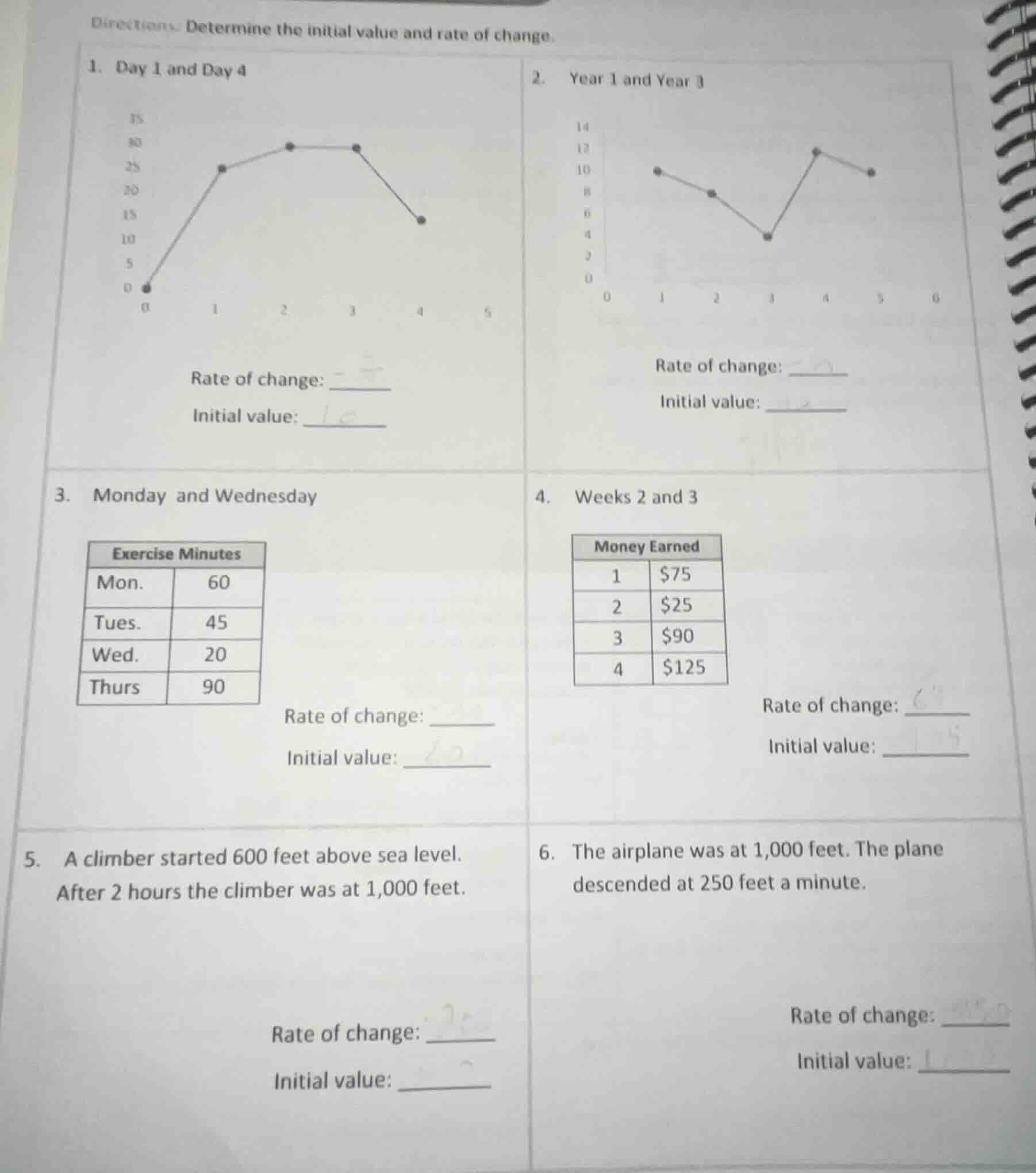
directions: determine the initial value and rate of change.
- day 1 and day 4
rate of change:
initial value:
- year 1 and year 3
rate of change:
initial value:
- monday and wednesday
exercise minutes
mon. 60
tues. 45
wed. 20
thurs 90
rate of change:
initial value:
- weeks 2 and 3
money earned
1 $75
2 $25
3 $90
4 $125
rate of change:
initial value:
- a climber started 600 feet above sea level.
after 2 hours the climber was at 1,000 feet.
rate of change:
initial value:
- the airplane was at 1,000 feet. the plane descended at 250 feet a minute.
rate of change:
initial value:
Problem 1: Day 1 and Day 4
Step 1: Identify points
From the graph, at \( x = 0 \) (Day 0, initial), \( y = 0 \); at \( x = 4 \) (Day 4), \( y = 15 \). Wait, maybe misread. Wait, the first point is (0,0), then at Day 1 (x=1) y=25? Wait, no, the x-axis is days: 0,1,2,3,4. The initial value is at x=0, y=0. Then for rate of change between Day 0 and Day 4? Wait, the problem says Day 1 and Day 4? Wait, the graph: at x=0 (Day 0) y=0, x=1 (Day 1) y=25, x=4 (Day 4) y=15. Wait, maybe the rate of change is between Day 0 and Day 4? Wait, the initial value is at x=0, so initial value is 0. Then rate of change: \( \frac{\Delta y}{\Delta x}=\frac{15 - 0}{4 - 0}=\frac{15}{4}=3.75 \)? Wait, no, maybe the points are (0,0) and (4,15). So rate of change \( \frac{15 - 0}{4 - 0}=\frac{15}{4}=3.75 \), initial value 0. But maybe I misread. Alternatively, if it's Day 1 (x=1, y=25) and Day 4 (x=4, y=15), then \( \frac{15 - 25}{4 - 1}=\frac{-10}{3}\approx - 3.33 \). But the initial value is at x=0, y=0. Let's check the graph again: the first dot is at (0,0), then (1,25), (2,30), (3,30), (4,15). So initial value (x=0) is 0. Rate of change between Day 0 and Day 4: \( \frac{15 - 0}{4 - 0}=\frac{15}{4}=3.75 \). But maybe the problem is Day 1 and Day 4: x=1 (y=25) and x=4 (y=15). Then \( \frac{15 - 25}{4 - 1}=\frac{-10}{3}\approx - 3.33 \). Initial value is 0 (at x=0).
Step 2: Confirm initial value
Initial value is the value at the start (x=0), so y=0.
Step 1: Identify points
From the graph, Year 1 (x=1, y=10), Year 3 (x=3, y=4). So \( \Delta x = 3 - 1 = 2 \), \( \Delta y = 4 - 10 = - 6 \). Rate of change: \( \frac{-6}{2}=-3 \). Initial value: at x=0, what's y? The graph starts at x=0, but the first dot is at x=1, y=10. Wait, maybe x=0 is year 0, but the graph has dots at x=1 (y=10), x=2 (y=8), x=3 (y=4), x=4 (y=12), x=5 (y=10). So initial value (year 0) is not given, but maybe the initial value is at year 1? No, initial value is the starting value, so maybe year 0. But the graph doesn't have a dot at x=0. Wait, the y-axis starts at 0, x-axis 0-6. The dot at x=1 is y=10, x=3 is y=4. So rate of change between year 1 and year 3: \( \frac{4 - 10}{3 - 1}=\frac{-6}{2}=-3 \). Initial value: maybe at year 0, but since there's no dot, maybe we assume year 1 is initial? No, initial value is the first value. Wait, maybe the graph's first dot is at x=1, y=10, so initial value is 10 (at year 1). But that's not standard. Alternatively, maybe the initial value is at x=0, but no dot. This is unclear, but assuming rate of change between year 1 (x=1, y=10) and year 3 (x=3, y=4): \( \frac{4 - 10}{3 - 1}=-3 \), initial value (at x=1) is 10? No, initial value is the starting point, so maybe year 0, but we can't tell. Wait, the graph: x=1 (y=10), x=2 (y=8), x=3 (y=4), x=4 (y=12), x=5 (y=10). So initial value (if x=0 is year 0) is unknown, but maybe the problem considers year 1 as initial? No, initial value is the first value. Maybe the initial value is 10 (at year 1), rate of change -3.
Step 1: Identify values
Monday (x=1, y=60), Wednesday (x=3, y=20). \( \Delta x = 3 - 1 = 2 \), \( \Delta y = 20 - 60 = - 40 \). Rate of change: \( \frac{-40}{2}=-20 \). Initial value: Monday is day 1, so initial value (day 1) is 60? Wait, no, initial value is the first day (Monday), so 60.
Step 2: Calculate rate of change
\( \frac{20 - 60}{3 - 1}=\frac{-40}{2}=-20 \).

Snap & solve any problem in the app
Get step-by-step solutions on Sovi AI
Photo-based solutions with guided steps
Explore more problems and detailed explanations
Rate of change: \( \frac{15 - 0}{4 - 0}=\frac{15}{4}=3.75 \) (or if Day 1 to Day 4: \( \frac{15 - 25}{4 - 1}=-\frac{10}{3}\approx - 3.33 \)); Initial value: \( 0 \)