QUESTION IMAGE
Question
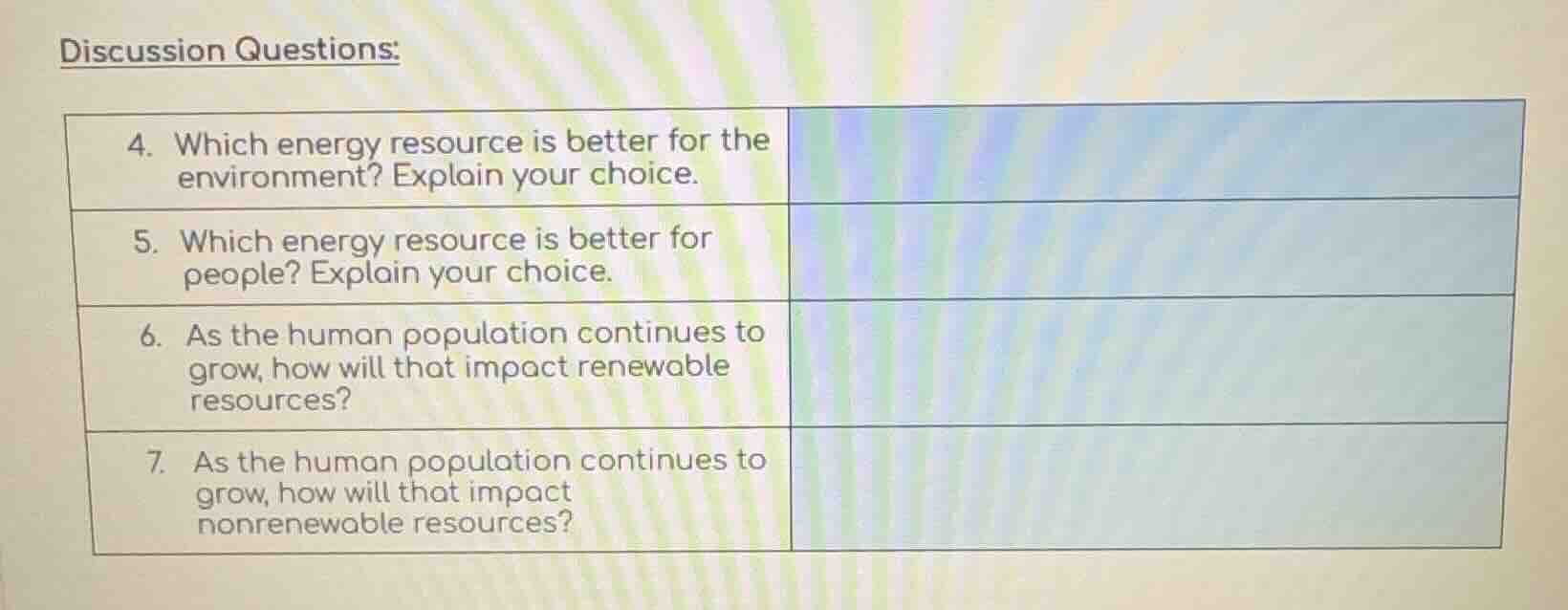
discussion questions:
- which energy resource is better for the environment? explain your choice.
- which energy resource is better for people? explain your choice.
- as the human population continues to grow, how will that impact renewable resources?
- as the human population continues to grow, how will that impact nonrenewable resources?
Brief Explanations
- For question 4: Solar energy is a top choice because it produces no greenhouse gas emissions during operation, has minimal land disruption (especially with rooftop installations), and avoids the pollution and waste associated with fossil fuels or nuclear energy.
- For question 5: Biomass energy (sustainably sourced) is strong for people; it can be locally produced in rural/developing areas, provides energy access where grid infrastructure is limited, and can support local agricultural economies when using crop residues or dedicated energy crops.
- For question 6: Population growth increases demand for renewable energy, driving investment in infrastructure and technological innovation to scale up sources like solar and wind. However, it may also create pressure for rapid development that could lead to habitat disruption if renewable projects are not sited responsibly.
- For question 7: Population growth directly boosts demand for nonrenewable resources (oil, coal, natural gas) for energy, transportation, and manufacturing. This accelerates depletion of finite reserves, increases extraction-related environmental harm (like oil spills or mining damage), and raises prices as supplies become scarcer.

Snap & solve any problem in the app
Get step-by-step solutions on Sovi AI
Photo-based solutions with guided steps
Explore more problems and detailed explanations
- Solar energy is better for the environment. It generates no operational greenhouse gas emissions, has low long-term ecological impact compared to fossil fuels or nuclear, and is a infinitely renewable resource.
- Sustainably sourced biomass energy is better for people. It enables local energy production in underserved areas, supports agricultural livelihoods, and can be adapted to small-scale, community-level use.
- Human population growth will increase demand for renewable energy, spurring innovation and expansion of renewable infrastructure, but may also lead to unsustainable siting of projects if growth is unplanned.
- Human population growth will accelerate the depletion of finite nonrenewable resources, increase extraction-related environmental damage, and drive up global resource prices due to higher demand.