QUESTION IMAGE
Question
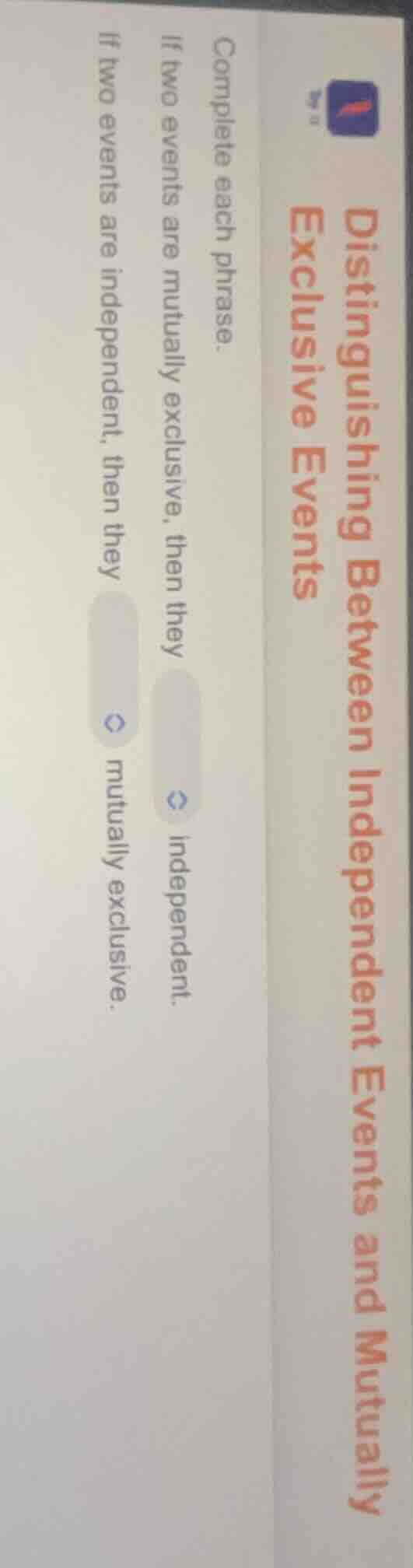
distinguishing between independent events and mutually exclusive events
complete each phrase.
if two events are mutually exclusive, then they
independent.
if two events are independent, then they
mutually exclusive.
Response
For the first blank ("If two events are mutually exclusive, then they ____ independent"):
- Recall the definitions: Mutually exclusive events cannot occur at the same time, so \( P(A \cap B) = 0 \). For independent events, \( P(A \cap B)=P(A)P(B) \). If \( A \) and \( B \) are mutually exclusive and non - impossible ( \( P(A)>0, P(B)>0 \) ), then \( P(A)P(B)>0
eq P(A \cap B) = 0 \), so they are not independent (except in trivial cases like one event having probability 0). So the answer for the first blank is "are not".
For the second blank ("If two events are independent, then they ____ mutually exclusive"):
- Using the same definitions: If \( A \) and \( B \) are independent, \( P(A \cap B)=P(A)P(B) \). If they were mutually exclusive, \( P(A \cap B) = 0 \), which would imply \( P(A)=0 \) or \( P(B)=0 \). For non - trivial independent events ( \( P(A)>0, P(B)>0 \) ), \( P(A)P(B)>0
eq0 \), so they are not mutually exclusive (except in trivial cases). So the answer for the second blank is "are not".

Snap & solve any problem in the app
Get step-by-step solutions on Sovi AI
Photo-based solutions with guided steps
Explore more problems and detailed explanations
- If two events are mutually exclusive, then they \(\boldsymbol{\text{are not}}\) independent.
- If two events are independent, then they \(\boldsymbol{\text{are not}}\) mutually exclusive.