QUESTION IMAGE
Question
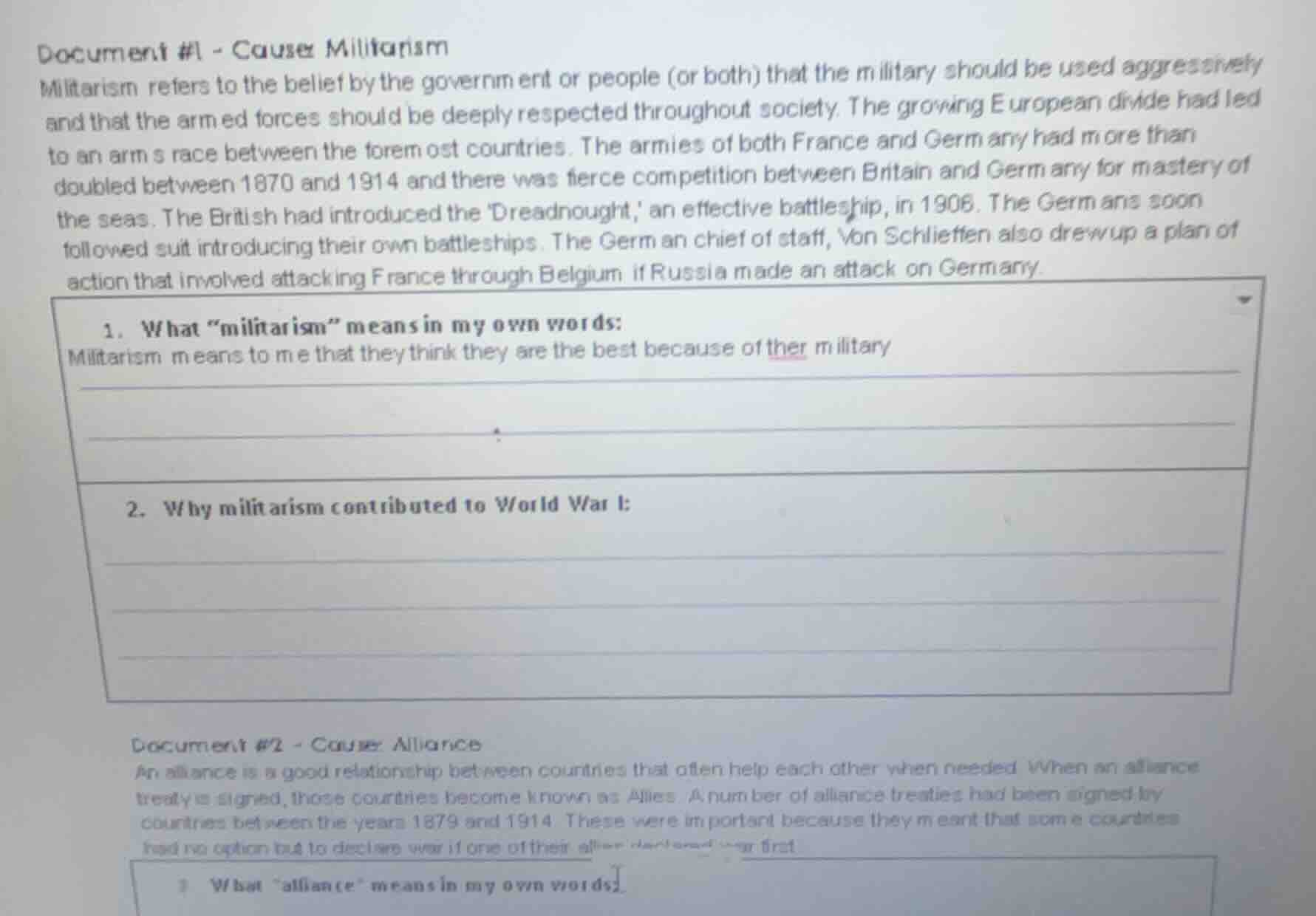
document #1 - cause: militarism
militarism refers to the belief by the government or people (or both) that the military should be used aggressively and that the armed forces should be deeply respected throughout society. the growing european divide had led to an arms race between the foremost countries. the armies of both france and germany had more than doubled between 1870 and 1914 and there was fierce competition between britain and germany for mastery of the seas. the british had introduced the dreadnought, an effective battleship, in 1906. the germans soon followed suit introducing their own battleships. the german chief of staff, von schlieffen also drew up a plan of action that involved attacking france through belgium if russia made an attack on germany.
- what \militarism\ means in my own words:
militarism means to me that they think they are the best because of their military
- why militarism contributed to world war i:
document #2 - cause: alliance
an alliance is a good relationship between countries that often help each other when needed. when an alliance treaty is signed, those countries become known as allies. a number of alliance treaties had been signed by countries between the years 1879 and 1914. these were important because they meant that some countries had no option but to declare war if one of their allies declared war first.
- what \alliance\ means in my own words:
Question 1: What "militarism" means in my own words
To rephrase the definition of militarism, we take the key elements from the document: the government/people's belief in aggressive military use and deep respect for armed forces. Then, we simplify it into personal wording. The original definition says militarism is the belief that the military should be used aggressively and respected. So in own words, it can be explained as a belief where a country or its people think the military should be used in an aggressive way and that the armed forces deserve great respect in society, and also that a country might feel superior due to its military strength. The given student's answer has a typo ("ther" instead of "their") but the core idea is about feeling superior because of the military. A better rephrasing could be: Militarism is the idea that a government or people believe the military should be used aggressively, and the armed forces should be highly respected, often leading to a sense of superiority based on military power.
From the document, militarism led to an arms race (France and Germany's armies doubled, Britain and Germany competed for sea mastery with battleships like Dreadnought) and strategic plans (Von Schlieffen's plan). These factors increased tensions and prepared countries for conflict, making war more likely. The arms race created a competitive environment where countries were building up their militaries, leading to mistrust and a desire to show dominance. The strategic plans also meant countries were ready to engage in war, so when tensions rose, militarism (through arms race and war plans) pushed them towards World War I.
The document defines an alliance as a good relationship between countries that help each other when needed, and when a treaty is signed, they become Allies. To rephrase, we take the key points: good relationship, mutual help, treaty - based. So in own words, an alliance is an agreement or good relationship between countries where they promise to help each other when one of them is in need, usually formalized by a treaty.

Snap & solve any problem in the app
Get step-by-step solutions on Sovi AI
Photo-based solutions with guided steps
Explore more problems and detailed explanations
Militarism means (to me) that a government or people believe the military should be used aggressively, and the armed forces should be highly respected, often leading to a sense of superiority based on military power. (Or refining the student's answer: Militarism means to me that they think they are the best because of their military (with "their" corrected), and also that the military should be used aggressively and respected throughout society.)