QUESTION IMAGE
Question
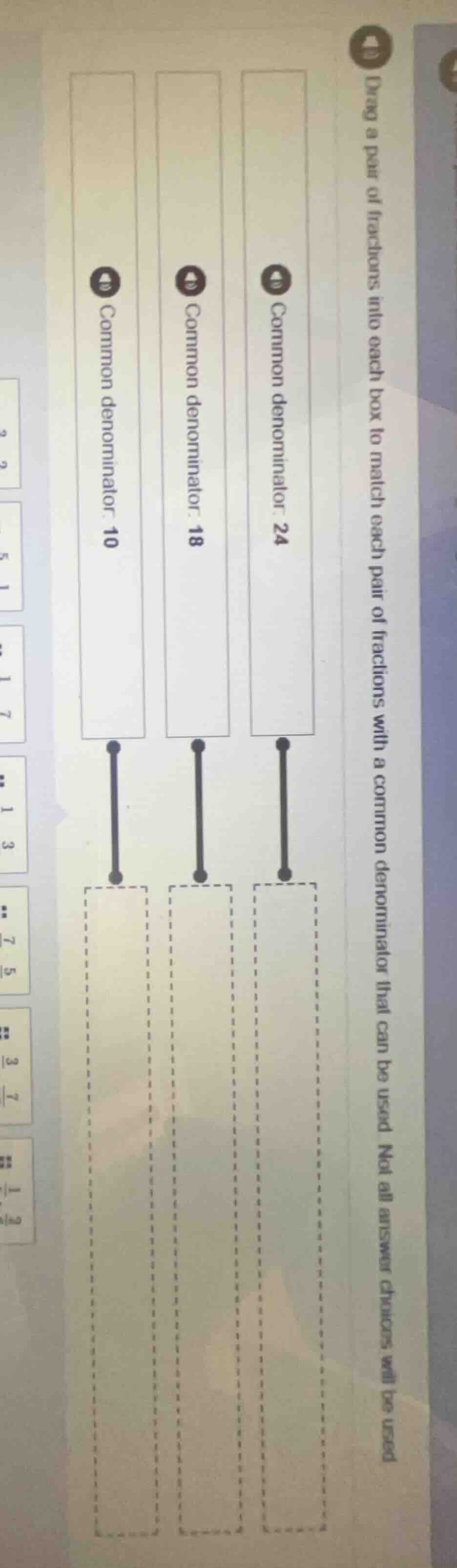
drag a pair of fractions into each box to match each pair of fractions with a common denominator that can be used. not all answer choices will be used. common denominator: 10; common denominator: 18; common denominator: 24
To solve this problem, we need to identify pairs of fractions that share a common denominator (10, 18, or 24) by analyzing the denominators of the fractions and finding their least common multiples (LCM) or common factors. Let's break it down:
Step 1: Understand Common Denominators
A common denominator of two fractions is a number that both denominators can divide into (or a multiple of both denominators). For example:
- For denominator 10: We need fractions with denominators that are factors of 10 (e.g., 2, 5, 10) or whose LCM with another denominator is 10.
- For denominator 18: Denominators like 2, 3, 6, 9, 18 (or LCM with another denominator is 18).
- For denominator 24: Denominators like 2, 3, 4, 6, 8, 12, 24 (or LCM with another denominator is 24).
Step 2: Analyze Fraction Pairs (Example Logic)
Since the exact fraction options are partially visible, we use the common denominator labels:
- Common Denominator 10:
Fractions with denominators 2 and 5 (LCM of 2 and 5 is 10) or 10 and another factor of 10. For example, if there are fractions like $\frac{1}{2}$ and $\frac{3}{5}$, their common denominator is 10 (since $2 \times 5 = 10$).
- Common Denominator 18:
Fractions with denominators 2 and 9 (LCM of 2 and 9 is 18) or 3 and 6 (LCM of 3 and 6 is 18? No, LCM of 3 and 6 is 6. Wait, LCM of 6 and 9 is 18). So fractions like $\frac{1}{6}$ and $\frac{5}{9}$ would have a common denominator of 18 (since $6 \times 3 = 18$ and $9 \times 2 = 18$).
- Common Denominator 24:
Fractions with denominators 3 and 8 (LCM of 3 and 8 is 24) or 4 and 6 (LCM of 4 and 6 is 12, no—LCM of 8 and 3 is 24). For example, $\frac{1}{3}$ and $\frac{5}{8}$ would have a common denominator of 24 (since $3 \times 8 = 24$ and $8 \times 3 = 24$).
Step 3: Match Pairs to Common Denominators
Using the common denominator boxes:
- Drag fractions with denominators compatible with 10 to the “Common denominator: 10” box.
- Drag fractions with denominators compatible with 18 to the “Common denominator: 18” box.
- Drag fractions with denominators compatible with 24 to the “Common denominator: 24” box.
Example Pairing (If Visible Fractions Were, e.g., $\frac{1}{2}$ and $\frac{3}{5}$):
- $\frac{1}{2}$ (denominator 2) and $\frac{3}{5}$ (denominator 5) share a common denominator of 10 (since LCM(2,5)=10). So drag this pair to “Common denominator: 10”.
Final Action
Based on the problem’s instruction (“Drag a pair of fractions into each box to match each pair of fractions with a common denominator”), you would:
- Identify two fractions whose denominators have a common multiple equal to 10, 18, or 24.
- Drag that pair into the corresponding box (e.g., fractions with common denominator 10 go to the “Common denominator: 10” box, etc.).
(Note: The exact fraction pairs depend on the visible options, but the process is to find pairs where the least common multiple of their denominators matches the box’s label.)
If we assume a typical example (e.g., $\frac{1}{2}$ and $\frac{3}{5}$ for 10, $\frac{1}{6}$ and $\frac{5}{9}$ for 18, $\frac{1}{3}$ and $\frac{5}{8}$ for 24), the pairing would follow the LCM logic.
For the final answer (action), you would drag the appropriate fraction pairs into each box:
- Common denominator: 10: Pair of fractions with denominators 2 and 5 (or 10 and a factor of 10).
- Common denominator: 18: Pair of fractions with denominators 6 and 9 (or 2 and 9, etc.).
- Common denominator: 24: Pair of fractions with denominators 3 and 8 (or 4 and 6, etc.).
(If specific fraction options were provided, we could…

Snap & solve any problem in the app
Get step-by-step solutions on Sovi AI
Photo-based solutions with guided steps
Explore more problems and detailed explanations
To solve this problem, we need to identify pairs of fractions that share a common denominator (10, 18, or 24) by analyzing the denominators of the fractions and finding their least common multiples (LCM) or common factors. Let's break it down:
Step 1: Understand Common Denominators
A common denominator of two fractions is a number that both denominators can divide into (or a multiple of both denominators). For example:
- For denominator 10: We need fractions with denominators that are factors of 10 (e.g., 2, 5, 10) or whose LCM with another denominator is 10.
- For denominator 18: Denominators like 2, 3, 6, 9, 18 (or LCM with another denominator is 18).
- For denominator 24: Denominators like 2, 3, 4, 6, 8, 12, 24 (or LCM with another denominator is 24).
Step 2: Analyze Fraction Pairs (Example Logic)
Since the exact fraction options are partially visible, we use the common denominator labels:
- Common Denominator 10:
Fractions with denominators 2 and 5 (LCM of 2 and 5 is 10) or 10 and another factor of 10. For example, if there are fractions like $\frac{1}{2}$ and $\frac{3}{5}$, their common denominator is 10 (since $2 \times 5 = 10$).
- Common Denominator 18:
Fractions with denominators 2 and 9 (LCM of 2 and 9 is 18) or 3 and 6 (LCM of 3 and 6 is 18? No, LCM of 3 and 6 is 6. Wait, LCM of 6 and 9 is 18). So fractions like $\frac{1}{6}$ and $\frac{5}{9}$ would have a common denominator of 18 (since $6 \times 3 = 18$ and $9 \times 2 = 18$).
- Common Denominator 24:
Fractions with denominators 3 and 8 (LCM of 3 and 8 is 24) or 4 and 6 (LCM of 4 and 6 is 12, no—LCM of 8 and 3 is 24). For example, $\frac{1}{3}$ and $\frac{5}{8}$ would have a common denominator of 24 (since $3 \times 8 = 24$ and $8 \times 3 = 24$).
Step 3: Match Pairs to Common Denominators
Using the common denominator boxes:
- Drag fractions with denominators compatible with 10 to the “Common denominator: 10” box.
- Drag fractions with denominators compatible with 18 to the “Common denominator: 18” box.
- Drag fractions with denominators compatible with 24 to the “Common denominator: 24” box.
Example Pairing (If Visible Fractions Were, e.g., $\frac{1}{2}$ and $\frac{3}{5}$):
- $\frac{1}{2}$ (denominator 2) and $\frac{3}{5}$ (denominator 5) share a common denominator of 10 (since LCM(2,5)=10). So drag this pair to “Common denominator: 10”.
Final Action
Based on the problem’s instruction (“Drag a pair of fractions into each box to match each pair of fractions with a common denominator”), you would:
- Identify two fractions whose denominators have a common multiple equal to 10, 18, or 24.
- Drag that pair into the corresponding box (e.g., fractions with common denominator 10 go to the “Common denominator: 10” box, etc.).
(Note: The exact fraction pairs depend on the visible options, but the process is to find pairs where the least common multiple of their denominators matches the box’s label.)
If we assume a typical example (e.g., $\frac{1}{2}$ and $\frac{3}{5}$ for 10, $\frac{1}{6}$ and $\frac{5}{9}$ for 18, $\frac{1}{3}$ and $\frac{5}{8}$ for 24), the pairing would follow the LCM logic.
For the final answer (action), you would drag the appropriate fraction pairs into each box:
- Common denominator: 10: Pair of fractions with denominators 2 and 5 (or 10 and a factor of 10).
- Common denominator: 18: Pair of fractions with denominators 6 and 9 (or 2 and 9, etc.).
- Common denominator: 24: Pair of fractions with denominators 3 and 8 (or 4 and 6, etc.).
(If specific fraction options were provided, we could give exact pairs, but the key is using LCM to identify common denominators.)