QUESTION IMAGE
Question
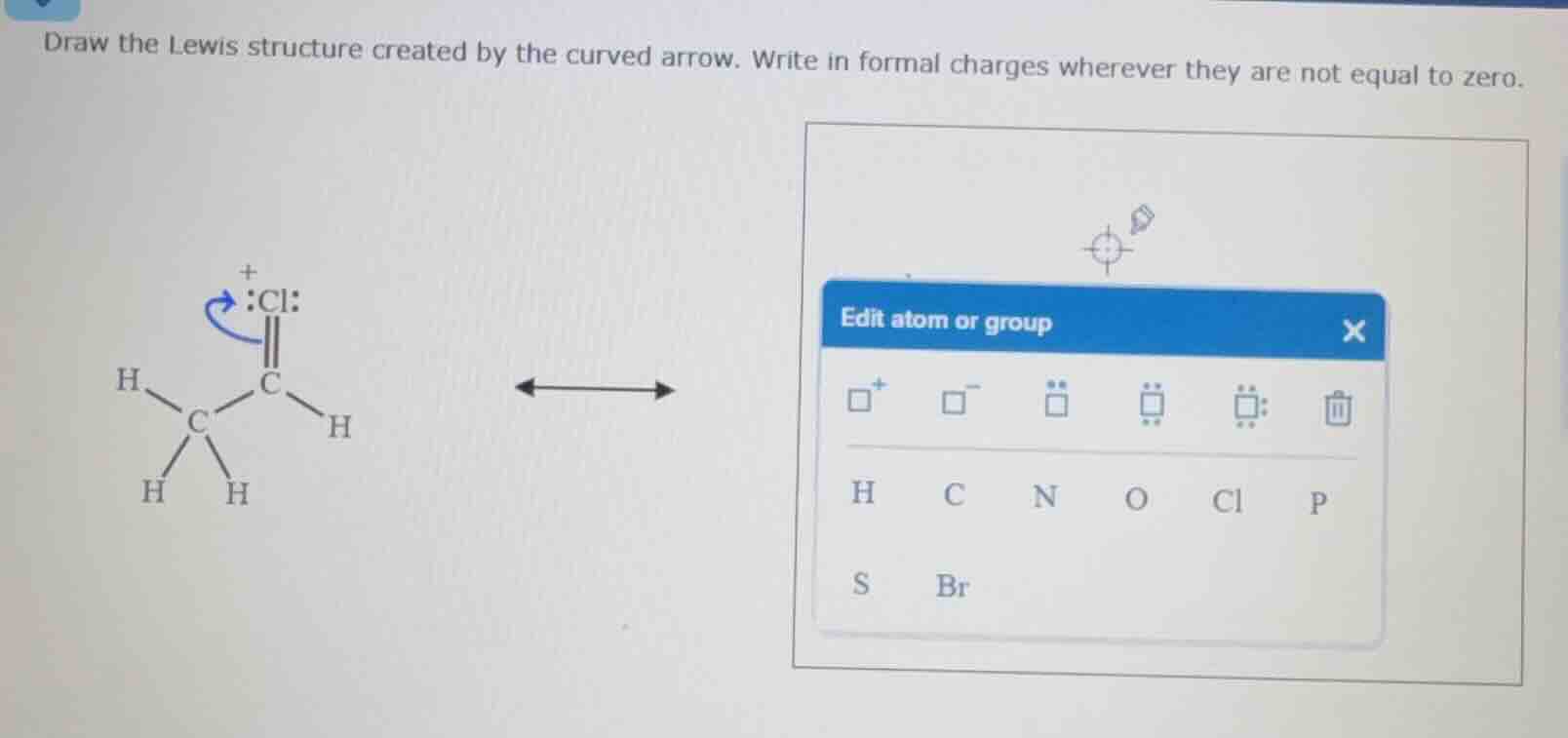
draw the lewis structure created by the curved arrow. write in formal charges wherever they are not equal to zero.
Step1: Analyze the Curved Arrow
The curved arrow shows electron movement from the double bond (between C and Cl) towards Cl. Initially, the C - Cl has a double bond, and Cl has a lone pair (but with a positive charge on the overall group? Wait, no, the initial structure: the central C (attached to Cl with a double bond) and another C (with three Hs). Wait, the curved arrow is a resonance arrow? Wait, no, the curved arrow here is showing a shift: the double bond's electron (a pair) moving to Cl, so the double bond becomes a single bond, and Cl gains a lone pair, while the C (attached to Cl) becomes positively charged? Wait, no, let's re - examine.
Original structure: The C connected to Cl has a double bond with Cl, and Cl has two lone pairs (and a positive charge? Wait, the + is on the Cl? Wait, the initial structure: :Cl: double bonded to C, with C also bonded to H and another C (with three Hs). The curved arrow is a resonance or electron - pushing arrow. When the curved arrow moves (from the double bond to Cl), the double bond (C = Cl) becomes a single bond (C - Cl), and Cl gains a lone pair. Now, let's calculate formal charges.
Formal charge formula: \(FC=V - N - \frac{B}{2}\), where \(V\) is valence electrons, \(N\) is non - bonding electrons, \(B\) is bonding electrons.
For Cl: Initially, in C = Cl (double bond), Cl has 6 non - bonding electrons (since :Cl: has two lone pairs, 4 electrons? Wait, no, the initial :Cl: has two lone pairs (4 electrons) and a double bond (4 electrons), so total electrons around Cl: 4 + 4 = 8. Valence electrons for Cl: 7. So initial formal charge: \(7-4 - \frac{4}{2}=7 - 4 - 2 = + 1\). After the electron shift: Cl has three lone pairs (6 electrons) and a single bond (2 electrons). So \(FC = 7-6-\frac{2}{2}=7 - 6 - 1 = 0\). The C (attached to Cl) initially had a double bond with Cl, so bonding electrons: 4 (from double bond) plus single bonds to H and the other C. After the shift, bonding electrons from C - Cl: 2 (single bond), so the C now has a positive charge? Wait, no, the other C (with three Hs) is neutral. Wait, maybe the structure is a carbocation? Wait, no, let's draw the new structure.
The new structure: The C (attached to Cl) is now bonded to Cl with a single bond, Cl has three lone pairs (6 electrons), and the C (attached to Cl) has a positive charge (since it lost an electron from the double bond). The other C is bonded to three Hs and the C with the positive charge.
So the Lewis structure after the curved arrow:
- The central C (let's call it C1) is bonded to Cl (single bond), H, and C2 (with three Hs). C1 has a positive charge. Cl has three lone pairs (6 electrons) and a single bond (2 electrons), so formal charge on Cl is 0. C1: valence electrons 4, non - bonding electrons 0, bonding electrons: 2 (from C - Cl) + 1 (from C - H) + 1 (from C - C2) = 4. So \(FC = 4-0-\frac{4}{2}=4 - 0 - 2 = + 1\).
So we need to draw the structure: C2 (with three Hs) - C1(+)-Cl (with three lone pairs, single bond to C1), and C1 also bonded to H.
Step2: Draw the Lewis Structure
- Draw the two carbon atoms: one (C2) with three H atoms attached (tetrahedral, single bonds), and the other (C1) with one H, a single bond to C2, and a single bond to Cl.
- Cl has three lone pairs (so six electrons, drawn as three pairs: : : :Cl - )
- C1 has a positive formal charge (+) since it has only four bonding electrons (from C - C2, C - H, C - Cl) and no non - bonding electrons.

Snap & solve any problem in the app
Get step-by-step solutions on Sovi AI
Photo-based solutions with guided steps
Explore more problems and detailed explanations
The Lewis structure will have:
- A carbon (C1) with a positive charge (\(+\)), bonded to a hydrogen (H), another carbon (C2) (which is bonded to three hydrogens), and a chlorine (Cl) with a single bond. Chlorine has three lone pairs of electrons (\(:\!\!\!\overset{..}{Cl}\!\!\!:\)) (wait, three lone pairs: \(:\!\!\!\overset{..}{Cl}\!\!\!:\) with three pairs? No, three lone pairs is six electrons, so \(:\!\!\!\overset{..}{Cl}\!\!\!:\) (two pairs) plus one more pair: \(:\!\!\!\overset{...}{Cl}\!\!\!:\) (three lone pairs). The carbon (C1) has a positive charge: \(^+C\) bonded to H, C2, and Cl.
Formal charges: Cl has \(FC = 0\) (using \(FC = 7-6-\frac{2}{2}=0\)), C1 has \(FC= + 1\) (using \(FC = 4 - 0-\frac{4}{2}=+1\)).