QUESTION IMAGE
Question
draw strain a
strain a - runners
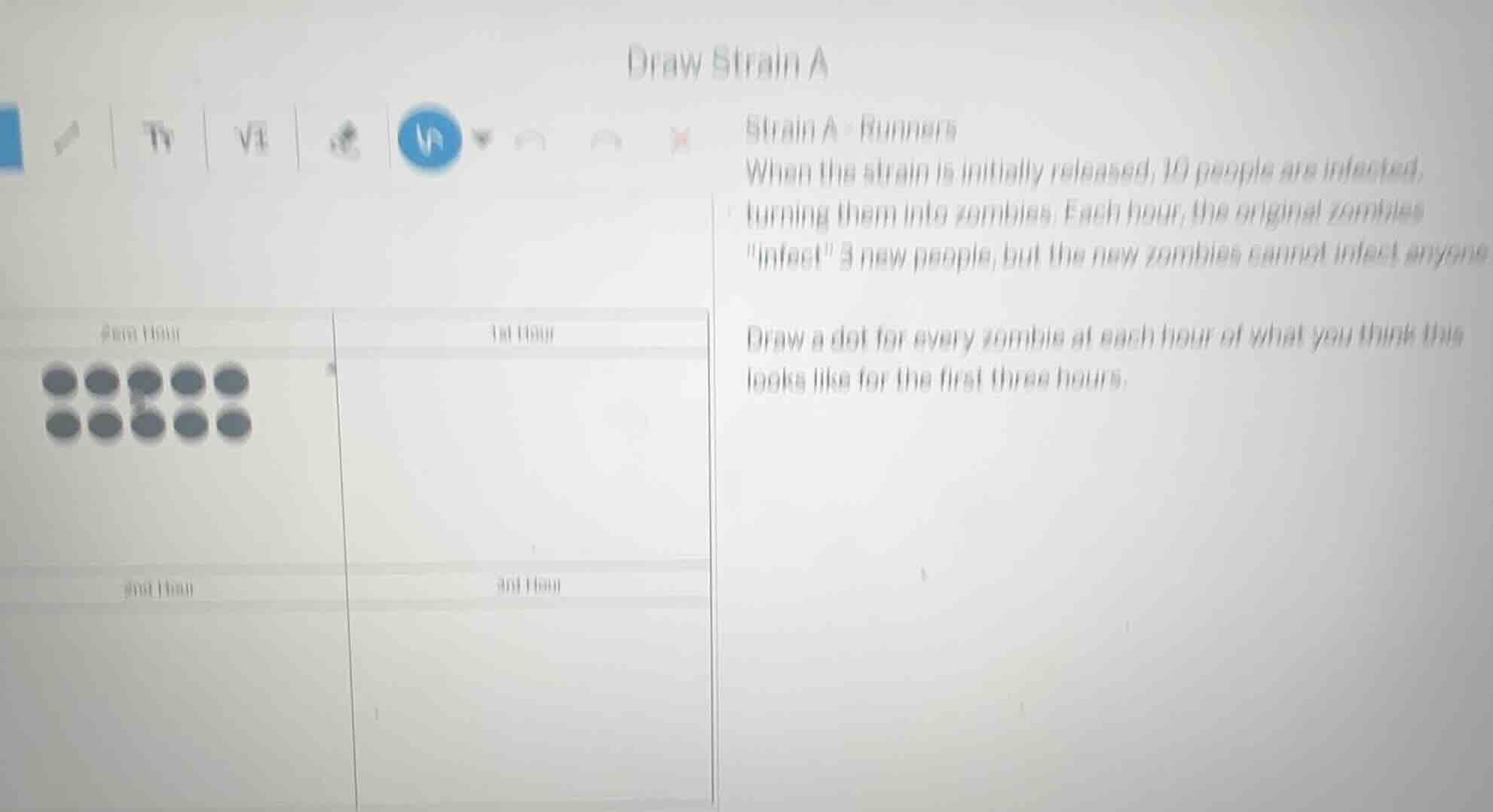
when the strain is initially released, 10 people are infected, turning them into zombies. each hour, the original zombies \infect\ 3 new people, but the new zombies cannot infect anyone.
draw a dot for every zombie at each hour of what you think this looks like for the first three hours.
(the left part of the image shows a table with 0th hour having dots, and 1st hour, 2nd hour, 3rd hour sections to draw dots.)
Step1: Identify Initial Zombies
Initially (0th hour), there are 10 zombies. So we draw 10 dots (as shown in the 0th hour box: 2 rows of 5 dots each, \( 2\times5 = 10 \)).
Step2: Calculate 1st Hour Zombies
Each hour, original zombies (10) infect 3 new people. But new zombies can't infect. So total zombies at 1st hour: initial (10) + new (3) = 13? Wait, no—wait, the problem says "the original zombies 'infect' 3 new people"—wait, maybe I misread. Wait, initial 10. Each hour, original zombies (the initial 10) infect 3 new? Wait, no, maybe "each original zombie infects 3"? Wait, the text: "When the strain is initially released, 10 people are infected... Each hour, the original zombies 'infect' 3 new people, but the new zombies cannot infect anyone." Oh, so original 10 zombies, each hour, the original 10 infect 3 new? Wait, no—"the original zombies 'infect' 3 new people"—so total new infections per hour: 3. So:
- 0th hour: 10 zombies (given, as 2 rows of 5 dots: \( 5 + 5 = 10 \))
- 1st hour: original 10 + 3 new = 13 zombies. So draw 13 dots. Maybe 2 rows of 5 (10) and 1 row of 3, or 3 rows: 5, 5, 3.
- 2nd hour: original 10 still infect 3 new (since new zombies can't infect). So 13 + 3 = 16 zombies. Draw 16 dots: 3 rows of 5 (15) and 1 dot, or 4 rows of 4, etc.
- 3rd hour: 16 + 3 = 19 zombies. Draw 19 dots.
Wait, but maybe the "3 new people" is per original zombie? Wait, the wording is "the original zombies 'infect' 3 new people"—maybe it's 3 total new per hour, not per zombie. Let's re-express:
Correct Interpretation:
- Initial (0h): 10 zombies (dots: 10)
- 1st h: 10 (original) + 3 (new) = 13 zombies
- 2nd h: 13 (but only original 10 infect 3 new) → 13 + 3 = 16
- 3rd h: 16 + 3 = 19
So to draw:
- 0th hour: 10 dots (as given: 2×5)
- 1st hour: 13 dots (e.g., 5, 5, 3)
- 2nd hour: 16 dots (5, 5, 6 or 5, 5, 5, 1)
- 3rd hour: 19 dots (5, 5, 5, 4 or 6, 6, 7)
But let's confirm the initial: 0th hour has 10 dots (2 rows of 5). So:
1st hour: 10 + 3 = 13. So draw 13 dots. Let's do 2 rows of 5 (10) and 1 row of 3: ••••• ••••• •••
2nd hour: 13 + 3 = 16. 2 rows of 5 (10), 1 row of 5 (5), 1 row of 1: ••••• ••••• ••••• •• (wait, 5+5+5+1=16? No, 5×3=15 +1=16. Or 4 rows of 4: •••• •••• •••• •••• (16)
3rd hour: 16 + 3 = 19. 3 rows of 5 (15) + 4: ••••• ••••• ••••• •••• (19)

Snap & solve any problem in the app
Get step-by-step solutions on Sovi AI
Photo-based solutions with guided steps
Explore more problems and detailed explanations
To draw the zombies for each hour:
- 0th Hour: 10 dots (as shown: 2 rows of 5, e.g., ••••• •••••)
- 1st Hour: 13 dots (e.g., ••••• ••••• •••)
- 2nd Hour: 16 dots (e.g., ••••• ••••• ••••• ••)
- 3rd Hour: 19 dots (e.g., ••••• ••••• ••••• ••••)
(Note: The key is that only the original 10 zombies infect 3 new people each hour, so new infections are +3 per hour, leading to 10, 13, 16, 19 zombies at 0h, 1h, 2h, 3h respectively.)