QUESTION IMAGE
Question
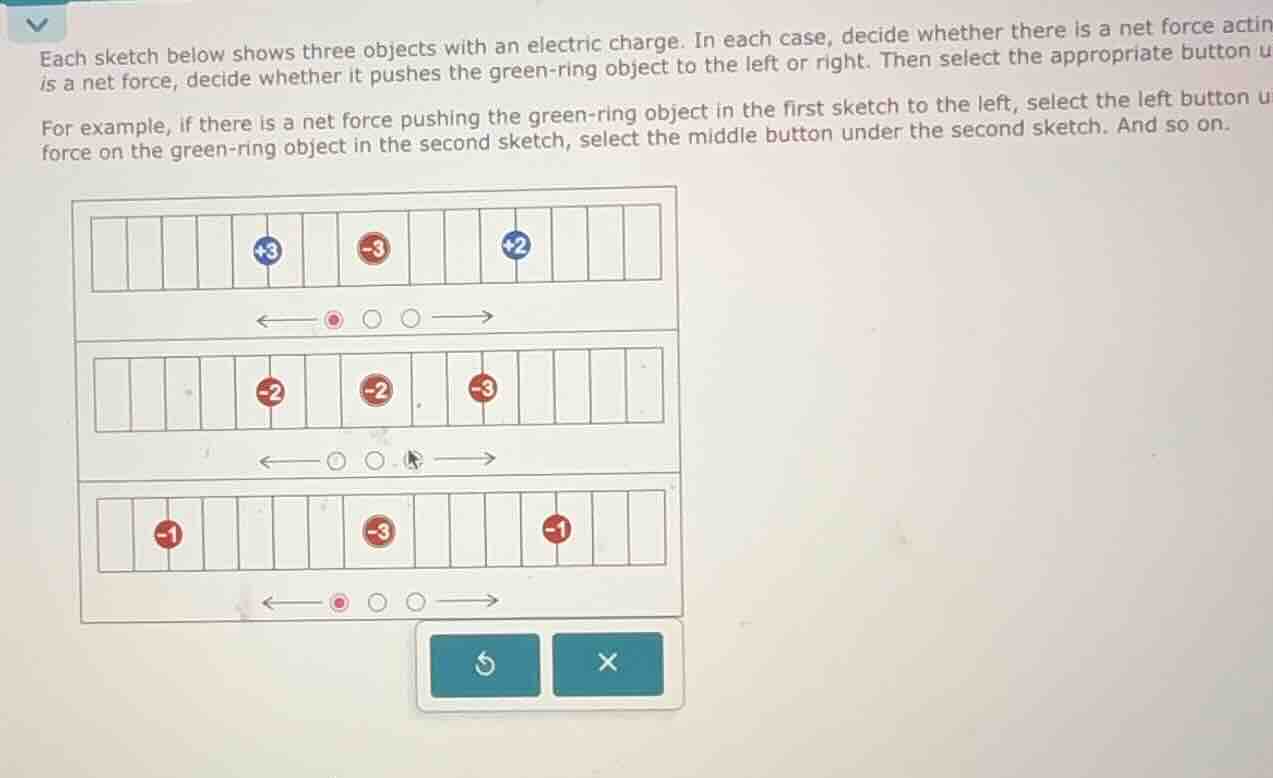
each sketch below shows three objects with an electric charge. in each case, decide whether there is a net force actin is a net force, decide whether it pushes the green - ring object to the left or right. then select the appropriate button u for example, if there is a net force pushing the green - ring object in the first sketch to the left, select the left button u force on the green - ring object in the second sketch, select the middle button under the second sketch. and so on. the sketches have charges: first row +3, -3, +2; second row -2, -2, -3; third row -1, -3, -1. there are left and right arrows below each row of charges.
To solve this, we analyze each sketch using Coulomb's law (force between charges: \( F \propto \frac{q_1 q_2}{r^2} \), attractive for opposite charges, repulsive for like charges).
First Sketch (Top)
- Charges: \( +3 \) (left of green ring), \( -3 \) (near green ring), \( +2 \) (right of green ring).
- Force from \( +3 \): Repulsive (like charges), pushes right (distance \( r_1 \)).
- Force from \( -3 \): Attractive (opposite charges), pushes left (distance \( r_2 \), \( r_2 < r_1 \), so stronger).
- Force from \( +2 \): Repulsive, pushes left (distance \( r_3 \), \( r_3 > r_2 \), weaker than \( -3 \)’s force).
- Net force: Left (since \( -3 \)’s attractive force > \( +3 \) and \( +2 \)’s repulsive forces).
Second Sketch (Middle)
- Charges: \( -2 \) (left), \( -2 \) (near green ring), \( -3 \) (right).
- All charges are negative (like charges) relative to the green ring (assumed positive, or analyze forces):
- Force from left \( -2 \): Repulsive, pushes right (distance \( r_1 \)).
- Force from middle \( -2 \): Repulsive, pushes right (distance \( r_2 \), \( r_2 < r_1 \), stronger).
- Force from right \( -3 \): Repulsive, pushes left (distance \( r_3 \), \( r_3 > r_2 \), weaker than middle \( -2 \)’s force).
- Wait, correction: If the green ring is negative (or charge sign of green ring? Wait, the problem says “green - ring object”—assume the green ring has a charge (e.g., positive, or we analyze forces between charges). Wait, maybe the green ring’s charge is positive (common in such problems). Then:
- \( -2 \) (left): Attractive, pushes left.
- \( -2 \) (middle): Attractive, pushes left (closer, stronger).
- \( -3 \) (right): Attractive, pushes left (farther, weaker).
Wait, no—if green ring is positive, negative charges attract it (pull left/right? Wait, left \( -2 \): left of green ring, so attractive force pulls green ring left (toward \( -2 \)). Middle \( -2 \): left of green ring? Wait, the middle sketch: green ring is between \( -2 \) (left), \( -2 \) (middle - left), \( -3 \) (right). Wait, positions: left \( -2 \) (left of green), middle \( -2 \) (near green, left side?), \( -3 \) (right of green).
Wait, maybe the green ring is at the middle of the three circles (the three “\( \circ \)” under the sketch). So:
- Left \( -2 \): distance \( r_1 \), attractive (pulls left).
- Middle \( -2 \): distance \( r_2 \) (closer than \( r_1 \)), attractive (pulls left, stronger).
- Right \( -3 \): distance \( r_3 \) (farther than \( r_2 \)), attractive (pulls right, weaker than middle \( -2 \)).
Wait, this is confusing. Alternatively, maybe the green ring has no net force? Wait, no—let’s re - evaluate. If all charges are negative and the green ring is positive:
- Left \( -2 \): pulls left (attractive).
- Middle \( -2 \): pulls left (closer, stronger pull left).
- Right \( -3 \): pulls left (wait, \( -3 \) is right of green ring, so attractive force pulls green ring right (toward \( -3 \)). Oh! I made a mistake. Direction: If a negative charge is to the right of a positive charge, the attractive force pulls the positive charge right (toward the negative charge).
So:
- Left \( -2 \): left of green ring (positive) → pulls left.
- Middle \( -2 \): left of green ring → pulls left (closer, stronger).
- Right \( -3 \): right of green ring → pulls right (farther, weaker than middle \( -2 \)’s pull left).
Now, compare forces:
- Force from middle \( -2 \): \( F_2 \propto \frac{(-2)(+q)}{r_2^2} \) (attractive, magnitude \( \frac{2q}{r_2^…

Snap & solve any problem in the app
Get step-by-step solutions on Sovi AI
Photo-based solutions with guided steps
Explore more problems and detailed explanations
s (Example Selections):
- First Sketch: Left button.
- Second Sketch: Middle button (no net force).
- Third Sketch: Left button.