QUESTION IMAGE
Question
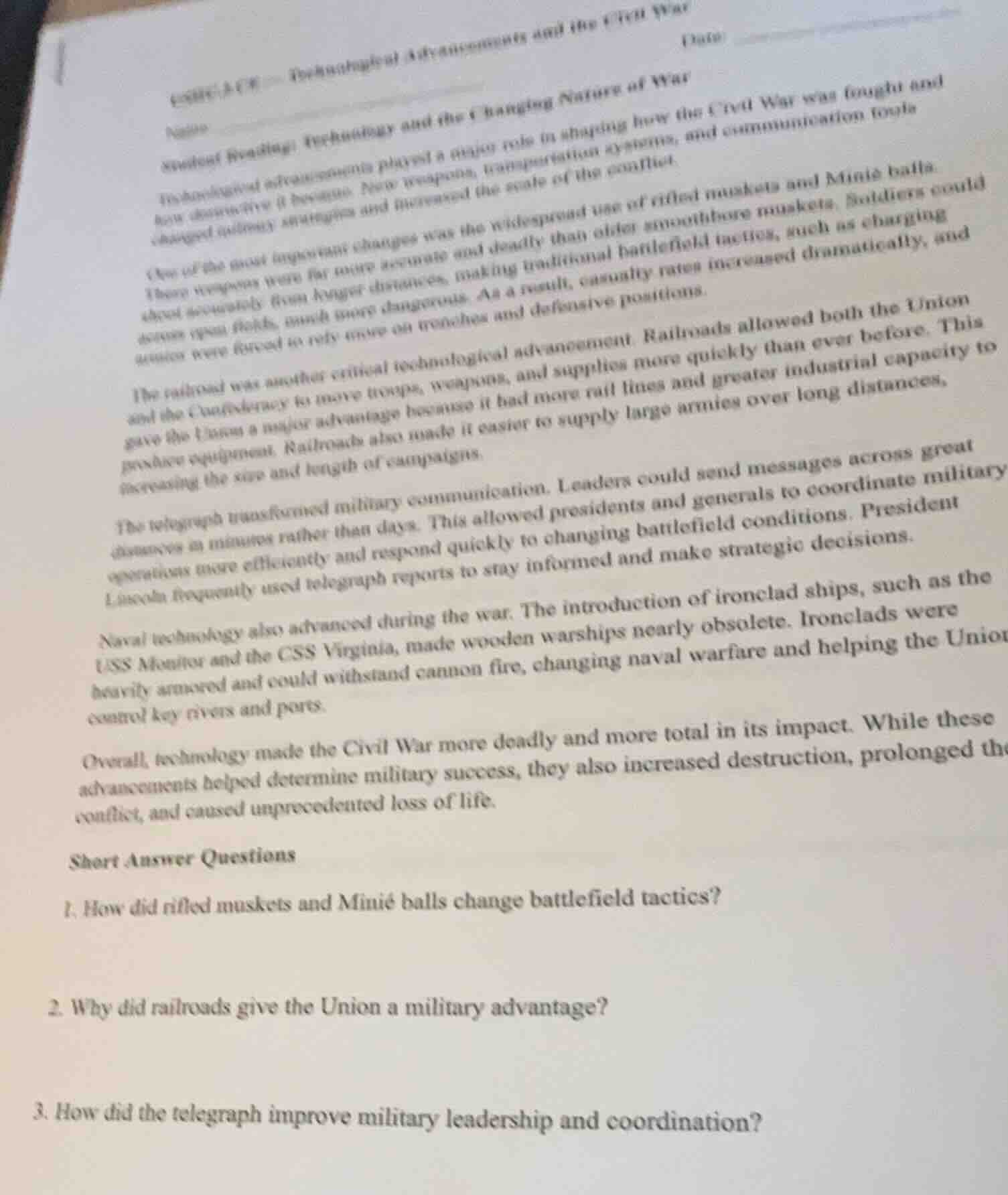
edhs 3.08 - technological advancements and the civil war
name
date
student reading: technology and the changing nature of war
technological advancements played a major role in shaping how the civil war was fought and how destructive it became. new weapons, transportation systems, and communication tools changed military strategies and increased the scale of the conflict.
one of the most important changes was the widespread use of rifled muskets and minié balls. these weapons were far more accurate and deadly than older smoothbore muskets. soldiers could shoot accurately from longer distances, making traditional battlefield tactics, such as charging across open fields, much more dangerous. as a result, casualty rates increased dramatically, and armies were forced to rely more on trenches and defensive positions.
the railroad was another critical technological advancement. railroads allowed both the union and the confederacy to move troops, weapons, and supplies more quickly than ever before. this gave the union a major advantage because it had more rail lines and greater industrial capacity to produce equipment. railroads also made it easier to supply large armies over long distances, increasing the size and length of campaigns.
the telegraph transformed military communication. leaders could send messages across great distances in minutes rather than days. this allowed presidents and generals to coordinate military operations more efficiently and respond quickly to changing battlefield conditions. president lincoln frequently used telegraph reports to stay informed and make strategic decisions.
naval technology also advanced during the war. the introduction of ironclad ships, such as the uss monitor and the css virginia, made wooden warships nearly obsolete. ironclads were heavily armored and could withstand cannon fire, changing naval warfare and helping the union control key rivers and ports.
overall, technology made the civil war more deadly and more total in its impact. while these advancements helped determine military success, they also increased destruction, prolonged the conflict, and caused unprecedented loss of life.
short answer questions
- how did rifled muskets and minié balls change battlefield tactics?
- why did railroads give the union a military advantage?
- how did the telegraph improve military leadership and coordination?
- Rifled muskets and Minié balls were far more accurate and deadly than older smoothbore muskets, allowing soldiers to shoot accurately from longer distances. This made traditional tactics like charging across open fields extremely dangerous, leading to massive casualties. Armies had to shift to using trenches and defensive positions instead.
- The Union had more rail lines and greater industrial capacity to produce equipment. Railroads allowed faster movement of troops, weapons, and supplies than ever before, and also made it easier to supply large armies over long distances, extending campaign size and length.
- The telegraph let military leaders send messages across great distances in minutes instead of days. This allowed presidents and generals to coordinate military operations more efficiently, respond quickly to changing battlefield conditions, and stay informed via telegraph reports to make strategic decisions.

Snap & solve any problem in the app
Get step-by-step solutions on Sovi AI
Photo-based solutions with guided steps
Explore more problems and detailed explanations
- They made open-field charges deadly, forcing armies to rely on trenches and defensive positions instead, as the weapons were far more accurate and deadly at longer ranges, causing massive casualties with traditional tactics.
- The Union had more rail lines and greater industrial capacity; railroads let them move troops, weapons, and supplies far faster, supply large armies over long distances, and extend campaign scale and length, giving them a logistical edge.
- It let leaders send messages in minutes (instead of days), enabling more efficient coordination of operations, quick responses to battlefield changes, and informed strategic decision-making by leaders like President Lincoln.