QUESTION IMAGE
Question
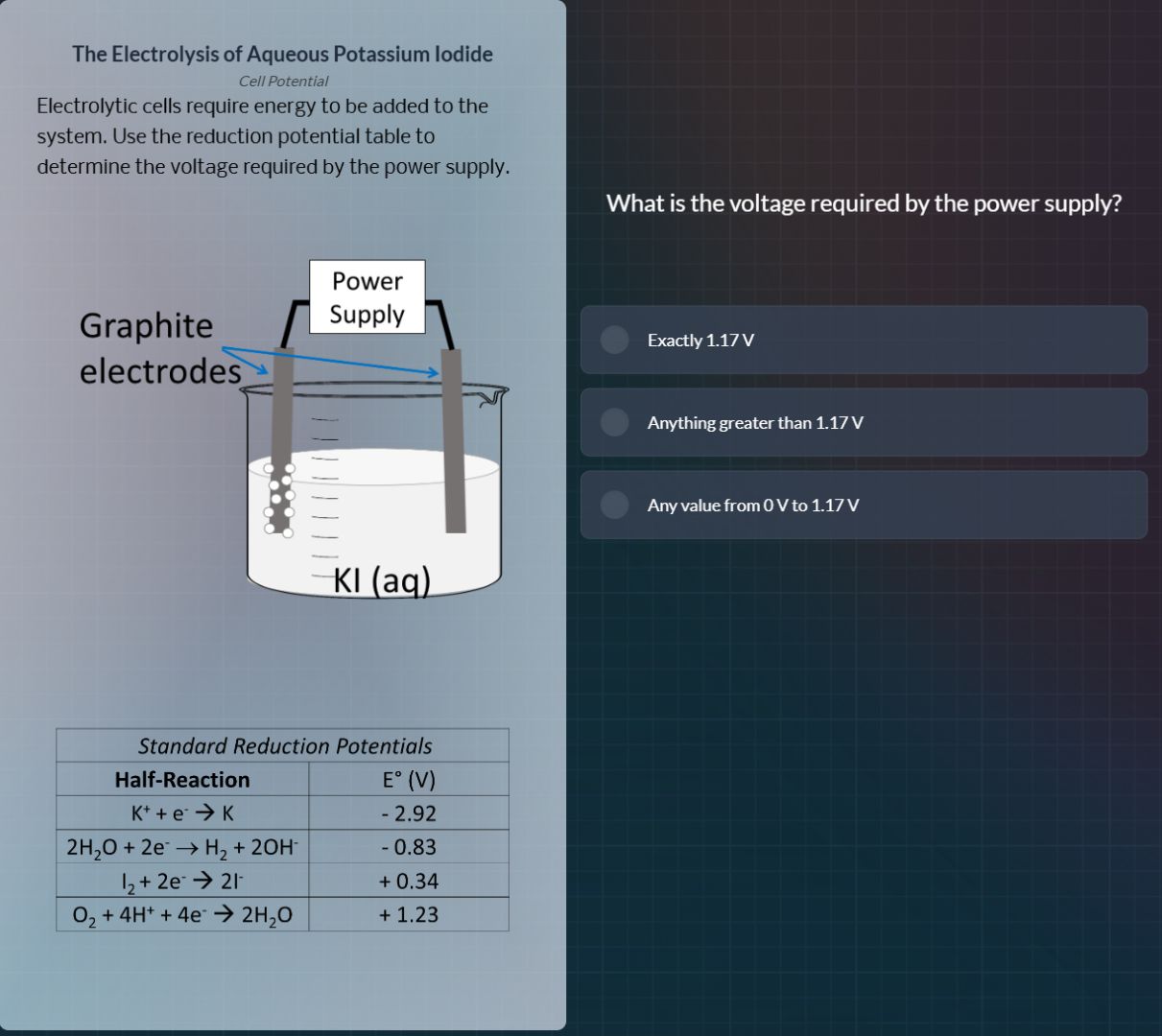
the electrolysis of aqueous potassium iodide
cell potential
electrolytic cells require energy to be added to the
system. use the reduction potential table to
determine the voltage required by the power supply.
what is the voltage required by the power supply?
exactly 1.17 v
anything greater than 1.17 v
any value from 0 v to 1.17 v
standard reduction potentials
half - reaction
e° (v)
k⁺ + e⁻ → k
-2.92
2h₂o + 2e⁻ → h₂ + 2oh⁻
-0.83
i₂ + 2e⁻ → 2i⁻
+0.34
o₂ + 4h⁺ + 4e⁻ → 2h₂o
+1.23
Step1: Identify half - reactions
In the electrolysis of aqueous KI, we need to determine the oxidation and reduction half - reactions.
For reduction (cathode): We compare the reduction potentials of possible species. The species with the less negative (or more positive) reduction potential will be reduced. Between \(K^++e^-\to K\) (\(E^o = - 2.92\ V\)) and \(2H_2O + 2e^-\to H_2+2OH^-\) (\(E^o=-0.83\ V\)), water is reduced because \(- 0.83\ V>-2.92\ V\). So the reduction half - reaction is \(2H_2O + 2e^-\to H_2+2OH^-\) with \(E_{cathode}^o=-0.83\ V\).
For oxidation (anode): We look at the oxidation of possible species. Oxidation is the reverse of reduction. The possible species to be oxidized are \(I^-\) (reverse of \(I_2 + 2e^-\to 2I^-\)) and \(H_2O\) (reverse of \(O_2 + 4H^++4e^-\to 2H_2O\)). The oxidation potential of \(I^-\) (reverse of \(I_2 + 2e^-\to 2I^-\)) is \(E_{oxidation}^o=- 0.34\ V\) (since \(E_{reduction}^o\) for \(I_2 + 2e^-\to 2I^-\) is \(+ 0.34\ V\)), and the oxidation potential of \(H_2O\) (reverse of \(O_2 + 4H^++4e^-\to 2H_2O\)) is \(E_{oxidation}^o=-1.23\ V\) (since \(E_{reduction}^o\) for \(O_2 + 4H^++4e^-\to 2H_2O\) is \(+ 1.23\ V\)). Since \(-0.34\ V>-1.23\ V\), \(I^-\) is oxidized. The oxidation half - reaction is \(2I^-\to I_2 + 2e^-\) with \(E_{anode}^o=-0.34\ V\) (oxidation potential) or \(E_{reduction}^o\) for the reverse reaction is \(+ 0.34\ V\)).
Step2: Calculate cell potential for electrolytic cell
For an electrolytic cell, the cell potential \(E_{cell}=E_{cathode}-E_{anode}\) (where \(E_{cathode}\) is the reduction potential of the cathode reaction and \(E_{anode}\) is the reduction potential of the anode reaction).
\(E_{cathode}^o=-0.83\ V\) (reduction of water) and \(E_{anode}^o = + 0.34\ V\) (reduction potential of the reverse reaction, since oxidation occurs at the anode, we use the reduction potential of the species being oxidized in reverse).
\(E_{cell}^o=E_{cathode}^o - E_{anode}^o=-0.83\ V-0.34\ V=- 1.17\ V\). The negative sign indicates that the reaction is non - spontaneous and we need to supply energy. The magnitude of the voltage required from the power supply must be greater than the magnitude of the cell potential (since we need to drive the non - spontaneous reaction). So the power supply must provide a voltage greater than \(1.17\ V\).

Snap & solve any problem in the app
Get step-by-step solutions on Sovi AI
Photo-based solutions with guided steps
Explore more problems and detailed explanations
Anything greater than 1.17 V