QUESTION IMAGE
Question
the electromagnetic spectrum and electronic transitions
coulombic interactions
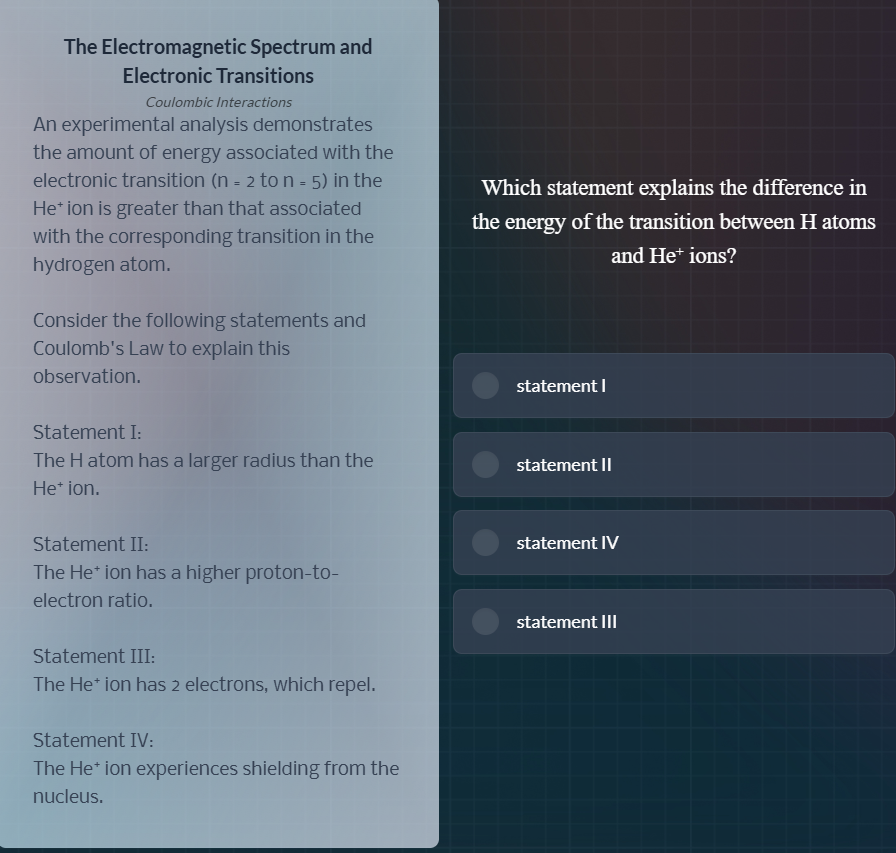
an experimental analysis demonstrates
the amount of energy associated with the
electronic transition (n = 2 to n = 5) in the
he⁺ ion is greater than that associated
with the corresponding transition in the
hydrogen atom.
consider the following statements and
coulombs law to explain this
observation.
statement i:
the h atom has a larger radius than the
he⁺ ion.
statement ii:
the he⁺ ion has a higher proton-to-
electron ratio.
statement iii:
the he⁺ ion has 2 electrons, which repel.
statement iv:
the he⁺ ion experiences shielding from the
nucleus.
which statement explains the difference in
the energy of the transition between h atoms
and he⁺ ions?
statement i
statement ii
statement iv
statement iii
The energy of electronic transitions in one-electron species depends on the nuclear charge. He⁺ has 2 protons while H has 1, and both have 1 electron, giving He⁺ a higher proton-to-electron ratio. This stronger nuclear attraction means electron energy levels in He⁺ are more tightly bound, so transitions between levels require more energy. Statement I is irrelevant to the energy difference cause; Statement III is false (He⁺ has only 1 electron); Statement IV is false (He⁺ has no shielding with one electron).

Snap & solve any problem in the app
Get step-by-step solutions on Sovi AI
Photo-based solutions with guided steps
Explore more problems and detailed explanations
statement II: The He⁺ ion has a higher proton-to-electron ratio.