QUESTION IMAGE
Question
the electromagnetic spectrum and electronic transitions
electronic transitions
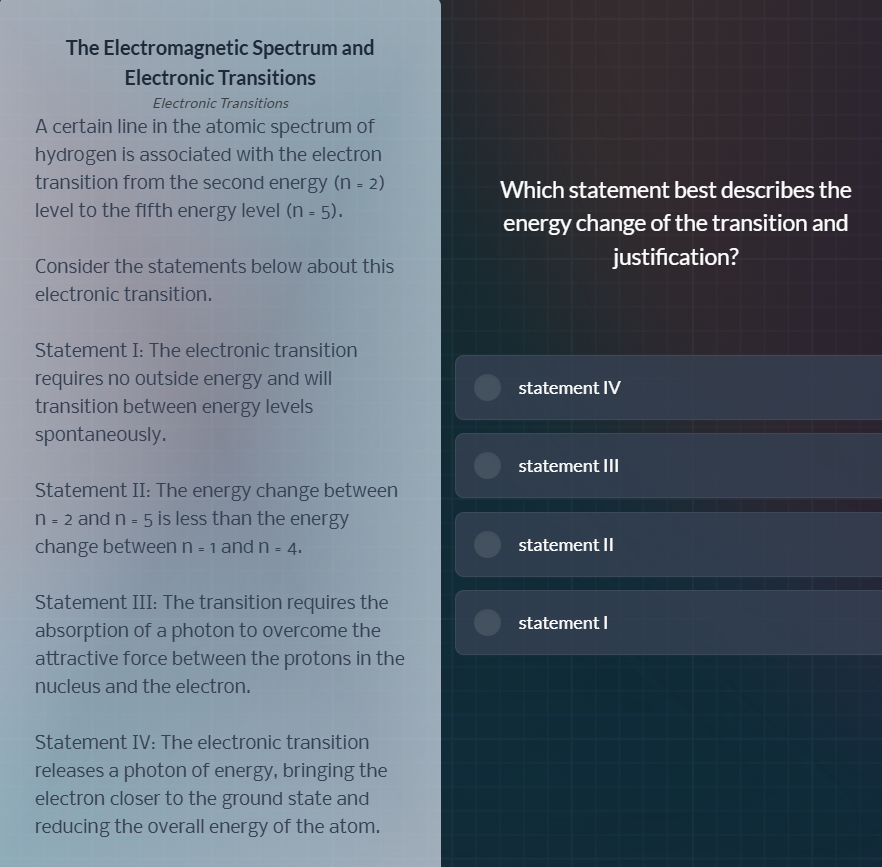
a certain line in the atomic spectrum of hydrogen is associated with the electron transition from the second energy (n = 2) level to the fifth energy level (n = 5).
consider the statements below about this electronic transition.
statement i: the electronic transition requires no outside energy and will transition between energy levels spontaneously.
statement ii: the energy change between n = 2 and n = 5 is less than the energy change between n = 1 and n = 4.
statement iii: the transition requires the absorption of a photon to overcome the attractive force between the protons in the nucleus and the electron.
statement iv: the electronic transition releases a photon of energy, bringing the electron closer to the ground state and reducing the overall energy of the atom.
which statement best describes the energy change of the transition and justification?
statement iv
statement iii
statement ii
statement i
- For Statement I: Moving from a lower energy level (n=2) to a higher one (n=5) requires energy input, so it will not happen spontaneously. This is incorrect.
- For Statement II: Energy differences in hydrogen are larger for transitions involving lower energy levels. The difference between n=1 and n=4 is much larger than between n=2 and n=5. This is incorrect.
- For Statement III: When an electron moves from a lower energy level to a higher one, it must absorb a photon with energy equal to the energy gap between the levels, which overcomes the nucleus-electron attraction. This is correct.
- For Statement IV: Releasing a photon occurs when an electron moves to a lower energy level (closer to the ground state), not a higher one. This is incorrect.

Snap & solve any problem in the app
Get step-by-step solutions on Sovi AI
Photo-based solutions with guided steps
Explore more problems and detailed explanations
statement III: The transition requires the absorption of a photon to overcome the attractive force between the protons in the nucleus and the electron.