QUESTION IMAGE
Question
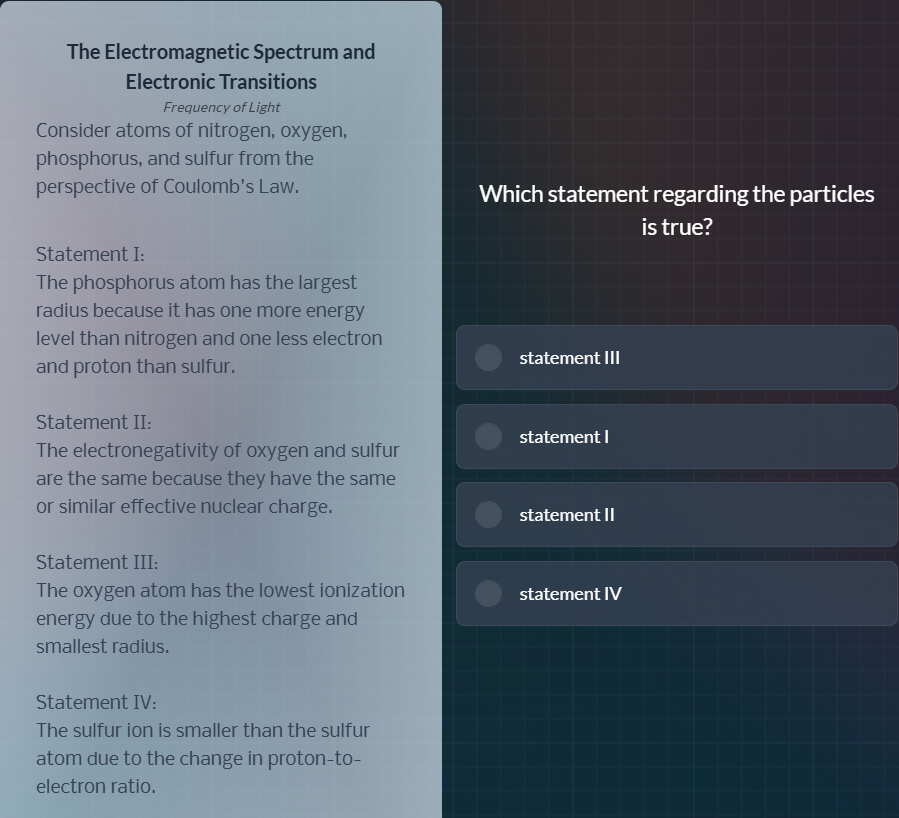
the electromagnetic spectrum and electronic transitionsfrequency of lightconsider atoms of nitrogen, oxygen, phosphorus, and sulfur from the perspective of coulombs law.statement i:the phosphorus atom has the largest radius because it has one more energy level than nitrogen and one less electron and proton than sulfur.statement ii:the electronegativity of oxygen and sulfur are the same because they have the same or similar effective nuclear charge.statement iii:the oxygen atom has the lowest ionization energy due to the highest charge and smallest radius.statement iv:the sulfur ion is smaller than the sulfur atom due to the change in proton-to-electron ratio.which statement regarding the particles is true?statement iiistatement istatement iistatement iv
- Statement I: Nitrogen (N, period 2) has 2 energy levels; phosphorus (P, period 3) has 3, sulfur (S, period 3) has 3. P has 1 less proton than S, so its nuclear attraction is weaker, making its atomic radius larger than S. N has fewer energy levels, so its radius is smaller than P. This statement is correct.
- Statement II: Oxygen is in period 2, sulfur in period 3. Sulfur has a larger atomic radius, so its effective nuclear charge felt by valence electrons is lower than oxygen. Electronegativity of O is higher than S, so this is false.
- Statement III: Lower ionization energy means easier electron removal. Oxygen has a smaller radius and higher nuclear charge, so its ionization energy is higher than sulfur and phosphorus, not the lowest. This is false.
- Statement IV: A sulfur ion (S²⁻) has 2 more electrons than a neutral S atom. The proton-to-electron ratio decreases, so electron-electron repulsion increases, making the ion larger than the neutral atom. This is false.

Snap & solve any problem in the app
Get step-by-step solutions on Sovi AI
Photo-based solutions with guided steps
Explore more problems and detailed explanations
statement I