QUESTION IMAGE
Question
- engineer it preventing charge from building up on objects is necessary on some job sites. the buildup of charge may be a safety hazard or could damage products. a company wants to design a device to minimize the buildup of charge on an object. which of the following materials would be the best choice to make such a device out of?
a. aluminum, which transfers charge quickly
b. rubber, which barely transfers charge
c. a new plastic, which transfers charge at a moderate rate
charges in neutral objects
generally, positive and negative charges are evenly spread out in an object. opposite charges are attracted to one another, and similar charges are repelled from one another, which typically leads to charges spreading evenly throughout an object. however, charges can move in a neutral object. wires generally have a neutral charge, but electric charges can move freely through them. charges are also able to move and separate within an object if exposed to outside forces.
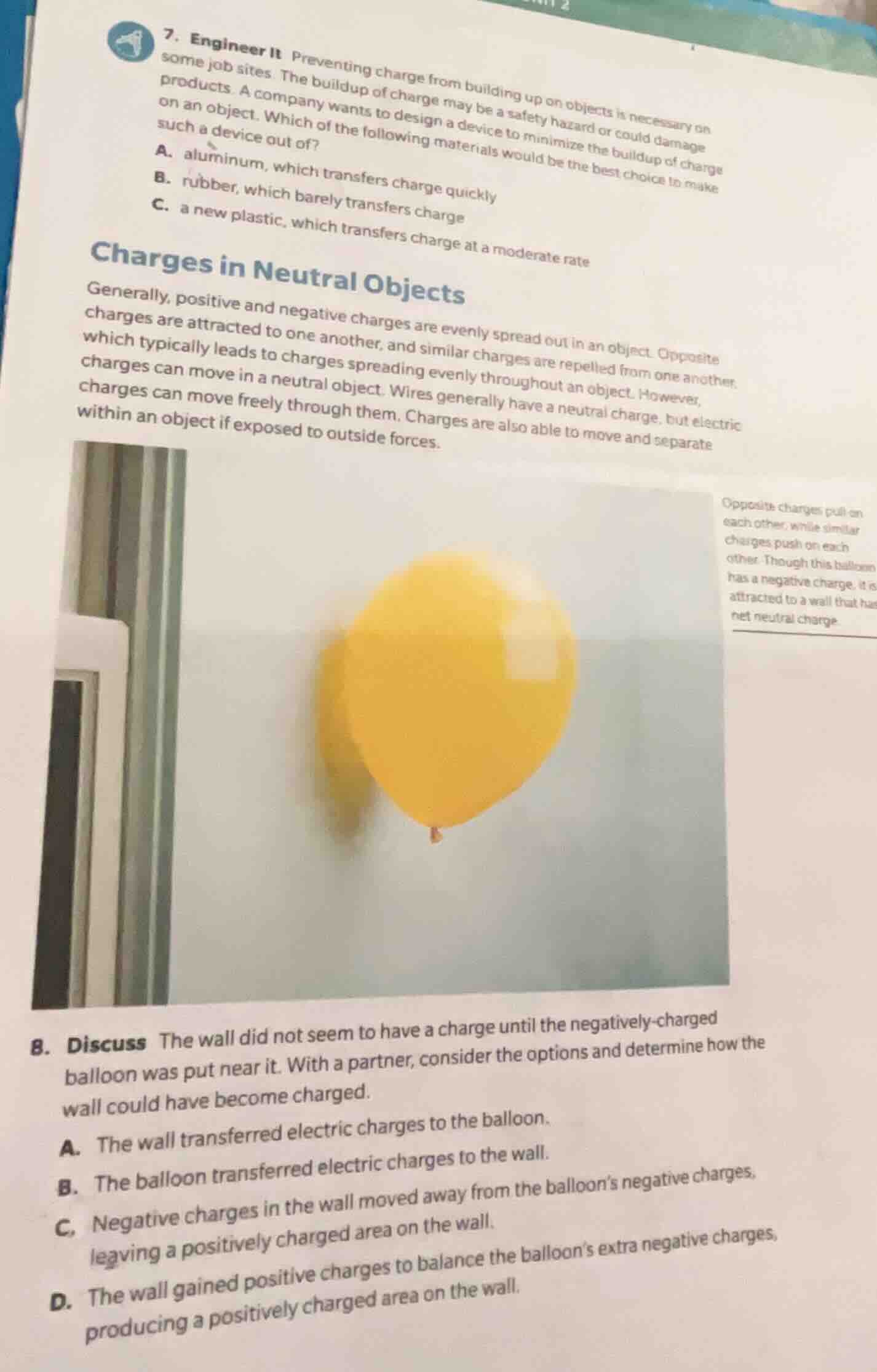
opposite charges pull on each other, while similar charges push on each other. though this balloon has a negative charge, it is attracted to a wall that has net neutral charge
- discuss the wall did not seem to have a charge until the negatively - charged balloon was put near it. with a partner, consider the options and determine how the wall could have become charged.
a. the wall transferred electric charges to the balloon.
b. the balloon transferred electric charges to the wall.
c. negative charges in the wall moved away from the balloon’s negative charges, leaving a positively charged area on the wall.
d. the wall gained positive charges to balance the balloon’s extra negative charges, producing a positively charged area on the wall.
First Question (Engineer It)
Step1: Identify goal: minimize charge buildup
To stop charge buildup, charge must be removed quickly.
Step2: Match material to requirement
Materials that transfer charge quickly (conductors) prevent buildup. Aluminum is a conductor, rubber/plastic are insulators.
When a negatively charged balloon is brought near a neutral wall, charge separation (polarization) occurs in the wall. The negative charges in the wall are repelled by the balloon's negative charge, moving away and leaving a positively charged region near the balloon, which creates the attraction. No charge transfer occurs; the wall remains neutral overall, just polarized.

Snap & solve any problem in the app
Get step-by-step solutions on Sovi AI
Photo-based solutions with guided steps
Explore more problems and detailed explanations
A. aluminum, which transfers charge quickly
---