QUESTION IMAGE
Question
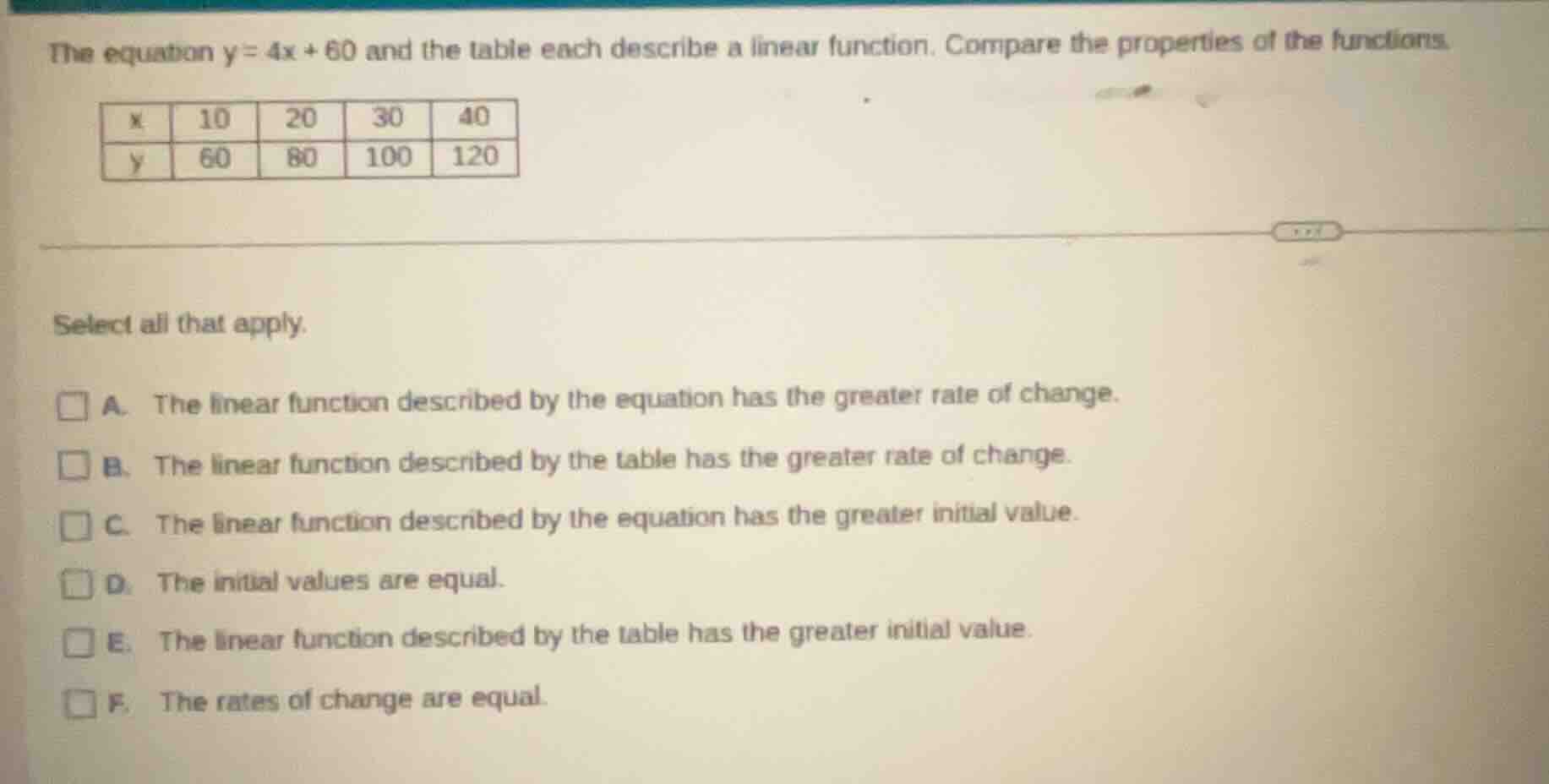
the equation $y = 4x + 60$ and the table each describe a linear function. compare the properties of the functions.\
\
| x | 10 | 20 | 30 | 40 | \ |
| y | 60 | 80 | 100 | 120 | \ |
\
select all that apply.\
\
a. the linear function described by the equation has the greater rate of change.\
\
b. the linear function described by the table has the greater rate of change.\
\
c. the linear function described by the equation has the greater initial value.\
\
d. the initial values are equal.\
\
e. the linear function described by the table has the greater initial value.\
\
f. the rates of change are equal.
Step1: Find rate of change for equation
The equation is \( y = 4x + 60 \), which is in slope - intercept form \( y=mx + b \), where \( m \) is the rate of change (slope). So the rate of change for the equation is \( m_1 = 4 \).
Step2: Find rate of change for table
For a linear function represented by a table, the rate of change (slope) is calculated using the formula \( m=\frac{y_2 - y_1}{x_2 - x_1} \). Let's take two points from the table, say \( (x_1,y_1)=(10,60) \) and \( (x_2,y_2)=(20,80) \). Then \( m_2=\frac{80 - 60}{20 - 10}=\frac{20}{10} = 2 \). We can check with other points, for example, \( (20,80) \) and \( (30,100) \): \( m_2=\frac{100 - 80}{30 - 20}=\frac{20}{10}=2 \), and \( (30,100) \) and \( (40,120) \): \( m_2=\frac{120 - 100}{40 - 30}=\frac{20}{10}=2 \). So the rate of change for the table is \( m_2 = 2 \).
Step3: Compare rates of change
Since \( 4>2 \), the rate of change of the function described by the equation is greater than that of the function described by the table.
Step4: Find initial value for equation
The initial value (y - intercept) of the equation \( y = 4x+60 \) is \( b_1 = 60 \) (when \( x = 0 \), \( y=60 \)).
Step5: Find initial value for table
To find the initial value (y - intercept) of the function in the table, we can use the slope - intercept form \( y=mx + b \). We know \( m = 2 \) and we can use a point, say \( (10,60) \). Substitute into \( y=mx + b \): \( 60=2\times10 + b \), so \( 60 = 20 + b \), then \( b=60 - 20=40 \). Let's verify with another point, \( (20,80) \): \( 80=2\times20 + b\Rightarrow80 = 40 + b\Rightarrow b = 40 \). So the initial value for the table is \( b_2=40 \).
Step6: Compare initial values
Since \( 60>40 \), the initial value of the function described by the equation is greater than that of the function described by the table.

Snap & solve any problem in the app
Get step-by-step solutions on Sovi AI
Photo-based solutions with guided steps
Explore more problems and detailed explanations
A. The linear function described by the equation has the greater rate of change.
C. The linear function described by the equation has the greater initial value.