QUESTION IMAGE
Question
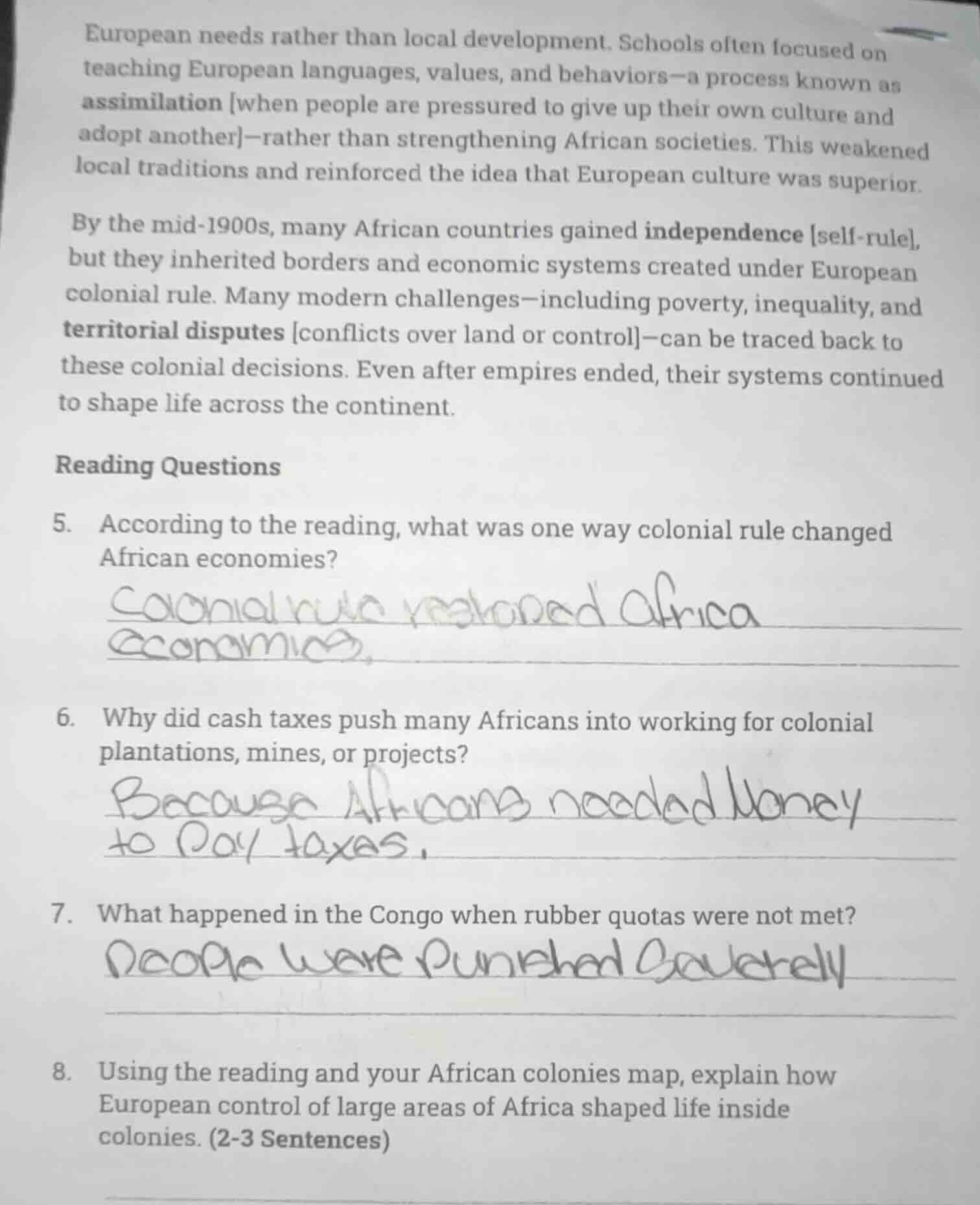
european needs rather than local development. schools often focused on teaching european languages, values, and behaviors—a process known as assimilation when people are pressured to give up their own culture and adopt another—rather than strengthening african societies. this weakened local traditions and reinforced the idea that european culture was superior.
by the mid - 1900s, many african countries gained independence self - rule, but they inherited borders and economic systems created under european colonial rule. many modern challenges—including poverty, inequality, and territorial disputes conflicts over land or control—can be traced back to these colonial decisions. even after empires ended, their systems continued to shape life across the continent.
reading questions
- according to the reading, what was one way colonial rule changed african economies?
- why did cash taxes push many africans into working for colonial plantations, mines, or projects?
- what happened in the congo when rubber quotas were not met?
- using the reading and your african colonies map, explain how european control of large areas of africa shaped life inside colonies. (2 - 3 sentences)
- For question 5: The reading states that post-independence African nations inherited economic systems created under European colonial rule, which laid the groundwork for modern economic struggles like poverty and inequality.
- For question 6: The provided handwritten answer aligns with the core logic—cash taxes required Africans to earn money, forcing them into colonial labor jobs to pay the taxes.
- For question 7: The handwritten answer is consistent with historical context tied to the reading's colonial exploitation theme; failure to meet rubber quotas in the Congo led to severe punishment of the local population.
- For question 8: European control reoriented African economies to serve European needs rather than local development, undermining traditional systems. Colonial schools pushed cultural assimilation, weakening local traditions and enforcing the idea of European cultural superiority. Additionally, the inherited colonial borders and economic structures continued to create challenges like territorial disputes and poverty long after independence.

Snap & solve any problem in the app
Get step-by-step solutions on Sovi AI
Photo-based solutions with guided steps
Explore more problems and detailed explanations
- Colonial powers established economic systems in Africa that were designed to serve European needs, and these systems were inherited by independent African nations, leading to modern economic challenges such as poverty and inequality.
- Because Africans needed money to pay the required cash taxes.
- People were punished severely.
- European control shaped colonial life by restructuring economies to prioritize European needs over local development, leaving independent nations with systems that fueled poverty and inequality. It also forced cultural assimilation through schools, weakening African traditions and promoting the idea of European cultural superiority. Additionally, the arbitrary colonial borders created under European rule led to ongoing territorial disputes that disrupted stability across the continent.