QUESTION IMAGE
Question
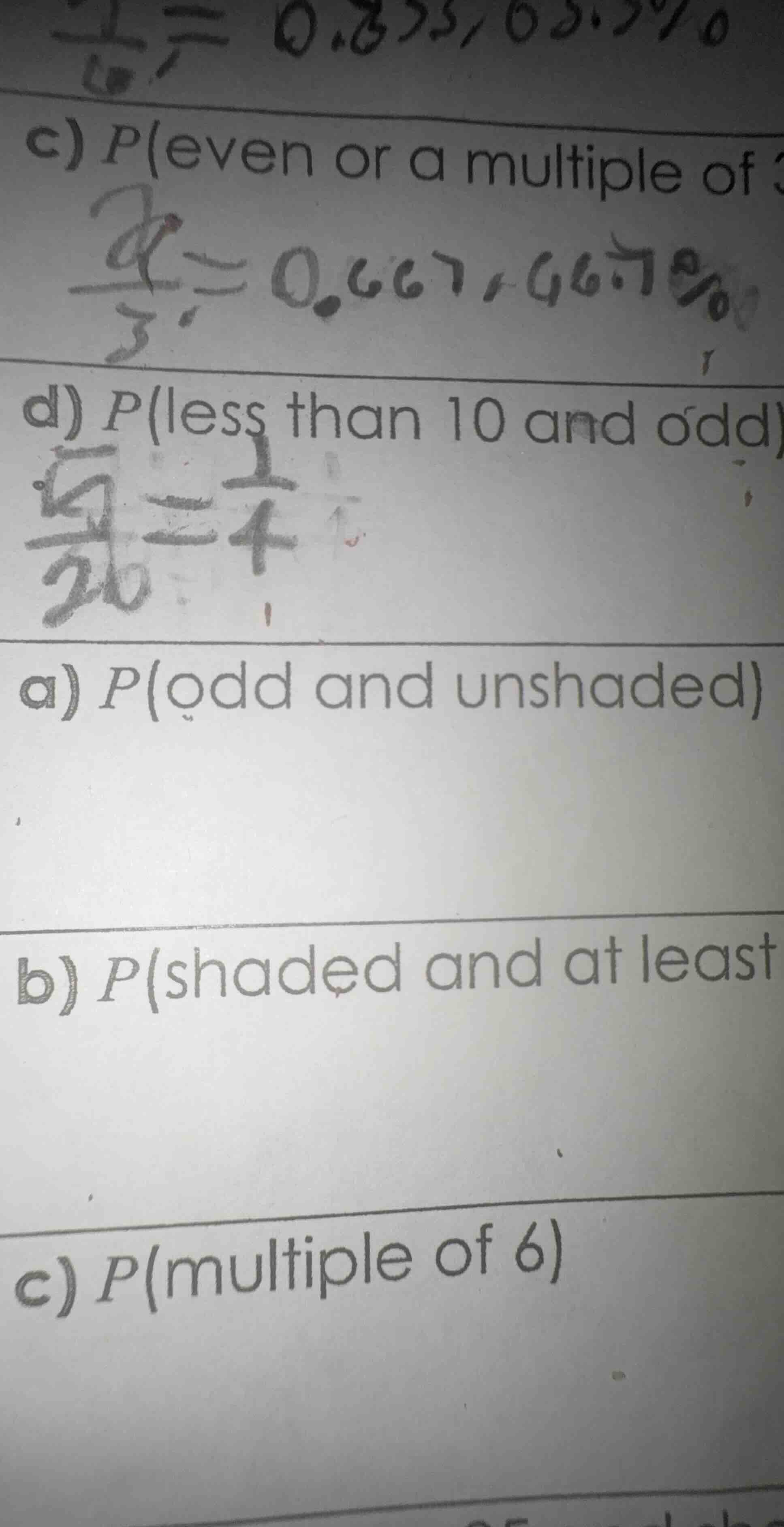
c) p(even or a multiple of
d) p(less than 10 and odd)
a) p(odd and unshaded)
b) p(shaded and at least
c) p(multiple of 6))
To solve these probability problems, we assume we are dealing with a set of numbers (likely from 1 to 20 or a similar range, given the denominators like 20 in part d). Let's solve part (c) \( P(\text{multiple of 6}) \) as an example (assuming the total number of outcomes \( n(S) = 20 \), common in such problems):
Step 1: Identify multiples of 6
Multiples of 6 within a reasonable range (e.g., 1–20) are: 6, 12, 18. So there are 3 favorable outcomes.
Step 2: Calculate probability
Probability \( P(A) = \frac{\text{Number of favorable outcomes}}{\text{Total number of outcomes}} \).
If \( n(S) = 20 \), then:
\( P(\text{multiple of 6}) = \frac{3}{20} = 0.15 \) (or 15%).
Note for other parts:
- For part (a) \( P(\text{odd and unshaded}) \), we need to know which numbers are odd and unshaded (missing diagram details, but the process is: count odd + unshaded, divide by total).
- For part (b) \( P(\text{shaded and at least [X]}) \), define "at least X" (e.g., at least 10) and count shaded numbers meeting that, divide by total.
- For part (d) \( P(\text{less than 10 and odd}) \), numbers less than 10 and odd: 1, 3, 5, 7, 9 (5 numbers). If total is 20, \( P = \frac{5}{20} = \frac{1}{4} \) (matches the handwritten note).
Example Answer (for part c, assuming total = 20):
\( \boldsymbol{\frac{3}{20}} \) (or 0.15, 15%).
If the total number of outcomes differs (e.g., 1–12), adjust accordingly. For example, in 1–12, multiples of 6 are 6, 12 (2 numbers), so \( P = \frac{2}{12} = \frac{1}{6} \approx 0.167 \).
Please provide the full context (e.g., range of numbers, shaded/unshaded details) for precise answers to all parts.

Snap & solve any problem in the app
Get step-by-step solutions on Sovi AI
Photo-based solutions with guided steps
Explore more problems and detailed explanations
To solve these probability problems, we assume we are dealing with a set of numbers (likely from 1 to 20 or a similar range, given the denominators like 20 in part d). Let's solve part (c) \( P(\text{multiple of 6}) \) as an example (assuming the total number of outcomes \( n(S) = 20 \), common in such problems):
Step 1: Identify multiples of 6
Multiples of 6 within a reasonable range (e.g., 1–20) are: 6, 12, 18. So there are 3 favorable outcomes.
Step 2: Calculate probability
Probability \( P(A) = \frac{\text{Number of favorable outcomes}}{\text{Total number of outcomes}} \).
If \( n(S) = 20 \), then:
\( P(\text{multiple of 6}) = \frac{3}{20} = 0.15 \) (or 15%).
Note for other parts:
- For part (a) \( P(\text{odd and unshaded}) \), we need to know which numbers are odd and unshaded (missing diagram details, but the process is: count odd + unshaded, divide by total).
- For part (b) \( P(\text{shaded and at least [X]}) \), define "at least X" (e.g., at least 10) and count shaded numbers meeting that, divide by total.
- For part (d) \( P(\text{less than 10 and odd}) \), numbers less than 10 and odd: 1, 3, 5, 7, 9 (5 numbers). If total is 20, \( P = \frac{5}{20} = \frac{1}{4} \) (matches the handwritten note).
Example Answer (for part c, assuming total = 20):
\( \boldsymbol{\frac{3}{20}} \) (or 0.15, 15%).
If the total number of outcomes differs (e.g., 1–12), adjust accordingly. For example, in 1–12, multiples of 6 are 6, 12 (2 numbers), so \( P = \frac{2}{12} = \frac{1}{6} \approx 0.167 \).
Please provide the full context (e.g., range of numbers, shaded/unshaded details) for precise answers to all parts.