QUESTION IMAGE
Question
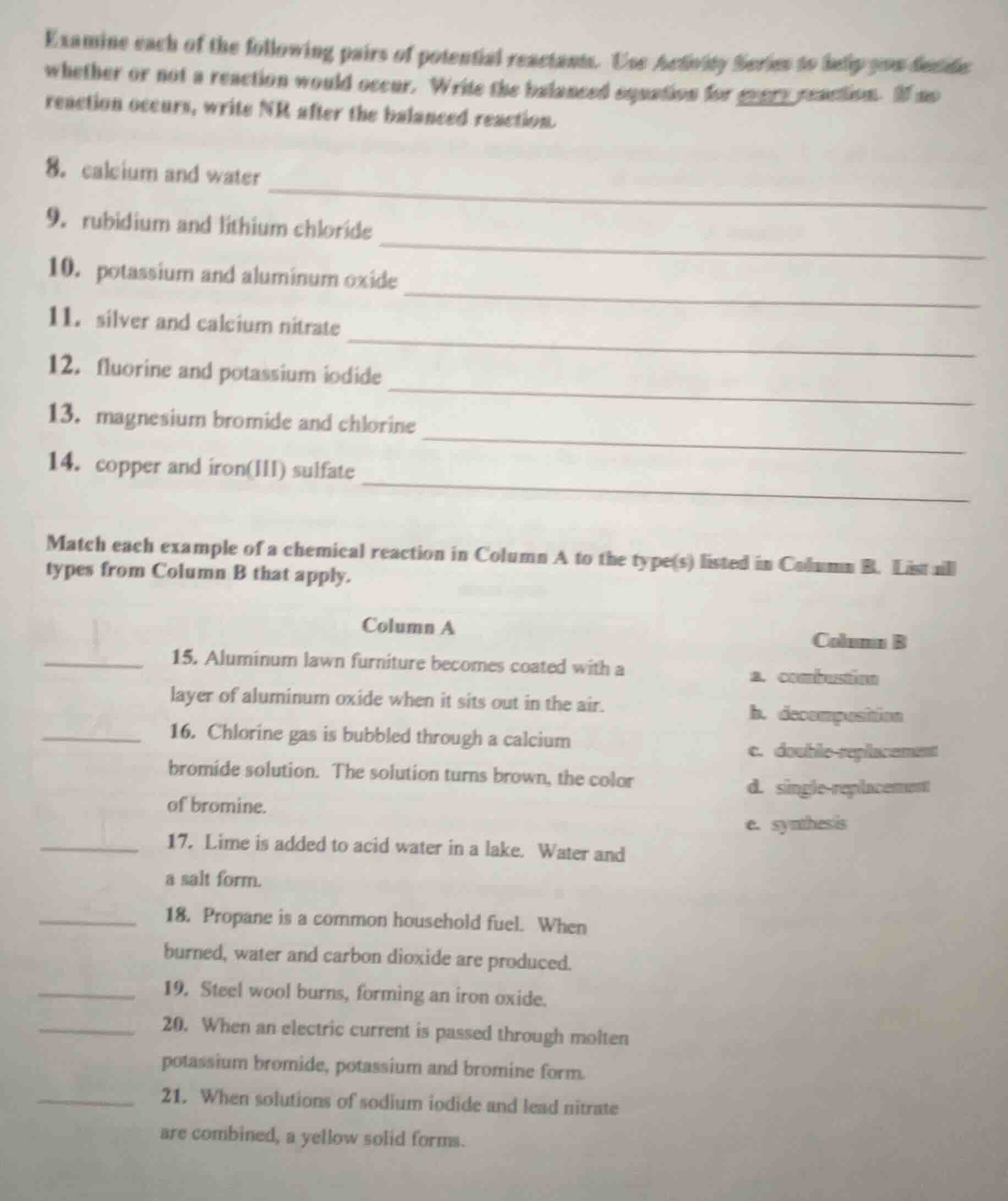
examine each of the following pairs of potential reactants. use activity series to help you decide whether or not a reaction would occur. write the balanced equation for every reaction. if no reaction occurs, write nr after the balanced reaction.
- calcium and water
- rubidium and lithium chloride
- potassium and aluminum oxide
- silver and calcium nitrate
- fluorine and potassium iodide
- magnesium bromide and chlorine
- copper and iron(iii) sulfate
match each example of a chemical reaction in column a to the type(s) listed in column b. list all types from column b that apply.
column a\tcolumn b
- aluminum lawn furniture becomes coated with a layer of aluminum oxide when it sits out in the air.\ta. combustion
- chlorine gas is bubbled through a calcium bromide solution. the solution turns brown, the color of bromine.\tb. decomposition
- lime is added to acid water in a lake. water and a salt form.\tc. double-replacement
- propane is a common household fuel. when burned, water and carbon dioxide are produced.\td. single-replacement
- steel wool burns, forming an iron oxide.\te. synthesis
- when an electric current is passed through molten potassium bromide, potassium and bromine form.
- when solutions of sodium iodide and lead nitrate are combined, a yellow solid forms.
(Problems 8-14):
Step1: Check reactivity, write unbalanced eq
8. Calcium + water:
$\text{Ca}(s) + \text{H}_2\text{O}(l)
ightarrow \text{Ca(OH)}_2(aq) + \text{H}_2(g)$
9. Rubidium + lithium chloride:
$\text{Rb}(s) + \text{LiCl}(aq)
ightarrow \text{RbCl}(aq) + \text{Li}(s)$
10. Potassium + aluminum oxide:
$\text{K}(s) + \text{Al}_2\text{O}_3(s)
ightarrow \text{K}_2\text{O}(s) + \text{Al}(s)$
11. Silver + calcium nitrate:
$\text{Ag}(s) + \text{Ca(NO}_3\text{)}_2(aq)
ightarrow \text{NR}$
12. Fluorine + potassium iodide:
$\text{F}_2(g) + \text{KI}(aq)
ightarrow \text{KF}(aq) + \text{I}_2(s)$
13. Magnesium bromide + chlorine:
$\text{MgBr}_2(aq) + \text{Cl}_2(g)
ightarrow \text{MgCl}_2(aq) + \text{Br}_2(l)$
14. Copper + iron(III) sulfate:
$\text{Cu}(s) + \text{Fe}_2(\text{SO}_4)_3(aq)
ightarrow \text{CuSO}_4(aq) + \text{FeSO}_4(aq)$
Step2: Balance each valid equation
8. Balance H, O:
$\text{Ca}(s) + 2\text{H}_2\text{O}(l)
ightarrow \text{Ca(OH)}_2(aq) + \text{H}_2(g)$
9. Balance all elements:
$2\text{Rb}(s) + 2\text{LiCl}(aq)
ightarrow 2\text{RbCl}(aq) + 2\text{Li}(s)$
10. Balance K, Al, O:
$6\text{K}(s) + \text{Al}_2\text{O}_3(s)
ightarrow 3\text{K}_2\text{O}(s) + 2\text{Al}(s)$
12. Balance K, I, F:
$\text{F}_2(g) + 2\text{KI}(aq)
ightarrow 2\text{KF}(aq) + \text{I}_2(s)$
13. Balance Br, Cl:
$\text{MgBr}_2(aq) + \text{Cl}_2(g)
ightarrow \text{MgCl}_2(aq) + \text{Br}_2(l)$
14. Balance Fe, Cu, sulfate:
$\text{Cu}(s) + \text{Fe}_2(\text{SO}_4)_3(aq)
ightarrow \text{CuSO}_4(aq) + 2\text{FeSO}_4(aq)$
(Problems 15-21):
Step1: Identify reaction type(s)
15. Al + O₂ → Al₂O₃: Synthesis (combining 2 substances)
16. Cl₂ + CaBr₂ → CaCl₂ + Br₂: Single-replacement (Cl replaces Br)
17. Acid + base → salt + water: Double-replacement (neutralization)
18. C₃H₈ + O₂ → CO₂ + H₂O: Combustion (fuel + O₂ → oxides)
19. Fe + O₂ → Fe₃O₄/Fe₂O₃: Synthesis (combining 2 substances) + Combustion (reaction with O₂ to form oxide)
20. KBr → K + Br₂: Decomposition (single compound breaks down)
21. NaI + Pb(NO₃)₂ → PbI₂ + NaNO₃: Double-replacement (ions swap to form precipitate)

Snap & solve any problem in the app
Get step-by-step solutions on Sovi AI
Photo-based solutions with guided steps
Explore more problems and detailed explanations
8. $\text{Ca}(s) + 2\text{H}_2\text{O}(l)
ightarrow \text{Ca(OH)}_2(aq) + \text{H}_2(g)$
9. $2\text{Rb}(s) + 2\text{LiCl}(aq)
ightarrow 2\text{RbCl}(aq) + 2\text{Li}(s)$
10. $6\text{K}(s) + \text{Al}_2\text{O}_3(s)
ightarrow 3\text{K}_2\text{O}(s) + 2\text{Al}(s)$
11. $\text{Ag}(s) + \text{Ca(NO}_3\text{)}_2(aq)
ightarrow \text{NR}$
12. $\text{F}_2(g) + 2\text{KI}(aq)
ightarrow 2\text{KF}(aq) + \text{I}_2(s)$
13. $\text{MgBr}_2(aq) + \text{Cl}_2(g)
ightarrow \text{MgCl}_2(aq) + \text{Br}_2(l)$
14. $\text{Cu}(s) + \text{Fe}_2(\text{SO}_4)_3(aq)
ightarrow \text{CuSO}_4(aq) + 2\text{FeSO}_4(aq)$