QUESTION IMAGE
Question
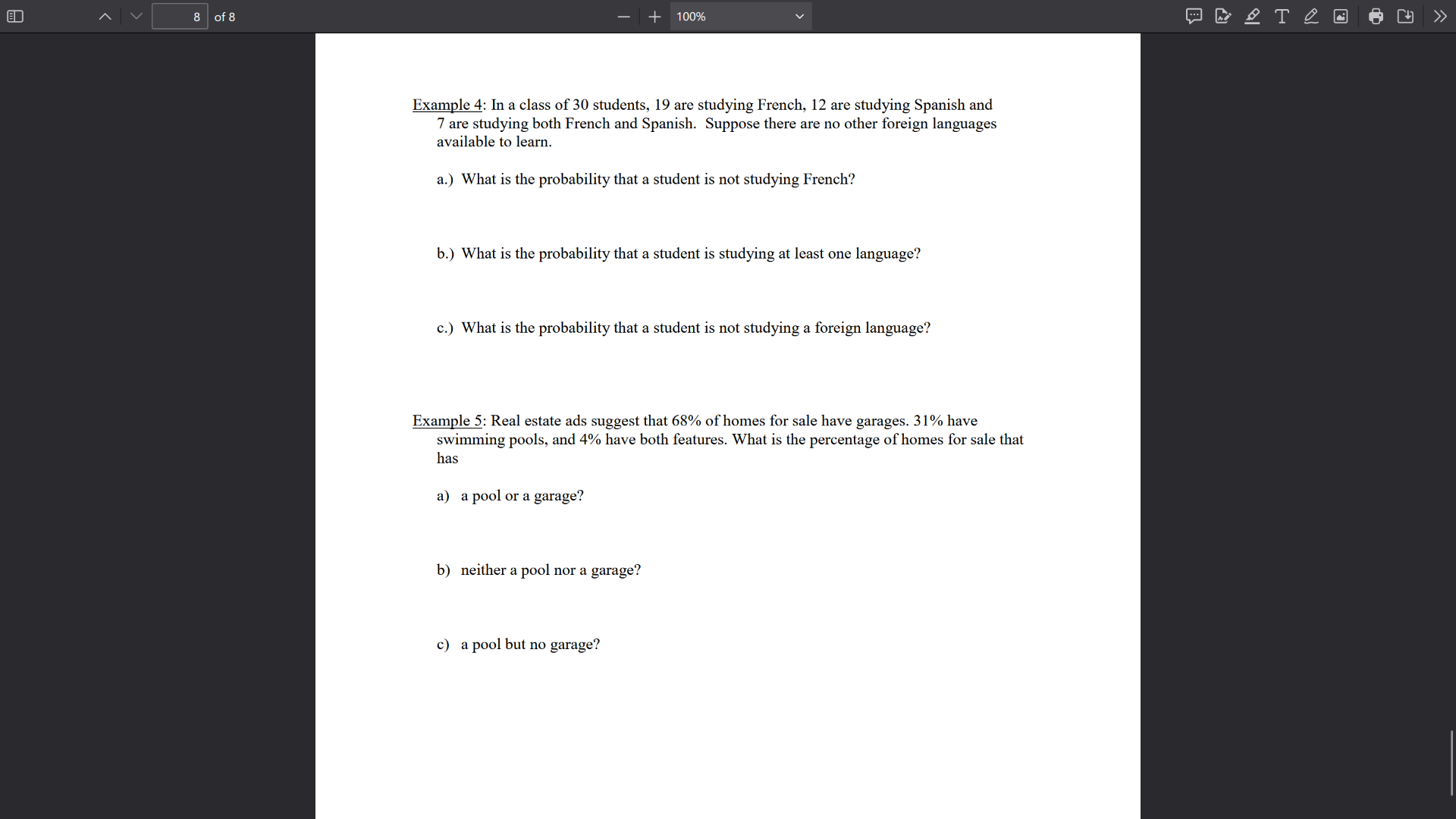
example 4: in a class of 30 students, 19 are studying french, 12 are studying spanish and 7 are studying both french and spanish. suppose there are no other foreign languages available to learn.
a.) what is the probability that a student is not studying french?
b.) what is the probability that a student is studying at least one language?
c.) what is the probability that a student is not studying a foreign language?
example 5: real estate ads suggest that 68% of homes for sale have garages. 31% have swimming pools, and 4% have both features. what is the percentage of homes for sale that has
a) a pool or a garage?
b) neither a pool nor a garage?
c) a pool but no garage?
(Example 4):
Step1: Find non-French students
Total students: 30; French students: 19
Non-French students: $30 - 19 = 11$
Probability: $\frac{11}{30}$
Step2: Calculate students in at least one language
Use principle of inclusion-exclusion:
Number of students in at least one language = $19 + 12 - 7 = 24$
Probability: $\frac{24}{30} = \frac{4}{5}$
Step3: Find students not studying any language
Total students minus those in at least one language: $30 - 24 = 6$
Probability: $\frac{6}{30} = \frac{1}{5}$
(Example 5):
Step1: Calculate % with pool or garage
Use inclusion-exclusion principle:
$P(\text{pool or garage}) = 68\% + 31\% - 4\% = 95\%$
Step2: Calculate % with neither feature
Subtract above from 100%:
$100\% - 95\% = 5\%$
Step3: Calculate % with pool but no garage
Subtract those with both from pool owners:
$31\% - 4\% = 27\%$

Snap & solve any problem in the app
Get step-by-step solutions on Sovi AI
Photo-based solutions with guided steps
Explore more problems and detailed explanations
Example 4:
a.) $\frac{11}{30}$
b.) $\frac{4}{5}$
c.) $\frac{1}{5}$
Example 5:
a.) 95%
b.) 5%
c.) 27%