QUESTION IMAGE
Question
exemplar 3
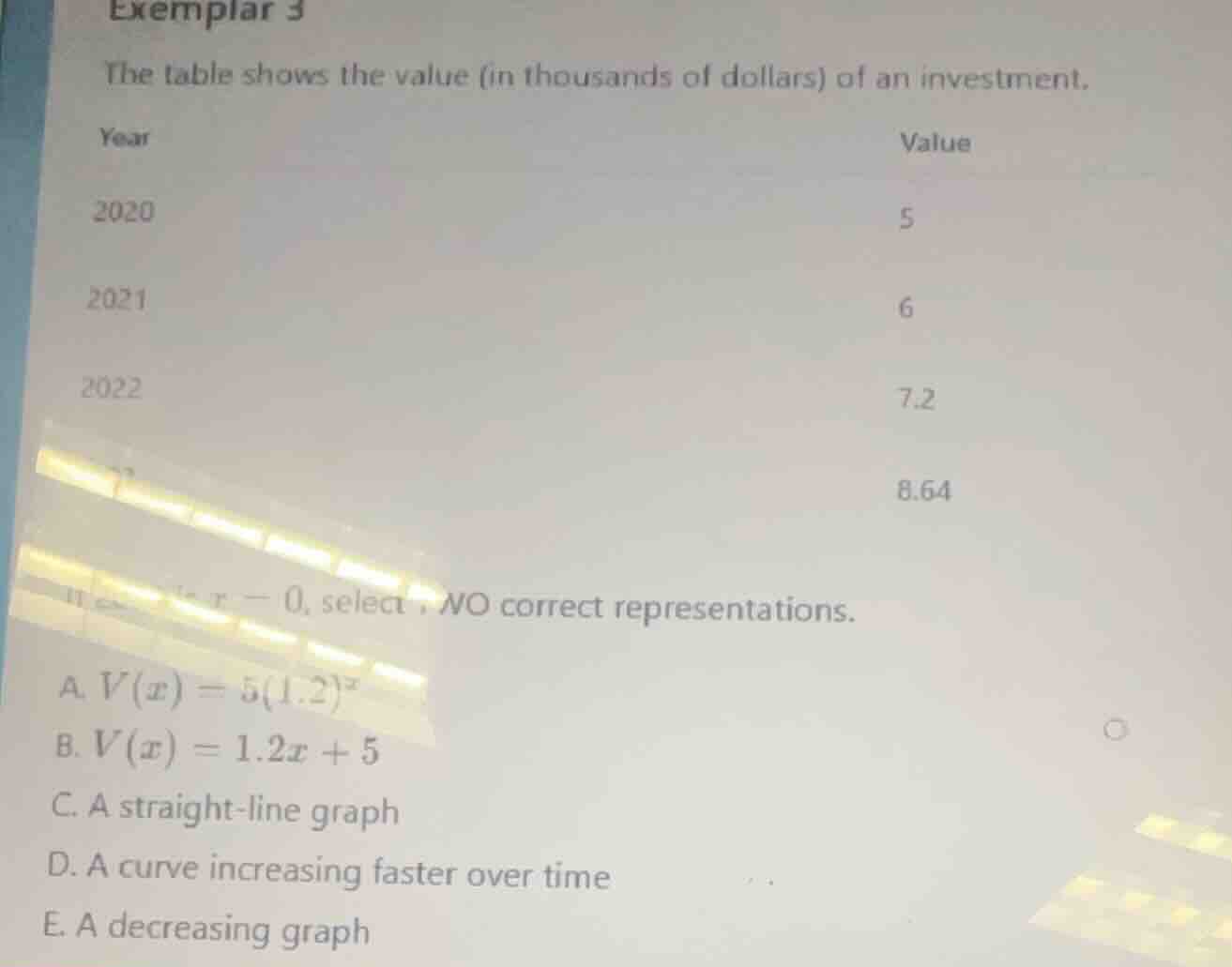
the table shows the value (in thousands of dollars) of an investment.
year\tvalue
2020\t5
2021\t6
2022\t7.2
\t8.64
x = 0, select no correct representations.
a. $v(x) = 5(1.2)^x$
b. $v(x) = 1.2x + 5$
c. a straight - line graph
d. a curve increasing faster over time
e. a decreasing graph
Step1: Analyze Option A
Check if \( V(x) = 5(1.2)^x \) fits the data. For \( x = 0 \) (2020), \( V(0)=5(1.2)^0 = 5 \), which matches. For \( x = 1 \) (2021), \( V(1)=5(1.2)^1 = 6 \), matches. For \( x = 2 \) (2022), \( V(2)=5(1.2)^2 = 5\times1.44 = 7.2 \), matches. For \( x = 3 \), \( V(3)=5(1.2)^3 = 5\times1.728 = 8.64 \), matches. So A is correct.
Step2: Analyze Option B
The function \( V(x)=1.2x + 5 \) is linear. For \( x = 1 \), \( V(1)=1.2 + 5 = 6.2
eq6 \), so B is incorrect.
Step3: Analyze Option C
Since the relationship is exponential (from A), not linear, it won't be a straight - line graph. So C is incorrect.
Step4: Analyze Option D
The function \( V(x)=5(1.2)^x \) is an exponential growth function with a growth factor \( 1.2>1 \). Exponential growth functions increase faster over time (the rate of growth increases as \( x \) increases). So D is correct.
Step5: Analyze Option E
The values are increasing (5, 6, 7.2, 8.64), so it's not a decreasing graph. E is incorrect.

Snap & solve any problem in the app
Get step-by-step solutions on Sovi AI
Photo-based solutions with guided steps
Explore more problems and detailed explanations
A. \( V(x) = 5(1.2)^x \)
D. A curve increasing faster over time