QUESTION IMAGE
Question
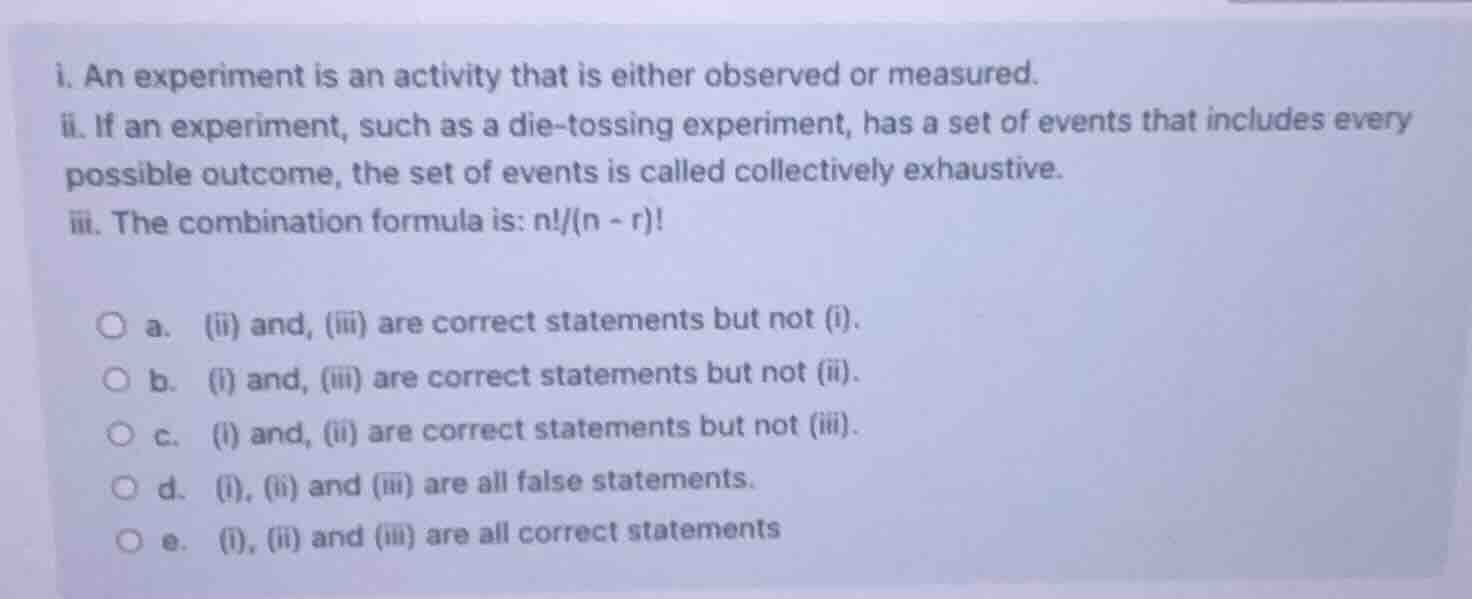
i. an experiment is an activity that is either observed or measured. ii. if an experiment, such as a die-tossing experiment, has a set of events that includes every possible outcome, the set of events is called collectively exhaustive. iii. the combination formula is: n!/(n - r)! a. (ii) and, (iii) are correct statements but not (i). b. (i) and, (iii) are correct statements but not (ii). c. (i) and, (ii) are correct statements but not (iii). d. (i), (ii) and (iii) are all false statements. e. (i), (ii) and (iii) are all correct statements
- For statement (i): An experiment in statistics is indeed an activity that can be observed or measured to record outcomes, so this is correct.
- For statement (ii): A collectively exhaustive set of events is defined as a set that includes every possible outcome of an experiment (like the 6 faces of a die covering all results of a die toss), so this is correct.
- For statement (iii): The combination formula is $\frac{n!}{r!(n-r)!}$, while $\frac{n!}{(n-r)!}$ is the permutation formula. So this statement is incorrect.

Snap & solve any problem in the app
Get step-by-step solutions on Sovi AI
Photo-based solutions with guided steps
Explore more problems and detailed explanations
c. (i) and, (ii) are correct statements but not (iii).