QUESTION IMAGE
Question
1 explain how golding’s own life experiences influenced his writing. you must be specific
lord of the flies background information & context
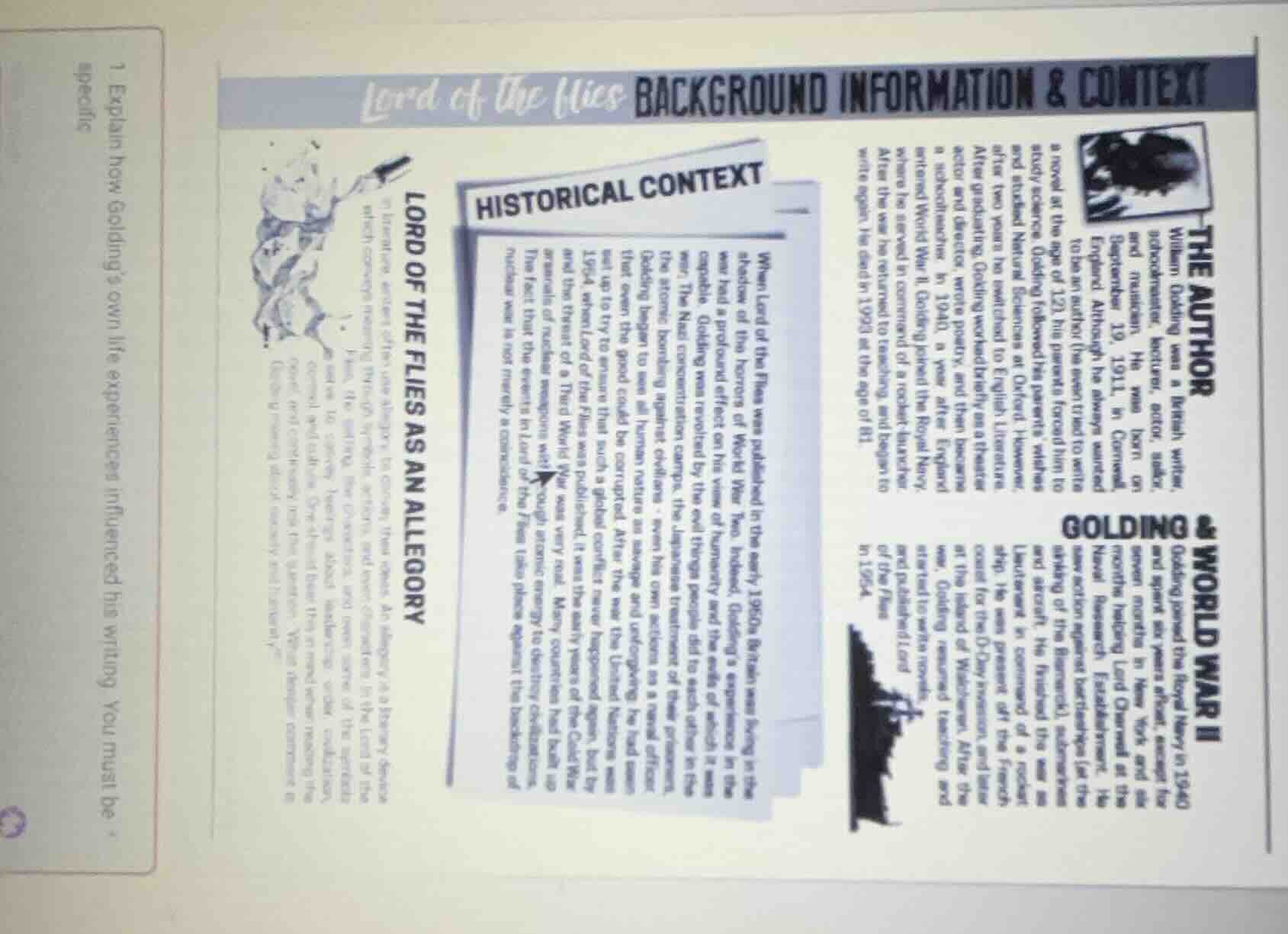
the author
william golding was a british writer, schoolmaster, lecturer, actor, and translator. born on september 19, 1911, in cornwall, england, although he always wanted to be an author (he even tried to write a novel at the age of 12), his parents forced him to study science (golding followed his parents’ wishes and studied natural sciences at oxford, however, after two years he switched to english literature. after graduating, golding worked briefly as a theater actor and director, wrote poetry, and then became a schoolteacher. in 1940, a few months after he was involved in the second world war (golding joined the royal navy, where he was involved in researching and beginning to write again), he retired in 1983 at the age of 81.
golding & world war ii
golding joined the royal navy in 1940 and spent six years in naval work, except for a brief interval in new york and the never-ending lord of the flies research, development, and action (he almost lost his life in the sinking of the bismarck), submarine and aircraft. he finished the war as lieutenant in command of a rocket ship. he was present at the french coast for the d-day invasion, and later was guiding rockets. after the war, he returned to teaching and published his first novel, lord of the flies, in 1954.
historical context
when lord of the flies was published in the early 1950s, britain was living in the shadow of the horrors of world war two, indeed, golding’s experiences in the war had a profound effect on his view of humanity and the evils of which it was capable. golding was revolted by the evil things people did to each other in the war. the nazi concentration camps, the japanese treatment of the prisoners, the atomic bombing against civilian - even his own actions as a naval officer (golding began to see that the good side of human nature is savage and unforgiving, he had seen men up to try to ensure that he could be corrupted after the war. the united nations was set up to try to ensure that such global conflicts never happened again, but by 1954, when lord of the flies was published, it was the early years of the cold war and the threat of a third world war was very real. many countries had been run by generals of nuclear weapons, though atomic energy to destroy civilizations. the fact that the events in lord of the flies take place against the backdrop of nuclear war is not merely a coincidence.
lord of the flies as an allegory
in literature, an author often uses a story and then uses an allegory (a story in which concrete items, people, or events represent abstract ideas or moral qualities). in lord of the flies, golding uses the characters and events to symbolize aspects of human nature and society. the island represents the world, the boys represent humanity, and the conflict between ralph and jack represents the conflict between civilization and savagery. the beast represents the evil within each person, and the conch shell represents order and democracy. by using these symbols, golding explores the idea that without the rules and order of civilization, human beings will revert to their savage and violent nature.
- Parental & Early Academic Influence: Golding's parents pushed him to study science, but he switched to English Literature, laying his writing foundation; his early failed novel attempt showed his persistent authorial ambition.
- World War II Military Experience: His 6-year naval service (combat, D-Day, rocket command) exposed him to extreme human cruelty and violence, shaping his grim view of human nature.
- Post-War Teaching & Reflection: Returning to teaching after the war, he observed children's unruliness, which mirrored the breakdown of order he saw in war, informing the novel's premise of civilized kids descending into savagery.
- Cold War Historical Context: The post-WWII threat of nuclear war and global conflict reinforced his belief in humanity's capacity for corruption, which became a core theme in Lord of the Flies.

Snap & solve any problem in the app
Get step-by-step solutions on Sovi AI
Photo-based solutions with guided steps
Explore more problems and detailed explanations
Golding's life experiences shaped his writing in four key ways:
- His early push to study science followed by a switch to English Literature, plus his early novel attempt, built his literary skills and authorial drive.
- His 6-year Royal Navy service in WWII, including combat, D-Day, and witnessing wartime cruelty, led him to develop a grim view of inherent human savagery, a central theme of Lord of the Flies.
- Post-war teaching allowed him to observe children's capacity for chaos, which inspired the novel's plot of civilized boys descending into violence without adult structure.
- The post-WWII Cold War and nuclear threat context reinforced his belief in humanity's potential for self-destruction, which is reflected in the novel's allegory of societal collapse.