QUESTION IMAGE
Question
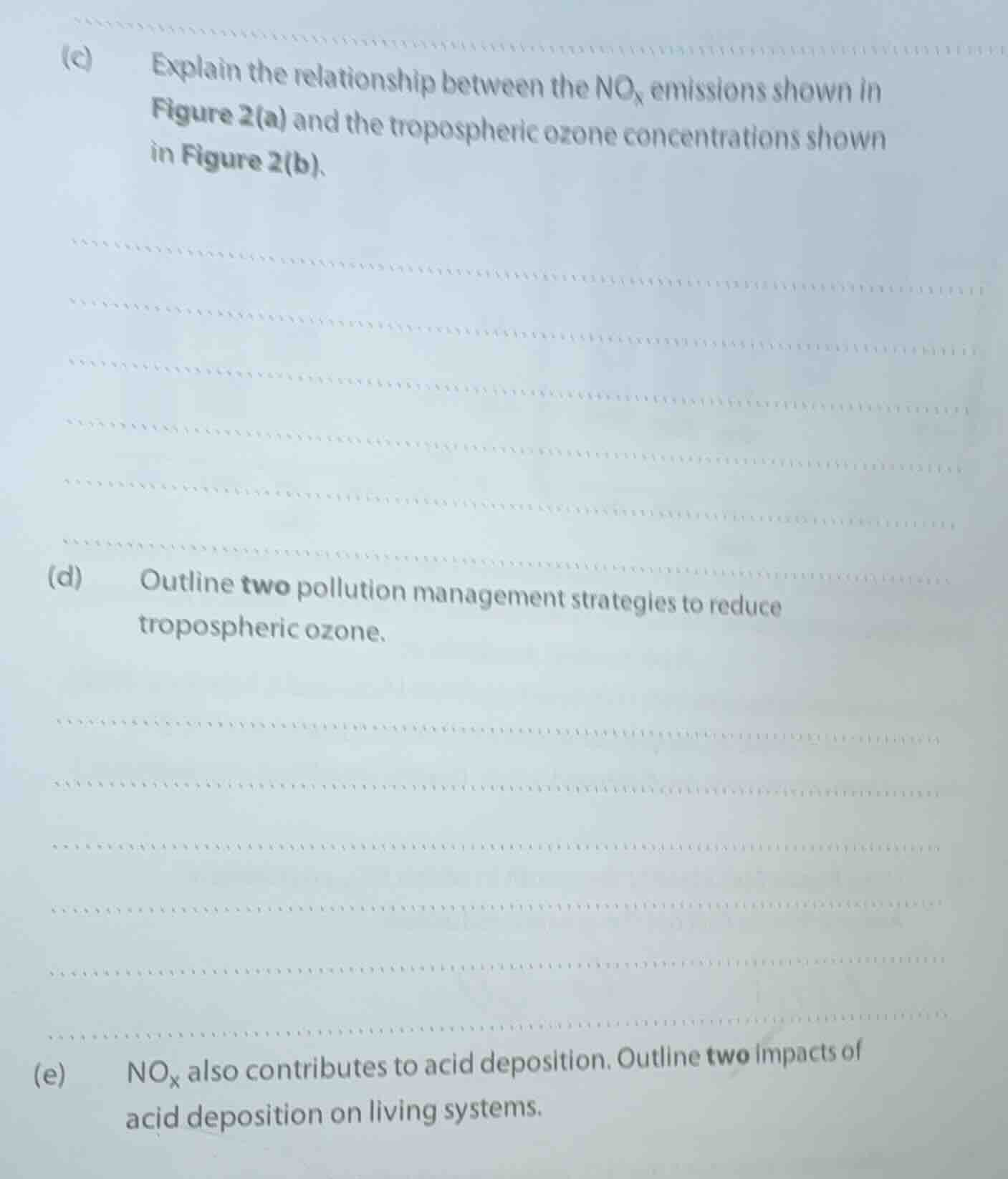
(c) explain the relationship between the noₓ emissions shown in figure 2(a) and the tropospheric ozone concentrations shown in figure 2(b).
(d) outline two pollution management strategies to reduce tropospheric ozone.
(e) noₓ also contributes to acid deposition. outline two impacts of acid deposition on living systems.
For (c):
NOₓ (nitrogen oxides) are precursor chemicals for tropospheric ozone. In sunlight, NOₓ reacts with volatile organic compounds (VOCs) and oxygen to form tropospheric ozone. So regions/time periods with higher NOₓ emissions (Figure 2(a)) will generally show higher tropospheric ozone concentrations (Figure 2(b)), assuming sufficient sunlight and VOCs are present.
For (d):
- Source control of NOₓ and VOCs: Require vehicles and industrial facilities to use catalytic converters or low-emission technologies to cut NOₓ and VOC releases, reducing ozone-forming reactants.
- Emission reduction policies: Implement cap-and-trade systems or strict emissions standards for power plants, factories, and transportation to limit overall NOₓ and VOC emissions.
For (e):
- Terrestrial ecosystem harm: Acid deposition leaches essential nutrients like calcium and magnesium from soil, and releases toxic aluminum, stunting plant growth and reducing forest health.
- Aquatic ecosystem harm: Acidified surface waters lower pH, which is lethal to many aquatic organisms (e.g., salmon larvae, amphibians) that cannot tolerate acidic conditions, disrupting food webs.

Snap & solve any problem in the app
Get step-by-step solutions on Sovi AI
Photo-based solutions with guided steps
Explore more problems and detailed explanations
(c)
NOₓ is a key precursor for tropospheric ozone. Under sunlight, NOₓ reacts with VOCs and oxygen to produce tropospheric ozone, so higher NOₓ emissions correspond to higher tropospheric ozone concentrations (when sunlight and VOCs are available).
(d)
- Mandate catalytic converters in vehicles to cut NOₓ/VOC emissions.
- Enforce industrial emissions standards for NOₓ and VOCs.
(e)
- Reduces forest health by depleting soil nutrients and releasing toxic metals.
- Kills aquatic organisms (e.g., fish larvae) in acidified waters, breaking food chains.