QUESTION IMAGE
Question
explaining trends in ionization energy
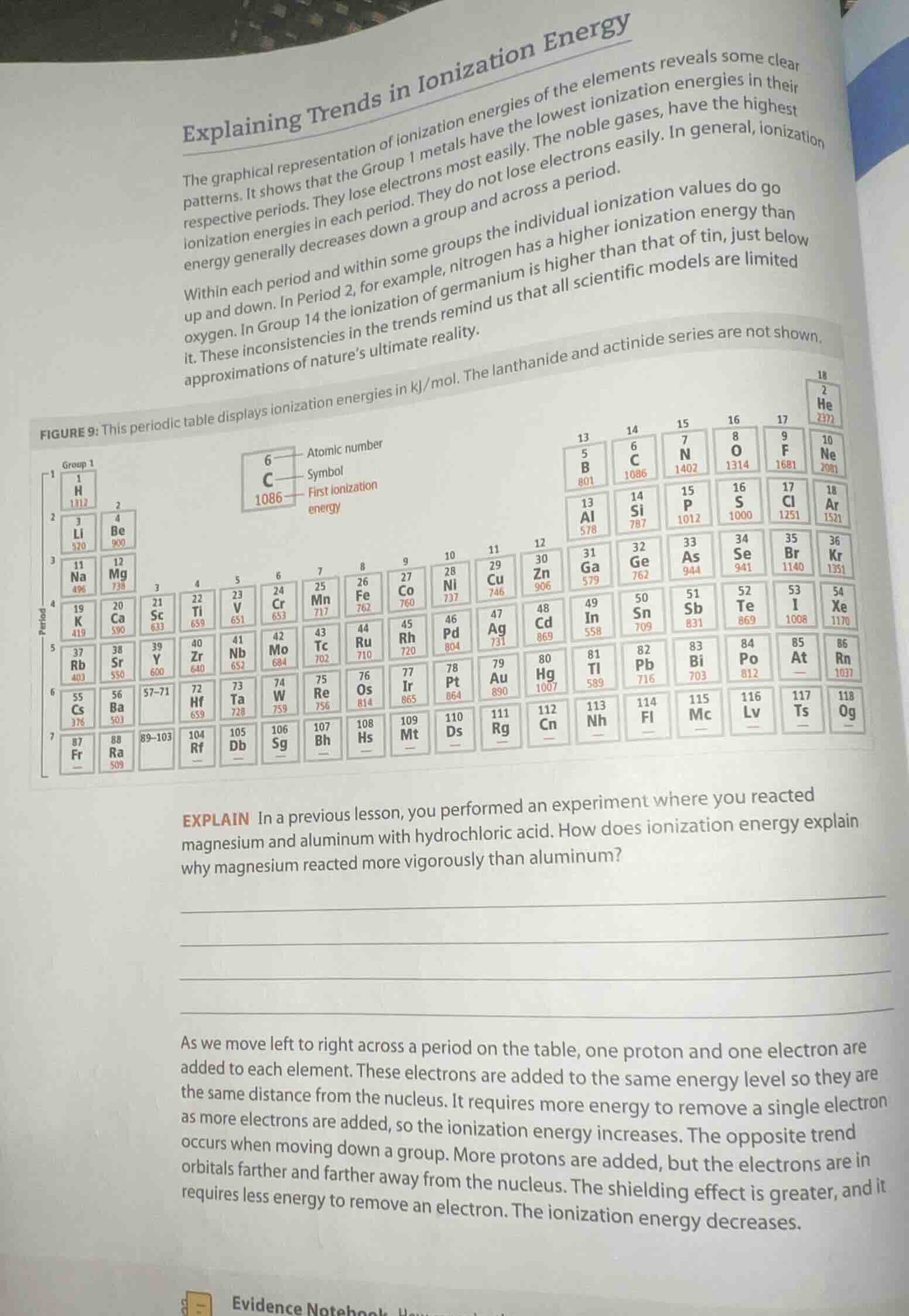
the graphical representation of ionization energies of the elements reveals some clear patterns. it shows that the group 1 metals have the lowest ionization energies in their respective periods. they lose electrons most easily. the noble gases, have the highest ionization energies in each period. they do not lose electrons easily. in general, ionization energy generally decreases down a group and across a period.
within each period and within some groups the individual ionization values do go up and down. in period 2, for example, nitrogen has a higher ionization energy than oxygen. in group 14 the ionization of germanium is higher than that of tin, just below it. these inconsistencies in the trends remind us that all scientific models are limited approximations of nature’s ultimate reality.
figure 9: this periodic table displays ionization energies in kj/mol. the lanthanide and actinide series are not shown.
explain in a previous lesson, you performed an experiment where you reacted magnesium and aluminum with hydrochloric acid. how does ionization energy explain why magnesium reacted more vigorously than aluminum?
as we move left to right across a period on the table, one proton and one electron are added to each element. these electrons are added to the same energy level so they are the same distance from the nucleus. it requires more energy to remove a single electron as more electrons are added, so the ionization energy increases. the opposite trend occurs when moving down a group. more protons are added, but the electrons are in orbitals farther and farther away from the nucleus. the shielding effect is greater, and it requires less energy to remove an electron. the ionization energy decreases.
- Recall the definition of ionization energy: the energy required to remove an electron from an atom.
- Magnesium (Mg) and aluminum (Al) are in the same period (Period 3). As we move left to right across a period, ionization energy generally increases (due to increased nuclear charge, same energy level for electrons, less shielding).
- Magnesium has a lower ionization energy than aluminum. This means Mg loses electrons more easily than Al.
- In the reaction with HCl, metals lose electrons (oxidation) to form cations. The easier a metal loses electrons (lower ionization energy), the more vigorous its reaction (since the oxidation process is faster). So Mg, with lower ionization energy, loses electrons more readily, leading to a more vigorous reaction with HCl than Al.

Snap & solve any problem in the app
Get step-by-step solutions on Sovi AI
Photo-based solutions with guided steps
Explore more problems and detailed explanations
Magnesium has a lower ionization energy than aluminum. Ionization energy is the energy needed to remove an electron from an atom. Since Mg has lower ionization energy, it loses electrons more easily. In the reaction with HCl, metals lose electrons (oxidize) to react; easier electron loss (lower ionization energy) means a more vigorous reaction. So Mg reacts more vigorously than Al because it loses electrons more readily (due to lower ionization energy).