QUESTION IMAGE
Question
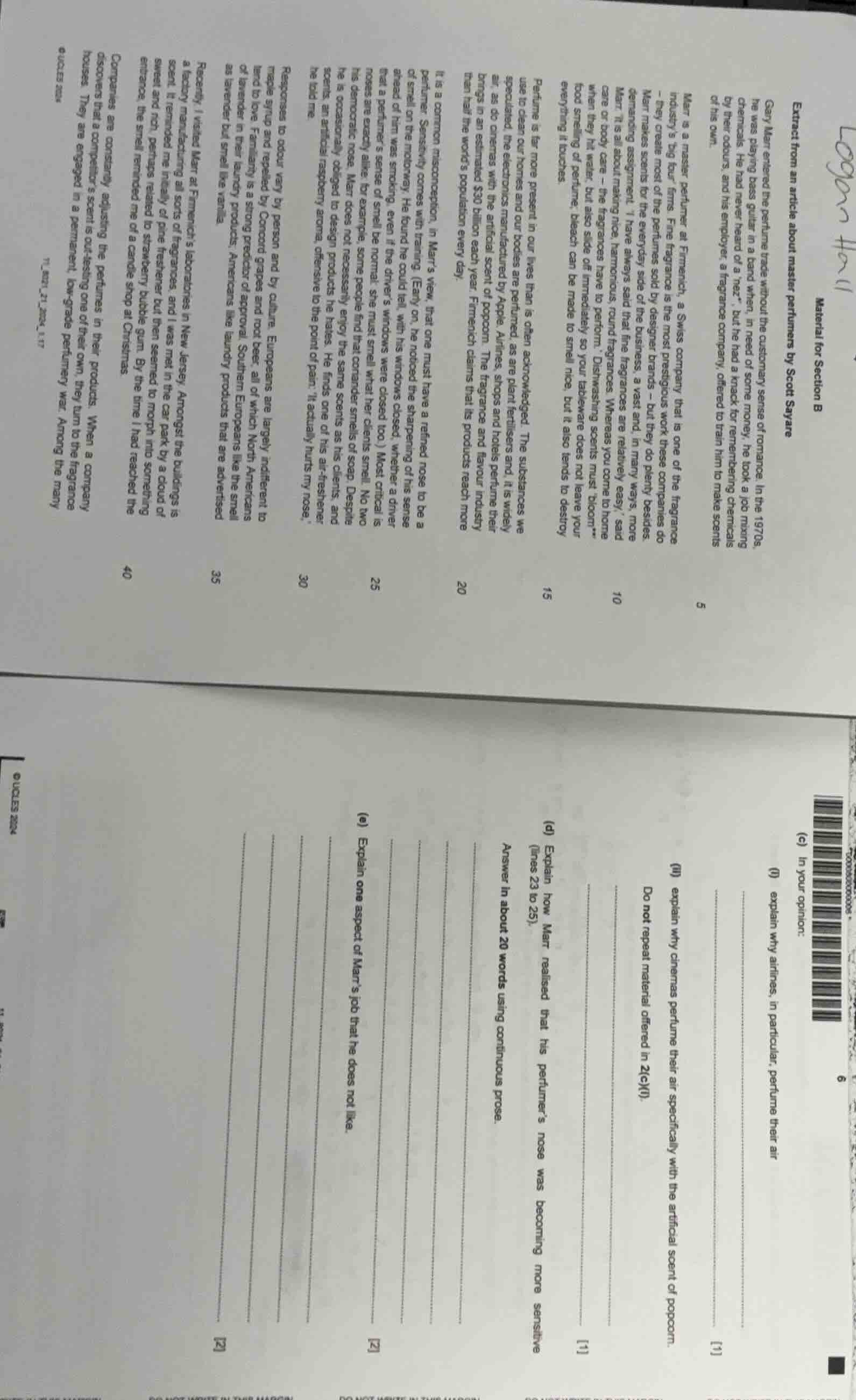
extract from an article about master perfumers by scott sayare gary marr entered the perfume trade without the customary sense of romance. in the 1970s, he was playing bass guitar in a band when, in need of some money, he took a job mixing chemicals. he had never heard of a “nez”, but he had a knack for remembering chemicals by their odours, and his employer, a fragrance company, offered to train him to make scents of his own. marr is a master perfumer at firmenich, a swiss company that is one of the fragrance industry’s big four: firms that design and sell the most prestigious fine fragrances by the most prestigious designer brands – but they do plenty besides. they create most of the perfumes sold by the business, a vast and, in many ways, more demanding assignment. “i have always said that fine fragrances are relatively easy, said marr. “it is all about making nice, harmonious, round fragrances. whereas you come to home care or body care – the fragrances have to perform. dishwashing scents must come to bloom when smelling hit water, but also slide off immediately so your tableware does not leave your food smelling of perfume. bleach can be made to smell nice, but it also tends to destroy everything it touches. perfume is far more present in our lives than is often acknowledged. the substances we use to clean our homes and our bodies are perfumed, as are cinemas, with the artificial scent of popcorn. airlines are plant fertilisers and, it is widely all, as do cinemas, with the artificial scent of popcorn. the fragrance and flavour industry brings in an estimated $30 billion each year. firmenich claims that its products reach more than half the world’s population every day. it is a common misconception, in marr’s view, that one must have a refined nose to be a perfumer. sensitivity comes with training. he found the sharpening of his sense of smell on the motorway: he would, when the driver’s windows were closed, whether a dinner ahead of him was smoking, even if he could tell, with his windows closed, that a perfumer’s sense of smell be normal. (most critical is noses are exactly alike, for example, she must smell what her clients smell. no two his democratic nose. marr does not necessarily enjoy the scents he finds for his clients, and he is occasionally obliged to design products he hates. he finds one of his air - freshener scents, an artificial raspberry aroma, offensive to the point of pain: it actually hurts my nose, he told me. responses to odour vary by person and by culture. europeans are largely indifferent to melon syrup and repelled by concord grapes and root beer, all of which north americans tend to love. familiarity is a strong predictor of approval. southern europeans like the smell of lavender in their laundry, products. americans like laundry products that are advertised as lavender but smell like vanilla. recently, i visited marr at firmenich’s laboratories in new jersey. amongst the buildings is a lobby manufacturing all sorts of fragrances, and i was met in the car park by a cloud of sweet and rich, perhaps related to strawberry bubble gum seemed to morph into something else entirely. by the time i had reached the entrance, the smell reminded me of a candle shop at christmas. companies are constantly adjusting the perfumes in their products. when a company discovers that a competitor’s scent is out - selling one of their own, they turn to the fragrance houses. they are engaged in a permanent, low - grade perfumery war. among the many (c) in your opinion: (i) explain why airlines, in particular, perfume their air (ii) explain why cinemas perfume their air specifically with the artificial scent of popcorn. do not repeat material offered in 2(c)(i). (d) explain how marr realised that his perfumer’s nose was becoming more sensitive (lines 23 to 25). answer in about 20 words using continuous prose. (e) explain one aspect of marr’s job that he does not like.
(c)(i)
Airlines perfume air to mask unpleasant odors (like body, food) and create a consistently nice, welcoming environment for passengers, aligning with Marr's view that scents should feel harmonious.
(c)(ii)
Cinemas use popcorn-scented perfume to trigger cravings for popcorn, encouraging customers to buy snacks and boosting the venue's food sales.
(d)
Marr noticed his sense of smell sharpened over time: he could detect even closed-car smoke, showing his trained nose grew more sensitive.
(e)
Marr dislikes designing scents he hates, such as an artificial raspberry aroma that physically irritates his nose.

Snap & solve any problem in the app
Get step-by-step solutions on Sovi AI
Photo-based solutions with guided steps
Explore more problems and detailed explanations
(c)(i)
To mask unwanted odors and create a pleasant, consistent atmosphere for passengers.
(c)(ii)
To stimulate customers' desire to purchase popcorn, increasing concession stand sales.
(d)
He noticed he could detect subtle smells (e.g., closed-car smoke), showing his trained nose grew more sensitive.
(e)
He dislikes creating scents he finds offensive, like an artificial raspberry aroma that causes him physical discomfort.