QUESTION IMAGE
Question
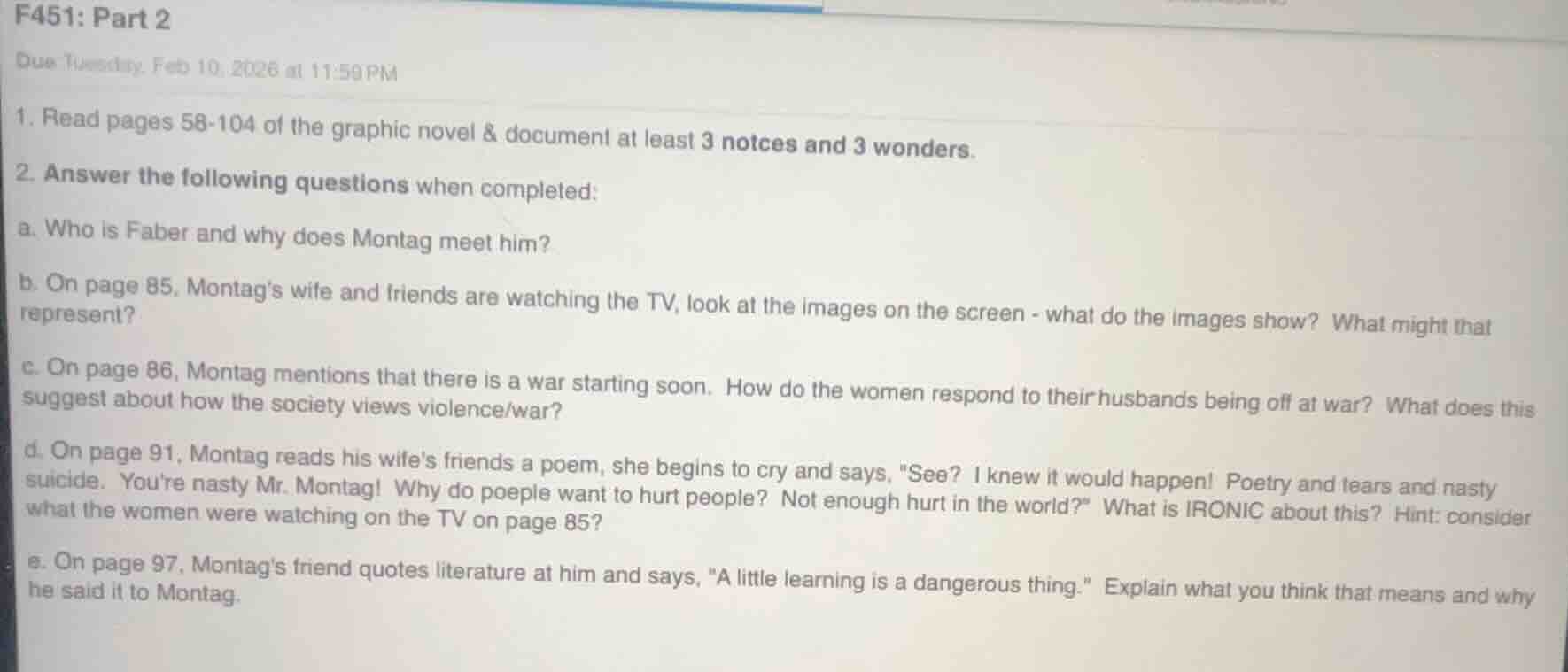
f451: part 2
due tuesday, feb 10, 2026 at 11:59 pm
- read pages 58-104 of the graphic novel & document at least 3 notices and 3 wonders.
- answer the following questions when completed:
a. who is faber and why does montag meet him?
b. on page 85, montags wife and friends are watching the tv, look at the images on the screen - what do the images show? what might that represent?
c. on page 86, montag mentions that there is a war starting soon. how do the women respond to their husbands being off at war? what does this suggest about how the society views violence/war?
d. on page 91, montag reads his wifes friends a poem, she begins to cry and says, \see? i knew it would happen! poetry and tears and nasty suicide. youre nasty mr. montag! why do poeple want to hurt people? not enough hurt in the world?\ what is ironic about this? hint: consider what the women were watching on the tv on page 85?
e. on page 97, montags friend quotes literature at him and says, \a little learning is a dangerous thing.\ explain what you think that means and why he said it to montag.
a.
Faber is a retired English professor, one of the few people Montag knows who still values books and critical thought. Montag meets him because he is struggling with his role as a fireman (burning books) and seeks understanding, guidance, and help to rebel against the oppressive, anti-intellectual society.
b.
On page 85, the TV shows a violent, interactive program where the viewer (Mildred and her friends) is encouraged to participate in hunting and shooting "enemies" on screen. This represents the society's obsession with mindless, sensationalized violence as a form of entertainment, designed to pacify people and distract them from critical thinking or meaningful connection.
c.
The women respond with casual indifference, even trivializing the war by talking about superficial things like hair and makeup instead of grieving or worrying about their husbands. This suggests the society has desensitized people to violence and war; it is treated as a distant, unimportant event, not a serious human tragedy, because the state uses media and distraction to keep people disconnected from real emotion and consequence.
d.
The irony is that the women were just engrossed in a violent, hurtful TV program that normalized harm, yet they become upset and condemn Montag for making them feel emotional pain through poetry. They are comfortable with artificial, sanitized violence for entertainment but cannot tolerate genuine, vulnerable emotional discomfort that comes from engaging with art and real human feeling.
e.
The phrase "A little learning is a dangerous thing" means gaining only a small, incomplete understanding of a subject can lead to overconfidence, recklessness, or harmful actions, rather than wisdom. Montag has recently started reading books and questioning society, but he has only a superficial grasp of literature and its meaning. His friend says this to warn him that his half-baked rebellion and newfound but unguided knowledge could put him in danger, or that he might act impulsively without fully understanding the consequences of challenging the system.

Snap & solve any problem in the app
Get step-by-step solutions on Sovi AI
Photo-based solutions with guided steps
Explore more problems and detailed explanations
a. Faber is a retired English professor who values books. Montag meets him to seek guidance on rebelling against the anti-intellectual society and understanding literature.
b. The TV shows a violent interactive hunting/shooting program. It represents the society's use of mindless, sensationalized violence as a pacifying, distracting form of entertainment.
c. The women respond with casual indifference, focusing on superficial topics. This suggests the society is desensitized to violence/war, treating it as an unimportant, distant event due to state-sponsored distraction.
d. The irony is that the women enjoyed violent, hurtful TV entertainment on page 85, yet they condemn Montag for making them feel emotional pain via poetry—they tolerate artificial violence but reject genuine emotional discomfort.
e. The phrase means incomplete knowledge can lead to recklessness. Montag's friend says this to warn him that his partial, unguided understanding of books and rebellion could lead to dangerous, impulsive actions against the society.