QUESTION IMAGE
Question
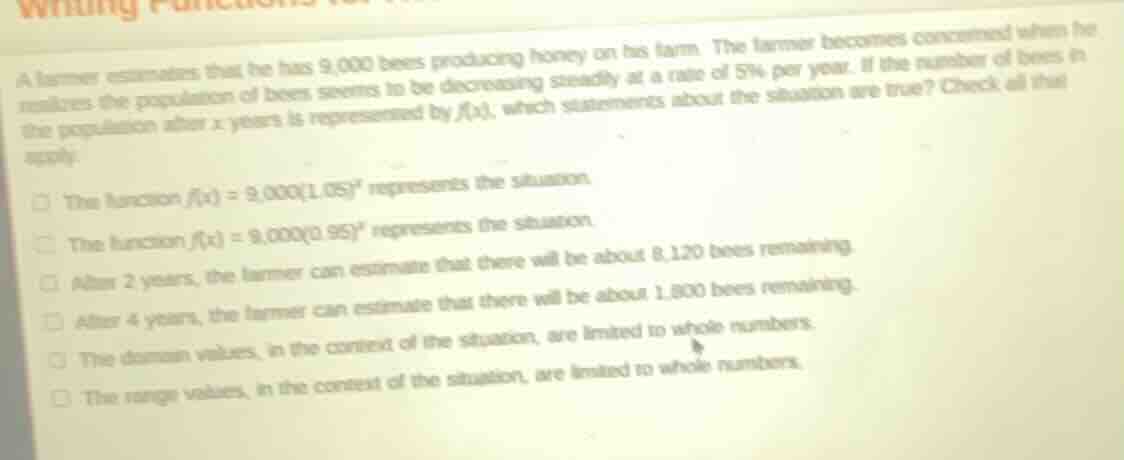
a farmer estimates that he has 9,000 bees producing honey on his farm. the farmer becomes concerned when he realizes the population of bees seems to be decreasing steadily at a rate of 5% per year. if the number of bees in the population after x years is represented by f(x), which statements about the situation are true? check all that apply.
- the function ( f(x) = 9,000(1.05)^x ) represents the situation.
- the function ( f(x) = 9,000(0.95)^x ) represents the situation.
- after 2 years, the farmer can estimate that there will be about 8,120 bees remaining.
- after 4 years, the farmer can estimate that there will be about 1,800 bees remaining.
- the domain values, in the context of the situation, are limited to whole numbers.
- the range values, in the context of the situation, are limited to whole numbers.
Step1: Identify decay function form
For a decreasing population at rate \( r \), the function is \( f(x) = P_0(1-r)^x \), where \( P_0=9000 \), \( r=0.05 \).
Expression: \( f(x) = 9000(1-0.05)^x = 9000(0.95)^x \)
Step2: Calculate population at x=2
Substitute \( x=2 \) into the decay function.
Expression: \( f(2) = 9000(0.95)^2 = 9000 \times 0.9025 = 8122.5 \approx 8120 \)
Step3: Calculate population at x=4
Substitute \( x=4 \) into the decay function.
Expression: \( f(4) = 9000(0.95)^4 = 9000 \times 0.81450625 = 7330.55625 \approx 7331 \)
Step4: Analyze domain and range
Domain (years) can be non-whole numbers (e.g., 1.5 years). Range (number of bees) must be whole numbers (cannot have a fraction of a bee).

Snap & solve any problem in the app
Get step-by-step solutions on Sovi AI
Photo-based solutions with guided steps
Explore more problems and detailed explanations
- The function \( f(x) = 9,000(0.95)^x \) represents the situation.
- After 2 years, the farmer can estimate that there will be about 8,120 bees remaining.
- The range values, in the context of the situation, are limited to whole numbers.