QUESTION IMAGE
Question
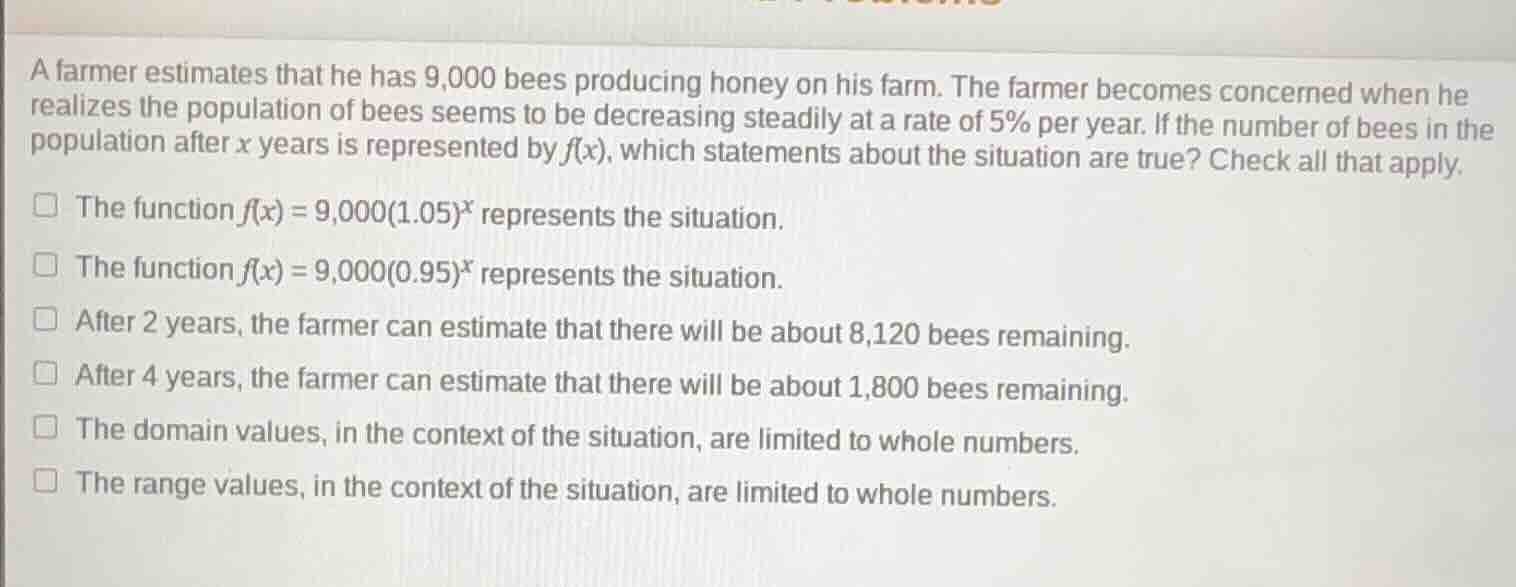
a farmer estimates that he has 9,000 bees producing honey on his farm. the farmer becomes concerned when he realizes the population of bees seems to be decreasing steadily at a rate of 5% per year. if the number of bees in the population after x years is represented by f(x), which statements about the situation are true? check all that apply. the function f(x) = 9,000(1.05)^x represents the situation. the function f(x) = 9,000(0.95)^x represents the situation. after 2 years, the farmer can estimate that there will be about 8,120 bees remaining. after 4 years, the farmer can estimate that there will be about 1,800 bees remaining. the domain values, in the context of the situation, are limited to whole numbers. the range values, in the context of the situation, are limited to whole numbers.
Step1: Analyze the exponential decay formula
For a population decreasing at a rate \( r \) per year, the formula is \( f(x)=a(1 - r)^x \), where \( a \) is the initial amount, \( r \) is the rate of decrease, and \( x \) is the time in years. Here, \( a = 9000 \), \( r=0.05 \), so \( f(x)=9000(1 - 0.05)^x=9000(0.95)^x \). So the first statement is wrong, the second is correct.
Step2: Calculate for \( x = 2 \)
Substitute \( x = 2 \) into \( f(x)=9000(0.95)^x \). \( f(2)=9000\times(0.95)^2=9000\times0.9025 = 8122.5\approx8120 \). So the third statement is correct.
Step3: Calculate for \( x = 4 \)
Substitute \( x = 4 \) into \( f(x)=9000(0.95)^x \). \( f(4)=9000\times(0.95)^4=9000\times0.81450625 = 7330.55625\approx7331 \), which is not 1800. So the fourth statement is wrong.
Step4: Analyze domain and range
The domain (values of \( x \)) can be any non - negative real number (time can be in fractions of a year), so the fifth statement is wrong. The range (values of \( f(x) \)) represents the number of bees, which must be a whole number (you can't have a fraction of a bee), so the sixth statement is correct.

Snap & solve any problem in the app
Get step-by-step solutions on Sovi AI
Photo-based solutions with guided steps
Explore more problems and detailed explanations
B. The function \( f(x)=9,000(0.95)^{x} \) represents the situation.
C. After 2 years, the farmer can estimate that there will be about 8,120 bees remaining.
F. The range values, in the context of the situation, are limited to whole numbers.