QUESTION IMAGE
Question
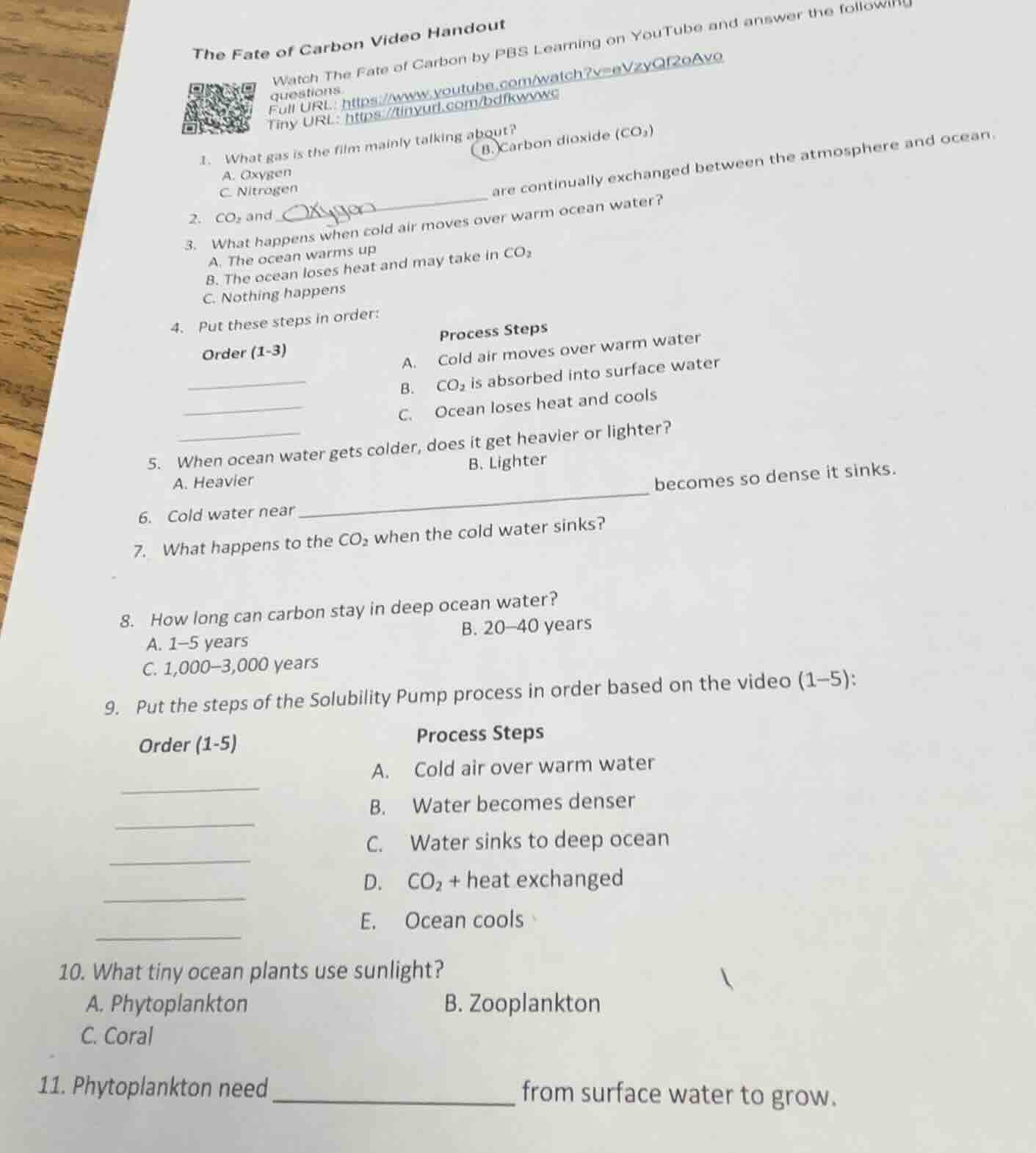
the fate of carbon video handoutwatch the fate of carbon by pbs learning on youtube and answer the following questions.full url: https://www.youtube.com/watch?v=evzyqf2oavotiny url: https://tinyurl.com/bdfkwvwc1. what gas is the film mainly talking about?a. oxygenb. carbon dioxide (co₂)c. nitrogen2. co₂ and ____ are continually exchanged between the atmosphere and ocean.3. what happens when cold air moves over warm ocean water?a. the ocean warms upb. the ocean loses heat and may take in co₂c. nothing happens4. put these steps in order:order (1-3)process stepsa. cold air moves over warm waterb. co₂ is absorbed into surface waterc. ocean loses heat and cools5. when ocean water gets colder, does it get heavier or lighter?a. heavierb. lighter6. cold water near __ becomes so dense it sinks.7. what happens to the co₂ when the cold water sinks?8. how long can carbon stay in deep ocean water?a. 1-5 yearsb. 20-40 yearsc. 1,000-3,000 years9. put the steps of the solubility pump process in order based on the video (1-5):order (1-5)process stepsa. cold air over warm waterb. water becomes denserc. water sinks to deep oceand. co₂ + heat exchangede. ocean cools10. what tiny ocean plants use sunlight?a. phytoplanktonb. zooplanktonc. coral11. phytoplankton need ____ from surface water to grow.
Step1: Match video core topic
The video focuses on carbon cycling, so the main gas is CO₂.
Step2: Identify ocean-atmosphere gas exchange
Oxygen and CO₂ are the primary gases exchanged between the ocean and atmosphere.
Step3: Analyze cold air-warm ocean interaction
Cold air draws heat from warm ocean, and cooler water holds more CO₂, so the ocean loses heat and takes in CO₂.
Step4: Sequence cold air-ocean CO₂ steps
First, cold air moves over warm water; then the ocean cools; finally, CO₂ is absorbed.
Step5: Relate water temp to density
Colder ocean water is denser, so it is heavier.
Step6: Locate dense cold water formation
Cold water near the poles becomes extremely dense and sinks.
Step7: Track CO₂ with sinking water
When cold water sinks, it carries dissolved CO₂ down to the deep ocean for storage.
Step8: Recall deep ocean carbon residence time
Carbon can remain in deep ocean water for 1,000–3,000 years.
Step9: Sequence Solubility Pump steps
Start with cold air over warm water, then CO₂/heat exchange, ocean cooling, water density increase, and finally sinking to deep ocean.
Step10: Identify sunlight-using ocean[LLM SSE On Failure]

Snap & solve any problem in the app
Get step-by-step solutions on Sovi AI
Photo-based solutions with guided steps
Explore more problems and detailed explanations
- B. Carbon dioxide (CO₂)
- Oxygen (O₂)
- B. The ocean loses heat and may take in CO₂
- 1. A. Cold air moves over warm water; 2. C. Ocean loses heat and cools; 3. B. CO₂ is absorbed into surface water
- A. Heavier
- the poles
- The CO₂ is carried down with the sinking cold water and stored in the deep ocean.
- C. 1,000–3,000 years
- 1. A. Cold air over warm water; 2. D. CO₂ + heat exchanged; 3. E. Ocean cools; 4. B. Water becomes denser; 5. C. Water sinks to deep ocean
- A. Phytoplankton
- carbon dioxide (CO₂)