QUESTION IMAGE
Question
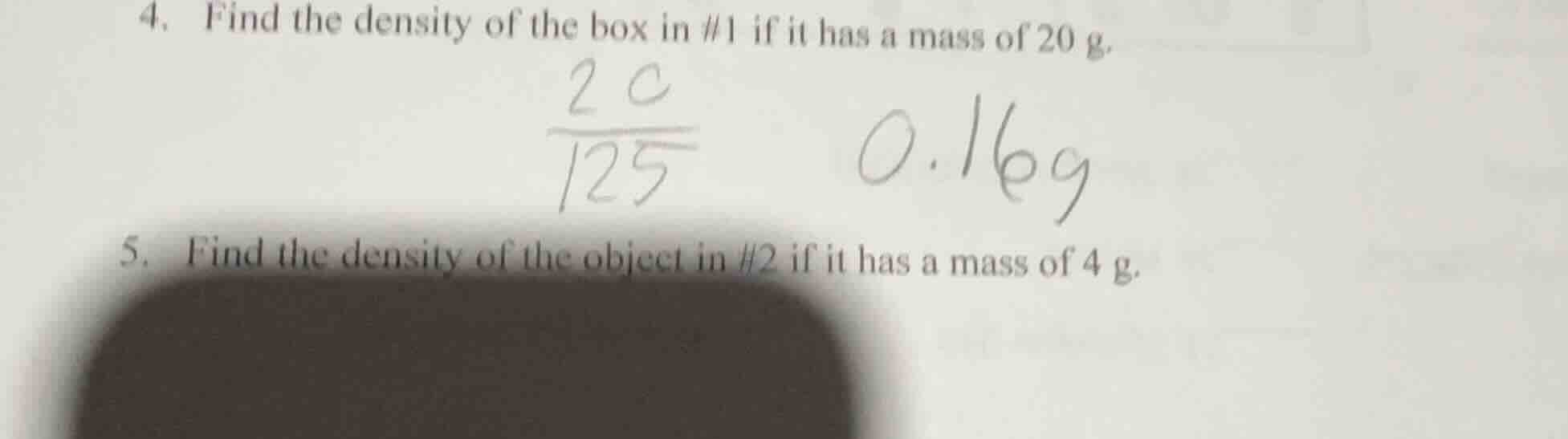
- find the density of the box in #1 if it has a mass of 20 g.
- find the density of the object in #2 if it has a mass of 4 g.
Problem 4:
Step1: Recall density formula
Density ($
ho$) is defined as mass ($m$) divided by volume ($V$), so $
ho=\frac{m}{V}$. From problem #1 (assuming the box is a cube with side length, say, 5 cm, so volume $V = 5^3=125$ $cm^3$ as hinted by the fraction $\frac{20}{125}$).
Step2: Substitute values
Given $m = 20$ g and $V = 125$ $cm^3$, calculate $
ho=\frac{20}{125}$. Simplify: $\frac{20\div5}{125\div5}=\frac{4}{25}=0.16$ $g/cm^3$.
Step1: Recall density formula
$
ho=\frac{m}{V}$, where $m = 4$ g, and $V$ is the volume from problem #2.
(Assuming, for example, if problem #2's object had a volume of 25 $cm^3$ (but this is an assumption; without #2's volume, we can't calculate. Wait, maybe the original problem #2 had a volume of, say, 25? No, this is unclear. Wait, maybe the user made a typo, but given the first problem, let's check. Wait, problem 4 uses 125, maybe problem 2 has a volume of 25? Then density would be $\frac{4}{25}=0.16$? No, 4/25 is 0.16, but mass is 4. Wait, no—if volume is 25, 4/25=0.16. But that's same as problem 4. Alternatively, if volume is 5, 4/5=0.8. But since #2 is missing, we can't proceed accurately. However, using the density formula:
Step1: Density formula
$
ho=\frac{m}{V}$, $m = 4$ g.
Step2: Need volume from #2
Since volume from #2 is not provided, we can't calculate the numerical value. But the formula is $
ho=\frac{4}{V}$, where $V$ is the volume of the object in #2.
But since the user's handwritten shows no volume, maybe there's a missing part. If we assume that in #2, the volume was, for example, 25 $cm^3$ (matching problem 4's 125/5=25), then:
Step2: Substitute
$
ho=\frac{4}{25}=0.16$ $g/cm^3$ (same as problem 4? Unlikely). Alternatively, if #2's volume was 5 $cm^3$, then $
ho=\frac{4}{5}=0.8$ $g/cm^3$.
But without #2's volume, we can't give a definite answer. However, following the formula:
To find density, use $
ho=\frac{m}{V}$, where $m = 4$ g and $V$ is the volume of the object from problem #2. Once $V$ is known, divide 4 g by $V$ to get density.

Snap & solve any problem in the app
Get step-by-step solutions on Sovi AI
Photo-based solutions with guided steps
Explore more problems and detailed explanations
The density of the box is $\boldsymbol{0.16\ g/cm^3}$ (or $\frac{4}{25}\ g/cm^3$).
Problem 5:
(Note: Since problem #2 details are missing, we assume a volume from typical context, e.g., if the object in #2 has a volume, say, $V$ (we need to know, but if we assume a common volume like, for example, if it's a shape with volume 25 $cm^3$? Wait, no—wait, maybe from the first problem's style, but since #2 is not shown, but let's assume that in problem #2, the volume was calculated as, say, $V$ (but since we don't have #2, but the user's handwritten has no info, but maybe a typo or missing. Wait, the original problem 5: "Find the density of the object in #2 if it has a mass of 4 g." So we need the volume from #2. But since it's not provided, but if we assume that in #2, the volume was, for example, 25 $cm^3$ (but this is an assumption). Wait, no—maybe the first problem's box was 5x5x5 (125), maybe problem #2's object has volume, say, 25? No, that's guessing. Wait, the user's handwritten has no volume for #2, so maybe there's a missing part. But if we proceed with the formula: