QUESTION IMAGE
Question
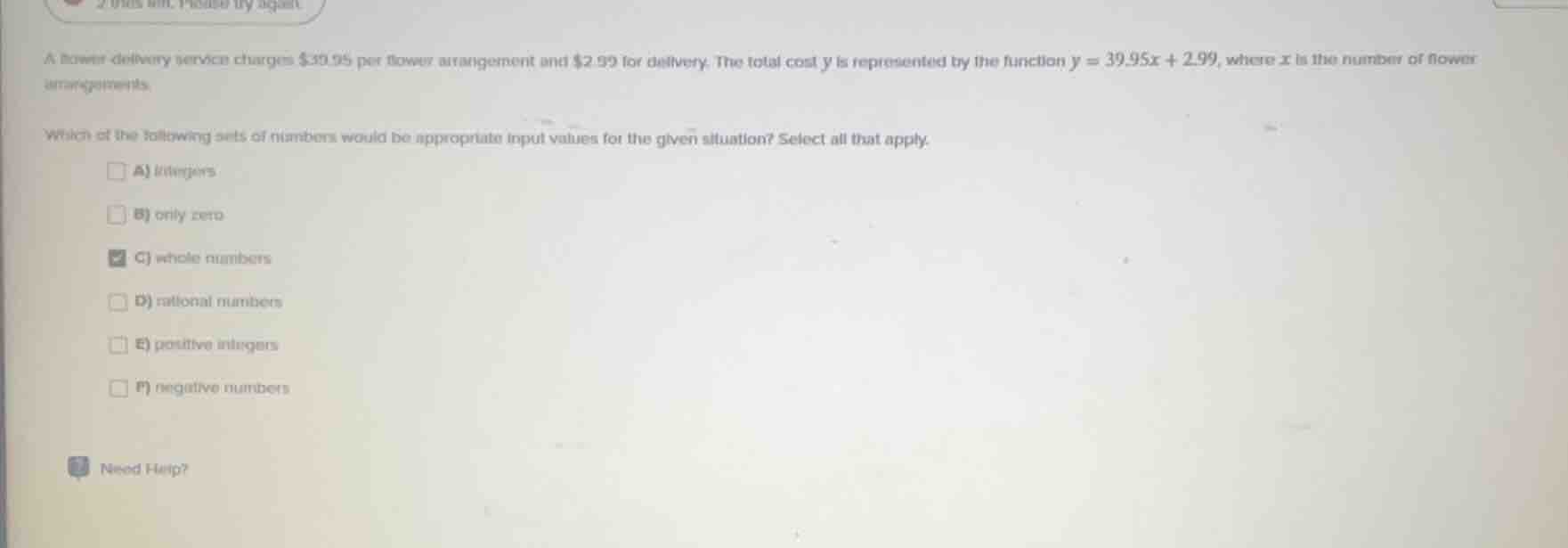
a flower delivery service charges $39.95 per flower arrangement and $2.99 for delivery. the total cost y is represented by the function $y = 39.95x + 2.99$, where x is the number of flower arrangements.
which of the following sets of numbers would be appropriate input values for the given situation? select all that apply.
a) integers
b) only zero
c) whole numbers
d) rational numbers
e) positive integers
f) negative numbers
- Input values are the number of flower arrangements, which can be 0 (no arrangements) or any positive whole number.
- Integers include negative numbers, which don't make sense here (you can't order a negative number of arrangements).
- Only zero is incorrect because you can order 1, 2, etc., arrangements.
- Rational numbers include fractions, which don't make sense (you can't order a fraction of an arrangement).
- Negative numbers are invalid as you can't order a negative number of arrangements.
- Whole numbers (0, 1, 2, 3,...) and positive integers (1, 2, 3,...) are valid, as well as integers only if we consider non-negative integers, but since integers include negatives, the most appropriate are whole numbers and positive integers, and integers can be considered if we restrict to non-negative, but the key valid sets are whole numbers and positive integers. Wait, actually, whole numbers include 0, which is valid (ordering 0 arrangements with delivery? Wait, no, if x=0, y=2.99, which would be delivery for 0 arrangements, which might be a possible scenario (just delivery fee for nothing? Or maybe x is at least 1. But the problem says x is the number of arrangements, so x can be 0 (if someone pays delivery for no arrangements, though unusual, but mathematically, whole numbers include 0, positive integers are 1,2,... and integers would include negatives which are invalid. Wait, actually, the correct sets are:
Whole numbers (0,1,2,...) because you can order 0 arrangements (pay just delivery) or more. Positive integers (1,2,...) are also valid if you must order at least one, but the function allows x=0. Also, integers are not valid because they include negatives. So the appropriate sets are whole numbers and positive integers? Wait no, wait the function is y=39.95x +2.99. If x=0, that's paying delivery for no flowers, which might be a possible scenario (maybe a delivery fee for a different service, but the problem says x is the number of flower arrangements. So x can be 0,1,2,... so whole numbers. Positive integers are 1,2,... which are also valid, but whole numbers include 0 which is also valid. Wait, but let's recheck:
- A) Integers: includes negative numbers, invalid.
- B) Only zero: no, you can order 1,2,...
- C) Whole numbers: 0,1,2,... valid, since you can order 0 or more arrangements.
- D) Rational numbers: includes fractions, invalid (can't order half an arrangement).
- E) Positive integers: 1,2,... valid, since you can order 1 or more arrangements.
- F) Negative numbers: invalid.
So the correct options are C and E. Wait, but can x=0 be a valid input? If x=0, that would mean paying a delivery fee for 0 flower arrangements, which might not be a real-world scenario, but mathematically, the function allows it. However, in most cases, you order at least 1 arrangement, but the problem says x is the number of arrangements, so x can be 0. So both whole numbers and positive integers are appropriate? Wait no, whole numbers include 0, which is a possible input (even if unusual), and positive integers are the number of arrangements when you order at least one. So both C and E are correct. Also, wait, integers: if we consider non-negative integers, but integers include negatives, so A is incorrect. So the appropriate sets are whole numbers and positive integers.
Wait, but let's think again: the question says "which sets of numbers would be appropriate input values". So input values are x, the number of flower arrangements. The number of arrangements can be 0,1,2,... so whole numbers (C) are appropriate. Positive integers (E) are also appro…

Snap & solve any problem in the app
Get step-by-step solutions on Sovi AI
Photo-based solutions with guided steps
Explore more problems and detailed explanations
C) whole numbers
E) positive integers