QUESTION IMAGE
Question
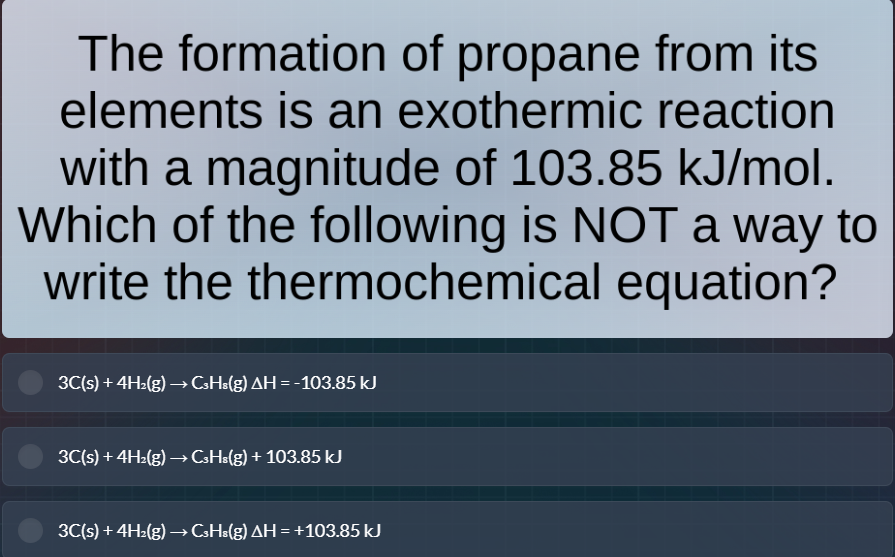
the formation of propane from its elements is an exothermic reaction with a magnitude of 103.85 kj/mol. which of the following is not a way to write the thermochemical equation? 3c(s) + 4h₂(g) → c₃h₈(g) δh = -103.85 kj 3c(s) + 4h₂(g) → c₃h₈(g) + 103.85 kj 3c(s) + 4h₂(g) → c₃h₈(g) δh = +103.85 kj
Brief Explanations
For an exothermic reaction, the enthalpy change ($\Delta H$) is negative because energy is released. Let's analyze each option:
- First option: $\ce{3C(s) + 4H_{2}(g) -> C_{3}H_{8}(g)}\ \Delta H = - 103.85\ \text{kJ}$ shows a negative $\Delta H$ for exothermic, correct.
- Second option: $\ce{3C(s) + 4H_{2}(g) -> C_{3}H_{8}(g) + 103.85\ \text{kJ}}$ also represents energy released (product side has energy), correct for exothermic.
- Third option: $\ce{3C(s) + 4H_{2}(g) -> C_{3}H_{8}(g)}\ \Delta H = + 103.85\ \text{kJ}$ has a positive $\Delta H$, which is for endothermic (energy absorbed), so this is incorrect for an exothermic reaction.

Snap & solve any problem in the app
Get step-by-step solutions on Sovi AI
Photo-based solutions with guided steps
Explore more problems and detailed explanations
3C(s) + 4H₂(g) → C₃H₈(g) ΔH = +103.85 kJ