QUESTION IMAGE
Question
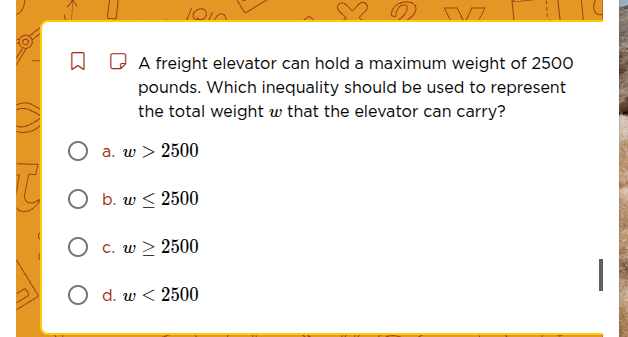
a freight elevator can hold a maximum weight of 2500 pounds. which inequality should be used to represent the total weight w that the elevator can carry?
a. $w > 2500$
b. $w \leq 2500$
c. $w \geq 2500$
d. $w < 2500$
Step1: Analyze the problem
The freight elevator has a maximum weight capacity of 2500 pounds. This means the total weight \( w \) it can carry should be less than or equal to 2500 pounds. If \( w \) were greater than 2500, it would exceed the elevator's capacity, which is not allowed.
Step2: Evaluate each option
- Option a: \( w>2500 \) implies the weight exceeds the maximum capacity, which is incorrect.
- Option b: \( w\leq2500 \) means the weight is less than or equal to the maximum capacity, which is correct.
- Option c: \( w\geq2500 \) implies the weight is at least 2500, but it could be more, which would exceed the capacity, so this is incorrect.
- Option d: \( w<2500 \) implies the weight is strictly less than 2500, but the elevator can also carry exactly 2500 pounds, so this is too restrictive and incorrect.

Snap & solve any problem in the app
Get step-by-step solutions on Sovi AI
Photo-based solutions with guided steps
Explore more problems and detailed explanations
b. \( w\leq2500 \)