QUESTION IMAGE
Question
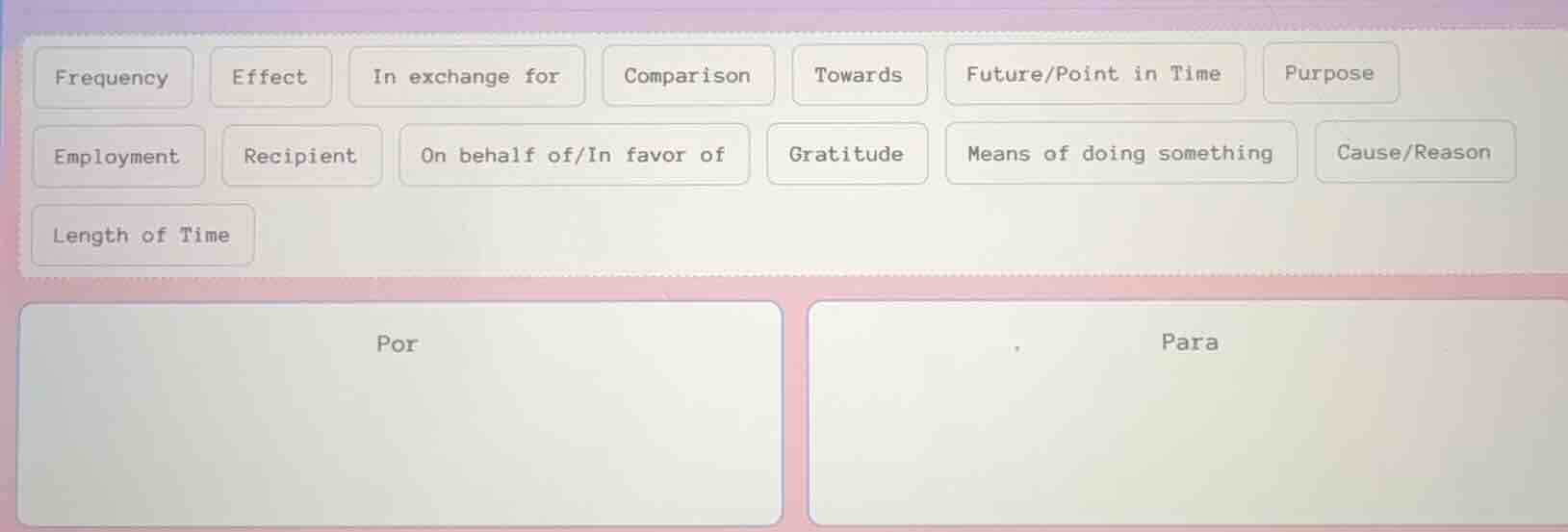
frequency effect in exchange for comparison towards future/point in time purpose employment recipient on behalf of/in favor of gratitude means of doing something cause/reason length of time por para
To solve the problem of categorizing the uses of "Por" and "Para" in Spanish (a Linguistics subfield under Arts), we analyze their common usages:
For "Por":
- Cause/Reason: Used to explain why something happens (e.g., "Lo hice por ti" can imply "I did it because of you" in some contexts, though more directly "por" for cause like "Me enfermé por el frío" - "I got sick because of the cold").
- Gratitude: As in "Gracias por tu ayuda" - "Thank you for your help".
- Means of doing something: "Voy al trabajo por tren" - "I go to work by train" (the means of transportation).
- In exchange for: "Te doy este libro por aquel" - "I'll give you this book for that one".
- On behalf of/In favor of: "Hablo por mi hermana" - "I speak on behalf of my sister"; "Estoy por la propuesta" - "I'm in favor of the proposal".
- Employment (less common, but can be used in contexts like "Trabajo por una empresa" - "I work for a company", though "para" is also used for employment, "por" can have this nuance in some cases).
- Frequency (rare, but "Salgo por la tarde" - "I go out in the afternoon" can have a frequency - like "I go out afternoons", but this is more of a time - related use which is also covered under other categories).
- Effect (indirectly, as the result of an action, but this is more of a secondary use).
- Length of Time (e.g., "Estuve en casa por dos horas" - "I was at home for two hours").
For "Para":
- Purpose: "Este regalo es para ti" - "This gift is for you" (the purpose of the gift is for you); "Estudio para ser médico" - "I study to become a doctor" (purpose of studying).
- Future/Point in Time: "Para mañana, tendremos que terminar el trabajo" - "For tomorrow, we'll have to finish the work" (referring to a future time).
- Recipient: "Este mensaje es para Juan" - "This message is for Juan" (the recipient of the message).
- Comparison (rare, but "Es muy alto para su edad" - "He's very tall for his age").
- Towards: "Camino para la escuela" - "I walk towards the school" (direction towards a place).
- Cause/Reason (less common than "por", but in some cases like "Está triste para no haber ganado" - "He's sad for not having won", though "por" is more common for cause, "para" can be used in a more purpose - related cause).
Now, to fill the boxes:
Por:
- Cause/Reason
- Gratitude
- Means of doing something
- In exchange for
- On behalf of/In favor of
- Employment (optional)
- Length of Time
- Frequency (optional)
- Effect (optional)
Para:
- Purpose
- Future/Point in Time
- Recipient
- Comparison
- Towards
- Cause/Reason (optional)
If we were to list the main ones:
Por:
- Cause/Reason
- Gratitude
- Means of doing something
- In exchange for
- On behalf of/In favor of
- Length of Time
Para:
- Purpose
- Future/Point in Time
- Recipient
- Towards
- Comparison
(Note: The categorization can vary slightly depending on the specific grammar source, but these are the common usages.)

Snap & solve any problem in the app
Get step-by-step solutions on Sovi AI
Photo-based solutions with guided steps
Explore more problems and detailed explanations
To solve the problem of categorizing the uses of "Por" and "Para" in Spanish (a Linguistics subfield under Arts), we analyze their common usages:
For "Por":
- Cause/Reason: Used to explain why something happens (e.g., "Lo hice por ti" can imply "I did it because of you" in some contexts, though more directly "por" for cause like "Me enfermé por el frío" - "I got sick because of the cold").
- Gratitude: As in "Gracias por tu ayuda" - "Thank you for your help".
- Means of doing something: "Voy al trabajo por tren" - "I go to work by train" (the means of transportation).
- In exchange for: "Te doy este libro por aquel" - "I'll give you this book for that one".
- On behalf of/In favor of: "Hablo por mi hermana" - "I speak on behalf of my sister"; "Estoy por la propuesta" - "I'm in favor of the proposal".
- Employment (less common, but can be used in contexts like "Trabajo por una empresa" - "I work for a company", though "para" is also used for employment, "por" can have this nuance in some cases).
- Frequency (rare, but "Salgo por la tarde" - "I go out in the afternoon" can have a frequency - like "I go out afternoons", but this is more of a time - related use which is also covered under other categories).
- Effect (indirectly, as the result of an action, but this is more of a secondary use).
- Length of Time (e.g., "Estuve en casa por dos horas" - "I was at home for two hours").
For "Para":
- Purpose: "Este regalo es para ti" - "This gift is for you" (the purpose of the gift is for you); "Estudio para ser médico" - "I study to become a doctor" (purpose of studying).
- Future/Point in Time: "Para mañana, tendremos que terminar el trabajo" - "For tomorrow, we'll have to finish the work" (referring to a future time).
- Recipient: "Este mensaje es para Juan" - "This message is for Juan" (the recipient of the message).
- Comparison (rare, but "Es muy alto para su edad" - "He's very tall for his age").
- Towards: "Camino para la escuela" - "I walk towards the school" (direction towards a place).
- Cause/Reason (less common than "por", but in some cases like "Está triste para no haber ganado" - "He's sad for not having won", though "por" is more common for cause, "para" can be used in a more purpose - related cause).
Now, to fill the boxes:
Por:
- Cause/Reason
- Gratitude
- Means of doing something
- In exchange for
- On behalf of/In favor of
- Employment (optional)
- Length of Time
- Frequency (optional)
- Effect (optional)
Para:
- Purpose
- Future/Point in Time
- Recipient
- Comparison
- Towards
- Cause/Reason (optional)
If we were to list the main ones:
Por:
- Cause/Reason
- Gratitude
- Means of doing something
- In exchange for
- On behalf of/In favor of
- Length of Time
Para:
- Purpose
- Future/Point in Time
- Recipient
- Towards
- Comparison
(Note: The categorization can vary slightly depending on the specific grammar source, but these are the common usages.)