QUESTION IMAGE
Question
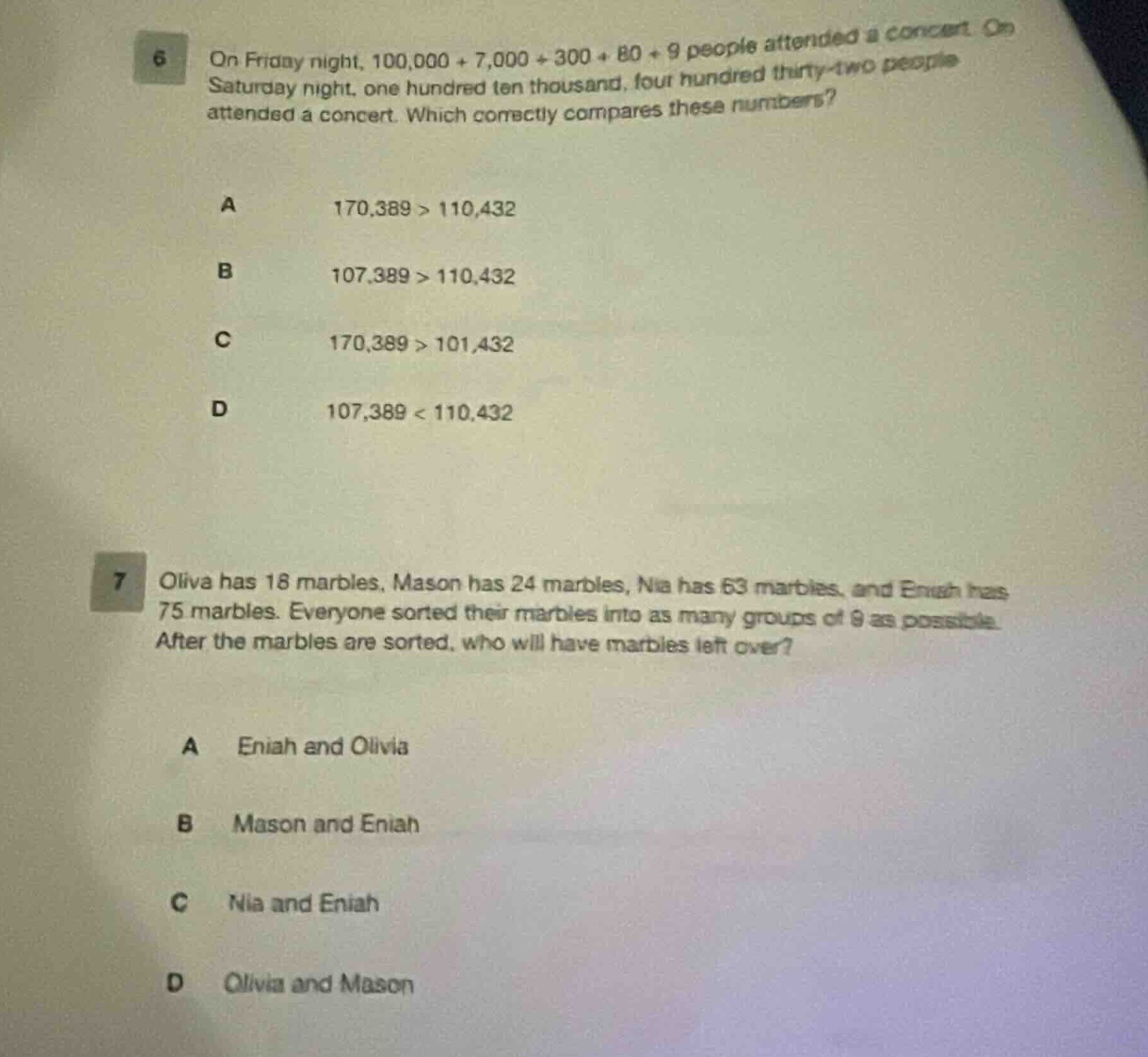
6 on friday night, 100,000 + 7,000 + 300 + 80 + 9 people attended a concert. on saturday night, one hundred ten thousand, four hundred thirty - two people attended a concert. which correctly compares these numbers? a 170,389 > 110,432 b 107,389 > 110,432 c 170,389 > 101,432 d 107,389 < 110,432 7 olivia has 18 marbles, mason has 24 marbles, nia has 63 marbles, and eniah has 75 marbles. everyone sorted their marbles into as many groups of 9 as possible. after the marbles are sorted, who will have marbles left over? a eniah and olivia b mason and eniah c nia and eniah d olivia and mason
Question 6
Step1: Calculate Friday's attendance
First, we calculate the number of people who attended the concert on Friday night. We have the expression \(100,000 + 7,000 + 300 + 80 + 9\). Let's add these numbers step by step:
- \(100,000 + 7,000 = 107,000\)
- \(107,000 + 300 = 107,300\)
- \(107,300 + 80 = 107,380\)
- \(107,380 + 9 = 107,389\)
So, the number of people who attended on Friday night is \(107,389\).
Step2: Identify Saturday's attendance
The number of people who attended on Saturday night is given as "one hundred ten thousand, four hundred thirty - two", which is written as \(110,432\).
Step3: Compare the two numbers
Now we compare \(107,389\) and \(110,432\). Since \(107,389\) is less than \(110,432\) (because when we compare the digits from left to right, the first digit where they differ is the ten - thousands place: \(0\) in \(107,389\) and \(1\) in \(110,432\)), we have \(107,389<110,432\).
To determine who will have marbles left over, we need to find the remainder when each person's number of marbles is divided by \(9\) (since they are sorting into groups of \(9\)). A remainder greater than \(0\) means they have marbles left over.
Step1: For Olivia
Olivia has \(18\) marbles. We calculate \(18\div9\). Using the division formula \(a\div b = q\) with remainder \(r\) (where \(a = bq + r\) and \(0\leq r < b\)), we have \(18=9\times2+0\). So the remainder is \(0\), which means Olivia has no marbles left over.
Step2: For Mason
Mason has \(24\) marbles. We calculate \(24\div9\). \(9\times2 = 18\), and \(24-18 = 6\). So \(24 = 9\times2+6\), and the remainder is \(6\). This means Mason has marbles left over.
Step3: For Nia
Nia has \(63\) marbles. We calculate \(63\div9\). \(9\times7=63\), so \(63 = 9\times7+0\). The remainder is \(0\), so Nia has no marbles left over.
Step4: For Eniah
Eniah has \(75\) marbles. We calculate \(75\div9\). \(9\times8 = 72\), and \(75 - 72=3\). So \(75=9\times8 + 3\), and the remainder is \(3\). This means Eniah has marbles left over.
So, Mason and Eniah have marbles left over.

Snap & solve any problem in the app
Get step-by-step solutions on Sovi AI
Photo-based solutions with guided steps
Explore more problems and detailed explanations
D. \(107,389 < 110,432\)