QUESTION IMAGE
Question
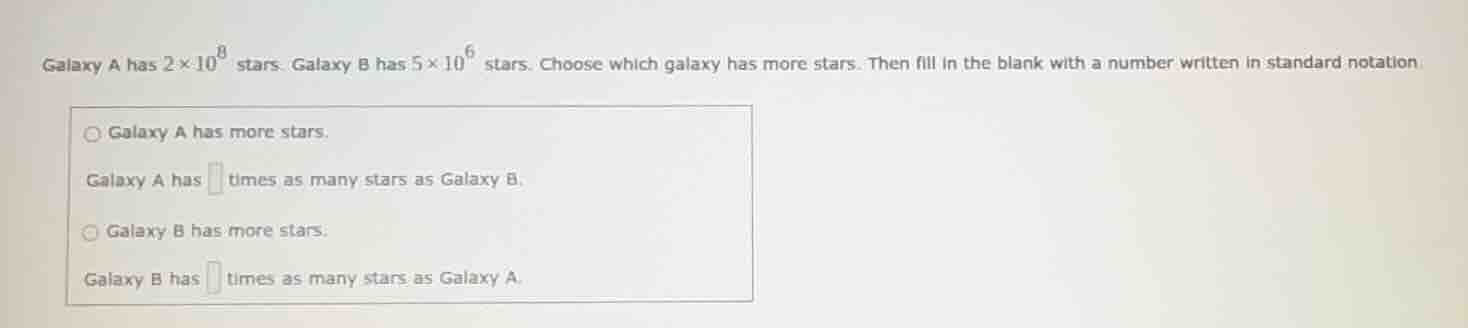
galaxy a has $2 \times 10^8$ stars. galaxy b has $5 \times 10^6$ stars. choose which galaxy has more stars. then fill in the blank with a number written in standard notation. \bigcirc galaxy a has more stars. galaxy a has \square times as many stars as galaxy b. \bigcirc galaxy b has more stars. galaxy b has \square times as many stars as galaxy a.
Step 1: Compare the exponents of 10
Galaxy A: \(2\times10^{8}\), Galaxy B: \(5\times10^{6}\). The exponent of 10 in A is 8, in B is 6. Since \(8>6\), \(10^{8}>10^{6}\), so Galaxy A has more stars.
Step 2: Calculate the ratio of stars in A to B
To find how many times A's stars are of B's, divide A's number by B's: \(\frac{2\times10^{8}}{5\times10^{6}}\).
Using exponent rule \(\frac{10^{m}}{10^{n}} = 10^{m - n}\), so \(10^{8-6}=10^{2}=100\).
Then \(\frac{2}{5}\times100=\frac{200}{5} = 40\).

Snap & solve any problem in the app
Get step-by-step solutions on Sovi AI
Photo-based solutions with guided steps
Explore more problems and detailed explanations
Galaxy A has more stars.
Galaxy A has 40 times as many stars as Galaxy B.