QUESTION IMAGE
Question
grade science
chapter 7
mum of 5 sentences)
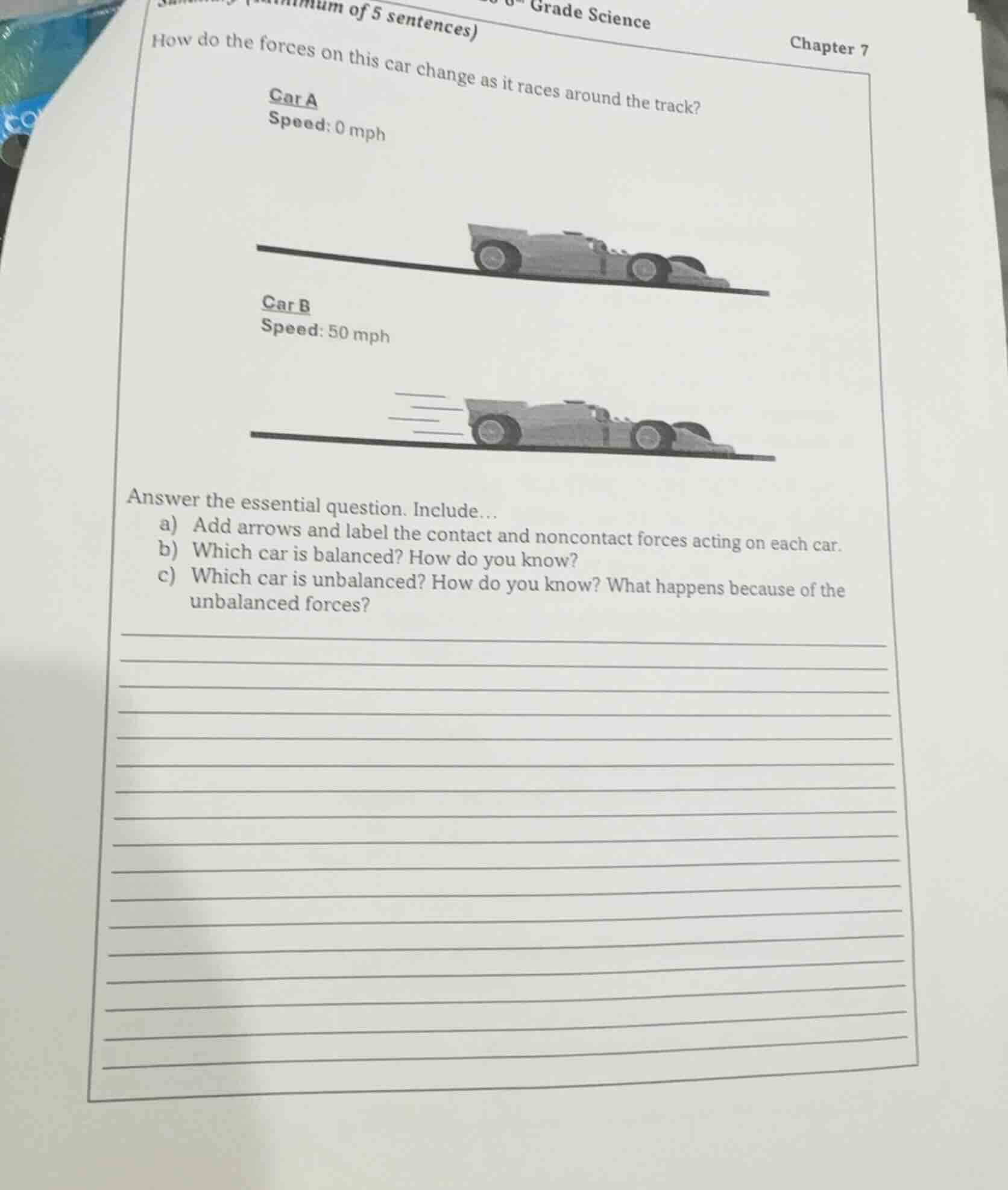
how do the forces on this car change as it races around the track?
car a
speed: 0 mph
car b
speed: 50 mph
answer the essential question. include…
a) add arrows and label the contact and noncontact forces acting on each car.
b) which car is balanced? how do you know?
c) which car is unbalanced? how do you know? what happens because of the
unbalanced forces?
Part (a)
For Car A (speed 0 mph) and Car B (speed 50 mph), the contact forces are:
- Friction (opposing motion, arrow opposite to direction of potential/actual motion)
- Normal Force (perpendicular to the track, upward arrow)
- Applied Force (for Car B, from the engine, forward arrow; Car A has no applied force if stationary).
Non - contact force: Gravity (downward arrow, acting on both cars).
Part (b)
Car A is balanced. A balanced object has a net force of zero, meaning the forces acting on it are equal in magnitude and opposite in direction. Car A is at rest (speed = 0 mph), so the normal force (upward) balances gravity (downward), and there is no applied force or net friction force (since it's not moving), resulting in a net force of zero.
Car B is unbalanced. An unbalanced object has a non - zero net force. Car B is moving at 50 mph, which means there is an applied force (from the engine) that is greater than the frictional force opposing its motion. The unbalanced forces cause a change in motion; in this case, the car accelerates (or maintains a non - zero velocity if the net force is constant) as the applied force overcomes friction.

Snap & solve any problem in the app
Get step-by-step solutions on Sovi AI
Photo-based solutions with guided steps
Explore more problems and detailed explanations
Car A is balanced. We know this because it is at rest (speed = 0 mph), so the forces acting on it (gravity, normal force) are balanced, resulting in a net force of zero.