QUESTION IMAGE
Question
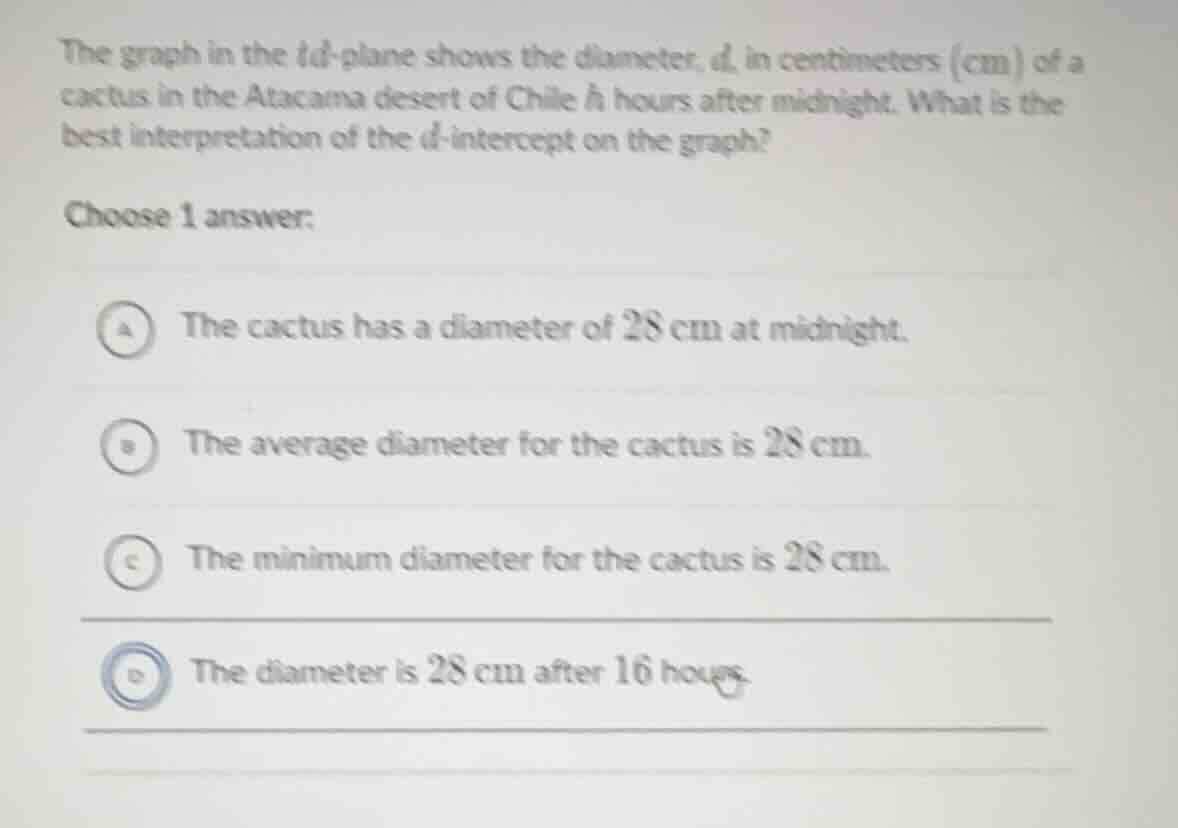
the graph in the ( h )-( d )-plane shows the diameter, ( d ), in centimeters (cm) of a cactus in the atacama desert of chile ( h ) hours after midnight. what is the best interpretation of the ( d )-intercept on the graph?
choose 1 answer:
a) the cactus has a diameter of 28 cm at midnight.
b) the average diameter for the cactus is 28 cm.
c) the minimum diameter for the cactus is 28 cm.
d) the diameter is 28 cm after 16 hours.
The \( d \)-intercept occurs when \( h = 0 \) (since \( h \) is hours after midnight). At \( h = 0 \), it represents the diameter at midnight. Option A states the cactus has a diameter of 28 cm at midnight, which matches the interpretation of the \( d \)-intercept (when \( h = 0 \)). Option B is about average, which isn't related to the intercept. Option C is about minimum, not implied by the intercept. Option D refers to \( h = 16 \), not the intercept (where \( h = 0 \)).

Snap & solve any problem in the app
Get step-by-step solutions on Sovi AI
Photo-based solutions with guided steps
Explore more problems and detailed explanations
A. The cactus has a diameter of 28 cm at midnight.