QUESTION IMAGE
Question
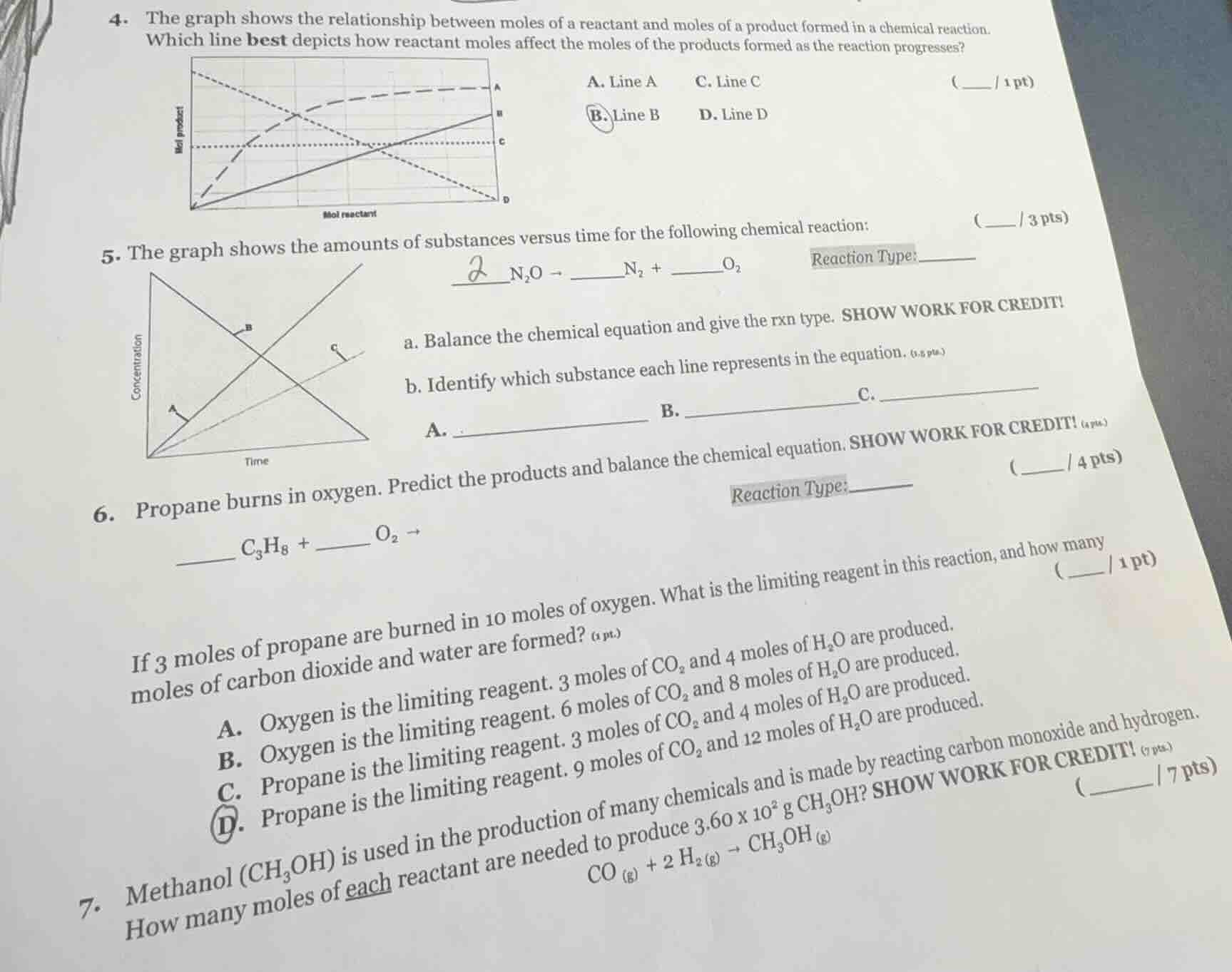
- the graph shows the relationship between moles of a reactant and moles of a product formed in a chemical reaction. which line best depicts how reactant moles affect the moles of the products formed as the reaction progresses?a. line a c. line cb. line b d. line d(__/ 1 pt)5. the graph shows the amounts of substances versus time for the following chemical reaction:n₂o → n₂ + o₂ reaction type:(/ 3 pts)a. balance the chemical equation and give the rxn type. show work for credit!b. identify which substance each line represents in the equation.a. ___________ b. ___________ c. ___________6. propane burns in oxygen. predict the products and balance the chemical equation. show work for credit!c₃h₈ + o₂ → reaction type:(/ 4 pts)if 3 moles of propane are burned in 10 moles of oxygen. what is the limiting reagent in this reaction, and how many moles of carbon dioxide and water are formed?a. oxygen is the limiting reagent. 3 moles of co₂ and 4 moles of h₂o are produced.b. oxygen is the limiting reagent. 6 moles of co₂ and 8 moles of h₂o are produced.c. propane is the limiting reagent. 3 moles of co₂ and 4 moles of h₂o are produced.d. propane is the limiting reagent. 9 moles of co₂ and 12 moles of h₂o are produced.(/ 1 pt)7. methanol (ch₃oh) is used in the production of many chemicals and is made by reacting carbon monoxide and hydrogen. how many moles of each reactant are needed to produce 3.60 x 10² g ch₃oh? show work for credit!co (g) + 2 h₂(g) → ch₃oh(g)(__/ 7 pts)
Question 4
Step1: Relate reactant to product
As reaction progresses, moles of reactant decrease, moles of product increase until reactant is exhausted, then product moles plateau.
Step2: Match to graph lines
Line B starts at 0 product, increases with reactant use, then levels off, which fits the relationship.
Part a: Balance equation and identify type
Step1: Balance N atoms
There are 2 N on left, so add 2 to $\text{N}_2$: $\text{2N}_2\text{O}
ightarrow 2\text{N}_2 + \text{O}_2$
Step2: Balance O atoms
Left has 2 O, right has 2 O (from $\text{O}_2$), so equation is balanced.
Step3: Identify reaction type
One reactant breaks into two products, so it is decomposition.
Part b: Match lines to substances
Step1: Identify reactant line
Line B decreases over time, so it is the reactant $\text{N}_2\text{O}$.
Step2: Identify fast product line
Line A increases fastest; $\text{N}_2$ has a coefficient of 2, so it forms faster: Line A = $\text{N}_2$.
Step3: Identify slow product line
Line C increases slowest; $\text{O}_2$ has a coefficient of 1, so it forms slower: Line C = $\text{O}_2$.
Step1: Predict products and balance equation
Combustion of propane produces $\text{CO}_2$ and $\text{H}_2\text{O}$. Balance:
- Balance C: $\text{C}_3\text{H}_8 + \text{O}_2
ightarrow 3\text{CO}_2 + \text{H}_2\text{O}$
- Balance H: $\text{C}_3\text{H}_8 + \text{O}_2
ightarrow 3\text{CO}_2 + 4\text{H}_2\text{O}$
- Balance O: $\text{C}_3\text{H}_8 + 5\text{O}_2
ightarrow 3\text{CO}_2 + 4\text{H}_2\text{O}$
Reaction type: Combustion.
Step2: Find limiting reagent and product amounts
Mole ratio: $\text{C}_3\text{H}_8:\text{O}_2 = 1:5$
For 3 mol $\text{C}_3\text{H}_8$, required $\text{O}_2 = 3 \times 5 = 15$ mol. Only 10 mol $\text{O}_2$ is available, so $\text{O}_2$ is limiting.
Moles of $\text{CO}_2$ formed: $\frac{3}{5} \times 10 = 6$ mol
Moles of $\text{H}_2\text{O}$ formed: $\frac{4}{5} \times 10 = 8$ mol

Snap & solve any problem in the app
Get step-by-step solutions on Sovi AI
Photo-based solutions with guided steps
Explore more problems and detailed explanations
B. Line B
---