QUESTION IMAGE
Question
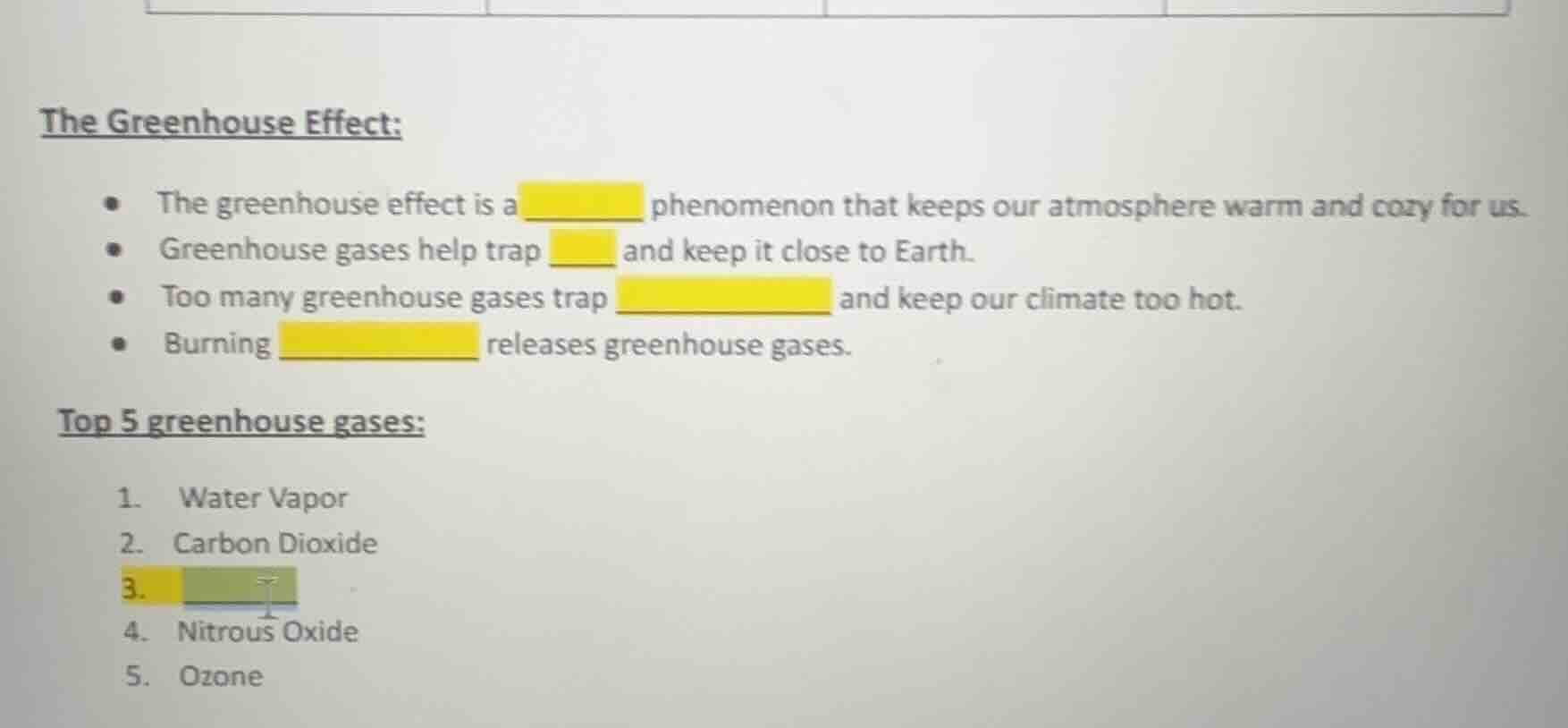
the greenhouse effect:
- the greenhouse effect is a ______ phenomenon that keeps our atmosphere warm and cozy for us.
- greenhouse gases help trap ___ and keep it close to earth.
- too many greenhouse gases trap ________ and keep our climate too hot.
- burning ________ releases greenhouse gases.
top 5 greenhouse gases:
- water vapor
- carbon dioxide
- ___
- nitrous oxide
- ozone
To solve the fill - in - the - blanks about the greenhouse effect, we analyze each blank based on the knowledge of the greenhouse effect:
For the first blank:
The greenhouse effect is a natural phenomenon. In the absence of human - induced changes, the greenhouse effect occurs naturally to maintain the Earth's temperature at a level suitable for life. So the first blank should be filled with "natural".
For the second blank:
Greenhouse gases help trap heat (or infrared radiation). The Sun's energy reaches the Earth, and some of the energy that is reflected back from the Earth's surface is in the form of infrared radiation (heat). Greenhouse gases trap this heat in the atmosphere. So the second blank can be filled with "heat" (or "infrared radiation").
For the third blank:
Too many greenhouse gases trap too much heat. When the concentration of greenhouse gases in the atmosphere increases, more heat is trapped, which leads to an increase in the Earth's average temperature, causing the climate to become too hot. So the third blank is "too much heat".
For the fourth blank:
Burning fossil fuels (such as coal, oil, and natural gas) releases greenhouse gases. Fossil fuels are rich in carbon, and when they are burned, carbon dioxide (a major greenhouse gas) and other greenhouse gases are released into the atmosphere. So the fourth blank can be filled with "fossil fuels".
For the third greenhouse gas (the blank in the "Top 5 greenhouse gases" list):
The third most important greenhouse gas (after water vapor and carbon dioxide) is Methane ($\ce{CH4}$). Methane is a potent greenhouse gas, and its sources include natural sources like wetlands and human - related sources like livestock farming and fossil fuel production.
Final Answers for the Blanks:
- The first blank: natural
- The second blank: heat (or infrared radiation)
- The third blank: too much heat
- The fourth blank: fossil fuels
- The third greenhouse gas: Methane

Snap & solve any problem in the app
Get step-by-step solutions on Sovi AI
Photo-based solutions with guided steps
Explore more problems and detailed explanations
To solve the fill - in - the - blanks about the greenhouse effect, we analyze each blank based on the knowledge of the greenhouse effect:
For the first blank:
The greenhouse effect is a natural phenomenon. In the absence of human - induced changes, the greenhouse effect occurs naturally to maintain the Earth's temperature at a level suitable for life. So the first blank should be filled with "natural".
For the second blank:
Greenhouse gases help trap heat (or infrared radiation). The Sun's energy reaches the Earth, and some of the energy that is reflected back from the Earth's surface is in the form of infrared radiation (heat). Greenhouse gases trap this heat in the atmosphere. So the second blank can be filled with "heat" (or "infrared radiation").
For the third blank:
Too many greenhouse gases trap too much heat. When the concentration of greenhouse gases in the atmosphere increases, more heat is trapped, which leads to an increase in the Earth's average temperature, causing the climate to become too hot. So the third blank is "too much heat".
For the fourth blank:
Burning fossil fuels (such as coal, oil, and natural gas) releases greenhouse gases. Fossil fuels are rich in carbon, and when they are burned, carbon dioxide (a major greenhouse gas) and other greenhouse gases are released into the atmosphere. So the fourth blank can be filled with "fossil fuels".
For the third greenhouse gas (the blank in the "Top 5 greenhouse gases" list):
The third most important greenhouse gas (after water vapor and carbon dioxide) is Methane ($\ce{CH4}$). Methane is a potent greenhouse gas, and its sources include natural sources like wetlands and human - related sources like livestock farming and fossil fuel production.
Final Answers for the Blanks:
- The first blank: natural
- The second blank: heat (or infrared radiation)
- The third blank: too much heat
- The fourth blank: fossil fuels
- The third greenhouse gas: Methane