QUESTION IMAGE
Question
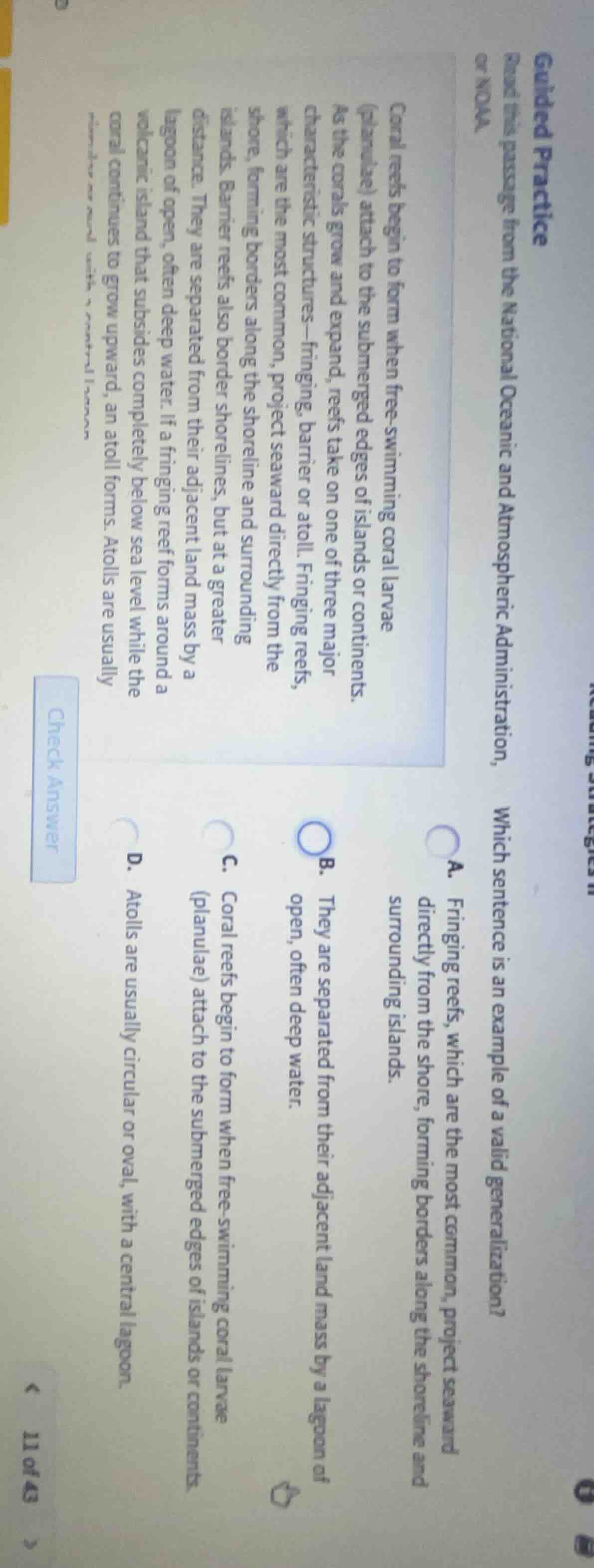
guided practice read this passage from the national oceanic and atmospheric administration, or noaa. coral reefs begin to form when free - swimming coral larvae (planulae) attach to the submerged edges of islands or continents. as the corals grow and expand, reefs take on one of three major characteristic structures—fringing, barrier or atoll. fringing reefs, which are the most common, project seaward directly from the shore, forming borders along the shoreline and surrounding islands. barrier reefs also border shorelines, but at a greater distance. they are separated from their adjacent land mass by a lagoon of open, often deep water. if a fringing reef forms around a volcanic island that subsides completely below sea level while the coral continues to grow upward, an atoll forms. atolls are usually circular or oval, with a central lagoon. which sentence is an example of a valid generalization? a. fringing reefs, which are the most common, project seaward directly from the shore, forming borders along the shoreline and surrounding islands. b. they are separated from their adjacent land mass by a lagoon of open, often deep water. c. coral reefs begin to form when free - swimming coral larvae (planulae) attach to the submerged edges of islands or continents. d. atolls are usually circular or oval, with a central lagoon.
To determine the valid generalization, we analyze each option:
- Option A: Describes fringing reefs' position, which is a specific detail, not a generalization.
- Option B: Describes a specific type of reef (barrier reefs' separation), not a general statement about coral reefs.
- Option C: States how coral reefs begin to form (larvae attaching to submerged edges), which is a general statement about the formation process of all coral reefs.
- Option D: Describes atolls' shape, a specific detail about atolls, not a generalization about coral reefs.

Snap & solve any problem in the app
Get step-by-step solutions on Sovi AI
Photo-based solutions with guided steps
Explore more problems and detailed explanations
C. Coral reefs begin to form when free - swimming coral larvae (planulae) attach to the submerged edges of islands or continents.