QUESTION IMAGE
Question
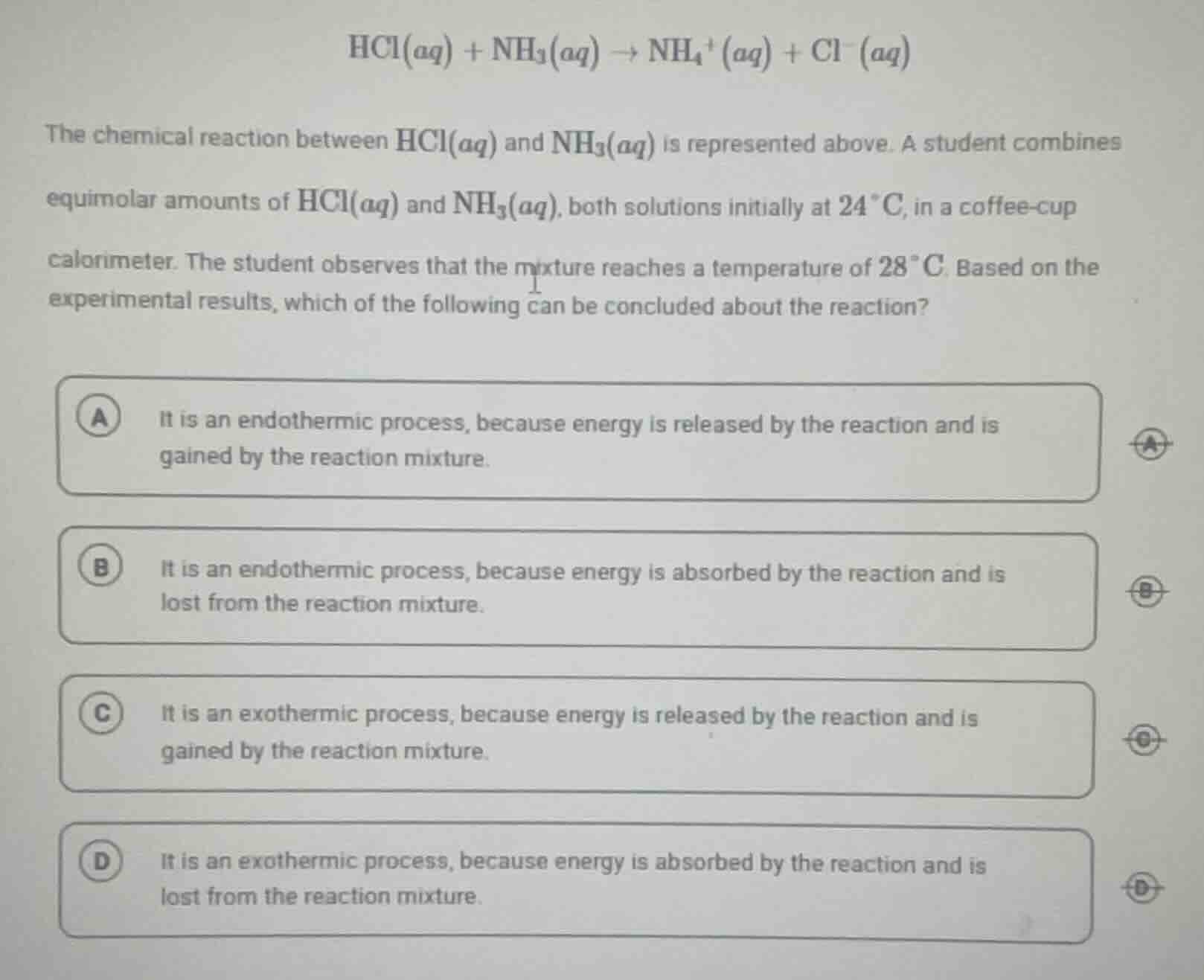
hcl(aq) + nh₃(aq) → nh₄⁺(aq) + cl⁻(aq)
the chemical reaction between hcl(aq) and nh₃(aq) is represented above. a student combines equimolar amounts of hcl(aq) and nh₃(aq), both solutions initially at 24 °c, in a coffee - cup calorimeter. the student observes that the mixture reaches a temperature of 28 °c. based on the experimental results, which of the following can be concluded about the reaction?
a it is an endothermic process, because energy is released by the reaction and is gained by the reaction mixture.
b it is an endothermic process, because energy is absorbed by the reaction and is lost from the reaction mixture.
c it is an exothermic process, because energy is released by the reaction and is gained by the reaction mixture.
d it is an exothermic process, because energy is absorbed by the reaction and is lost from the reaction mixture.
- First, analyze the temperature change: The initial temperature of the solutions is \(24^\circ\text{C}\), and the final temperature of the mixture is \(28^\circ\text{C}\). This means the temperature of the reaction mixture increased.
- For a reaction in a coffee - cup calorimeter (where the system is the reaction and the surroundings are the solution), if the temperature of the surroundings (the solution) increases, it means the reaction released energy to the surroundings.
- Recall the definitions of exothermic and endothermic processes:
- An exothermic process is one in which the system (the reaction) releases energy to the surroundings. In this case, the reaction between \(\text{HCl}(aq)\) and \(\text{NH}_3(aq)\) releases energy, which is gained by the reaction mixture (the surroundings in terms of the reaction - solution system), causing the temperature of the mixture to rise.
- An endothermic process is one in which the system absorbs energy from the surroundings, which would cause the temperature of the surroundings (the solution) to decrease.
- Option A: Says it is endothermic, but endothermic processes absorb energy, and the temperature of the mixture would decrease, not increase. Also, the explanation for A is incorrect as endothermic reactions absorb energy, not release.
- Option B: Claims it is endothermic, but the temperature increased, so it can't be endothermic. Also, the energy flow description is wrong for an endothermic process.
- Option C: Correctly identifies the process as exothermic (since the reaction releases energy) and the energy is gained by the reaction mixture (the solution), causing the temperature to rise.
- Option D: Incorrectly states that energy is absorbed by the reaction for an exothermic process. Exothermic reactions release energy, not absorb.

Snap & solve any problem in the app
Get step-by-step solutions on Sovi AI
Photo-based solutions with guided steps
Explore more problems and detailed explanations
C. It is an exothermic process, because energy is released by the reaction and is gained by the reaction mixture.